Your profile
 Alex
Alex
Answer 120 statements
Choose the option that describes you best. There are no right or wrong answers.
See how you tend to think, feel and act. Answer 120 questions in about 10 minutes for a profile of five traits and 30 facets, based on the open IPIP-NEO model. Free, with no sign-up.
Your partner, family, friends or colleagues. Once both of you have taken the test, you see similarities and differences side by side, with concrete topics to talk about.
Start with your own private profile.
The other person answers independently.
The result highlights both similarities and differences.
3clear conversation topics
Use the difference as an invitation to be curious, not as a verdict.
Pair Perspective is our relationship test. Answer 57 questions separately, then explore the strengths you share and the differences worth talking about.
The Big Five describes personality across five independent dimensions. No profile is better than another – it simply reflects different strengths, needs and tendencies.
Find your patternCuriosity, imagination and interest in new ideas.
Structure, self-discipline and how you work toward goals.
Social energy, initiative and need for stimulation.
Trust, empathy and how you meet other people.
The test is free. You need no account, and you can answer at your own pace.
Take the test nowChoose the option that describes you best. There are no right or wrong answers.
Your result shows five main domains and 30 underlying personality facets.
Understand your patterns and compare your result with people you know.
You often seek new perspectives and enjoy ideas that challenge the familiar.
Start with a clear overview, then explore each personality trait and what your scores may mean in everyday life.
Your profile describes tendencies, not a diagnosis or a definitive answer to who you are.
Deep dives into the five traits, the research and how personality shapes everyday life.
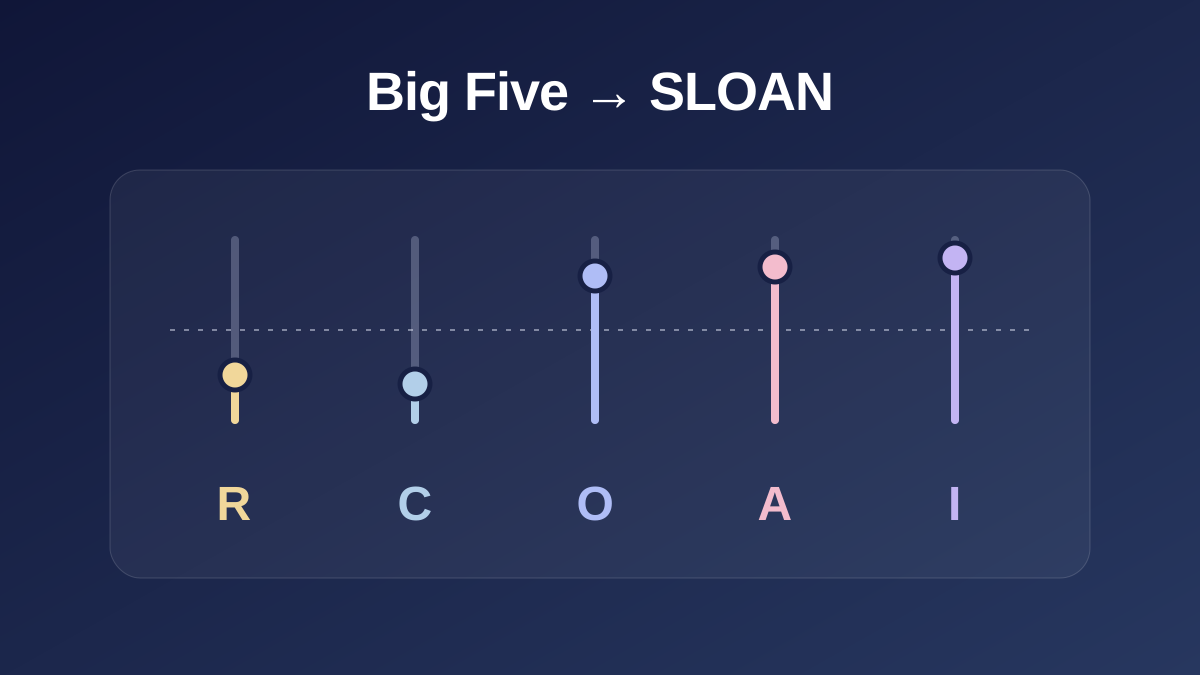
See all articlesDecode your SLOAN personality code, see how it connects to the Big Five, and learn why scores near the middle matter more than a type label.
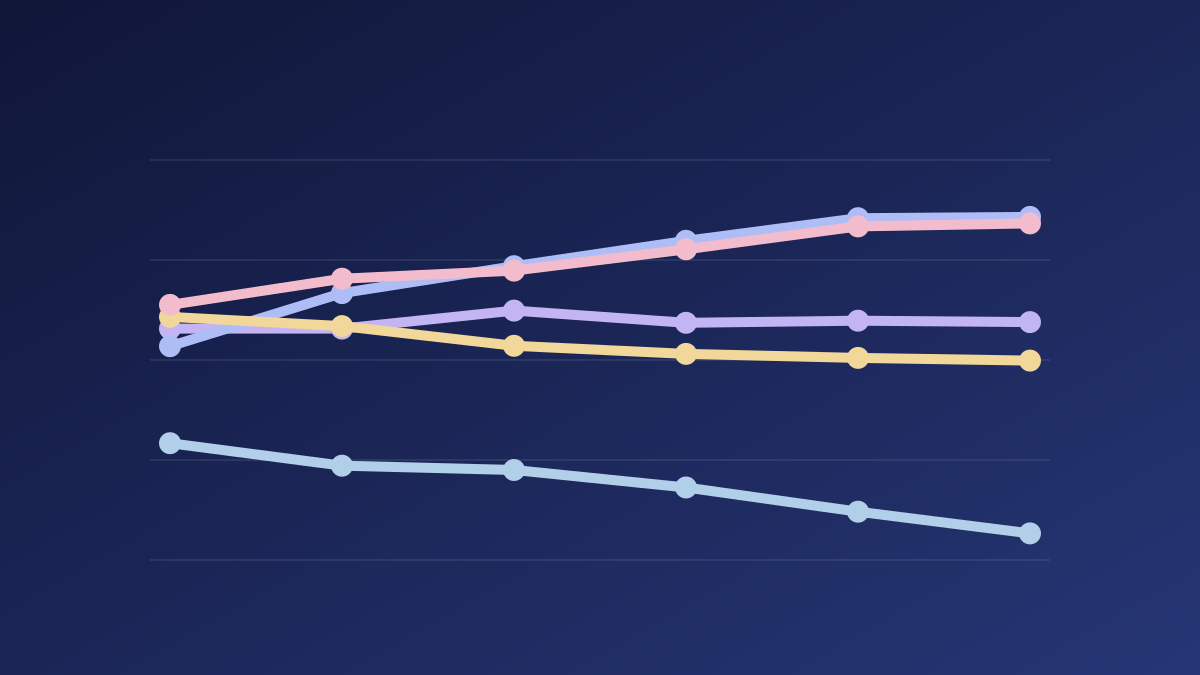
Compare the average Big Five profile of women and men at any age, trait by trait and facet by facet. Conscientiousness and agreeableness rise with age, neuroticism falls, and women score higher on agreeableness and neuroticism.
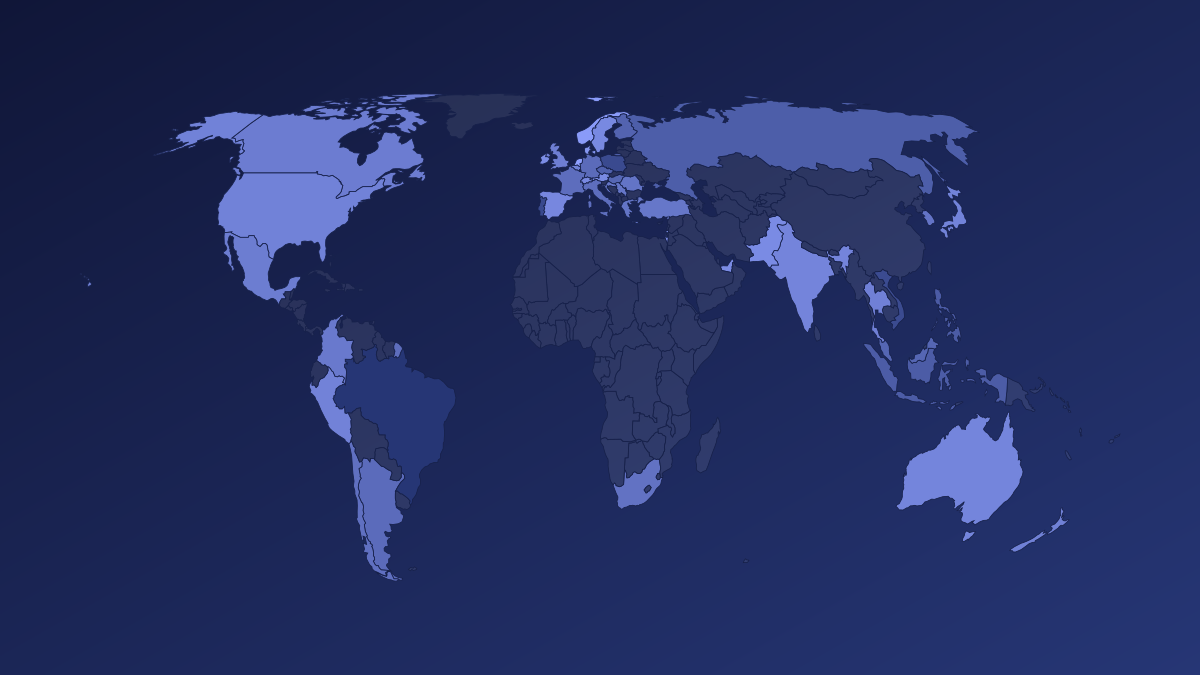
A world map of the Big Five from 584,535 people in 48 countries. The Netherlands and Norway come out most extraverted, Brazil least. Explore every trait and country, and see why country comparisons need care.
We judge strangers in a fraction of a second. A new study in Nature Human Behaviour shows how these first impressions are organised, and why they say more about stereotypes than about real personality.
What the nine Enneagram types are, how reliable Enneagram tests are, and how each type lines up with the Big Five traits, based on a review of 104 studies.
Your interests are not just your personality at work. They are among the most stable traits you have, and they predict job satisfaction, performance and choices in life. Take the free career interest test.
The test is based on the open IPIP model, is free to use and is open source. Its method and questions are available for review.
Personality, strengths, career interests and more. You get your result right away.
See all 27 testsYour personality across the five big traits and 30 facets: openness, conscientiousness, extraversion, agreeableness and neuroticism. Compare with friends and partners afterwards.
Explore nine personality types and the patterns you recognize in yourself. A free full profile for self-reflection.
Explore six sides of love, from chemistry and friendship to care. Get a personal profile and something to talk about.
A three-minute test of six broad traits: the Big Five plus honesty-humility. A quick overview; take the full Big Five test for facets and more detail.
The full IPIP-NEO-300 with 300 questions. It takes longer, but gives a more precise profile of the five traits and all 30 facets.
Each Big Five trait split in two: compassion and politeness, industriousness and orderliness, and more. 100 public-domain statements give you ten aspects.
Six broad traits instead of five: the HEXACO model adds honesty-humility to the Big Five picture. 240 public-domain statements give you 24 facets.
Raymond Cattell's classic model with 16 factors, from warmth and dominance to vigilance and perfectionism. 163 public-domain statements give you a profile between opposite poles.
Verbal, figural and numerical problems in 15 minutes, from a test published by psychologists in the journal Intelligence. Shows your reasoning in three areas. Not an IQ test.
Find your signature strengths among the 24 character strengths in Peterson and Seligman's classification, from curiosity and kindness to bravery and humor.
Find out which of eight interest areas suit you best, from leadership and creativity to analysis and practical work, and which occupations match your profile.
Which of Holland's six interest types fit you: Realistic, Investigative, Artistic, Social, Enterprising or Conventional? Get your three-letter code and matching careers, with the O*NET Interest Profiler used in career guidance across the United States.
Your profile across seven components of emotional intelligence: noticing your feelings, showing joy and distress, empathy, being moved by others, and how much feelings guide your decisions.
How strongly do you react to rewards and to risks? Four scales on drive, fun seeking, reward responsiveness and caution, based on Gray's model of the brain's approach and avoidance systems.
Do you believe your life is steered by your own choices, by powerful others, or by chance? Three scales from Levenson's classic model, with your orientation explained.
Ten statements on how you value yourself and your abilities, based on Rosenberg's classic self-esteem scale. Quick, with a short explanation of your score.
Do you tend to see possibilities or difficulties? Ten statements about your outlook on life, with an explanation of your optimism score.
A checklist of five kinds of everyday habits linked with good mental health: enjoyment, thinking habits, goals, routines and connection. With ideas for small steps.
The Short Dark Tetrad (SD4) measures four socially aversive traits found in everyone to some degree: Machiavellianism, narcissism, psychopathy and sadism.
Four sides of narcissism: the urge to lead, the need for attention, a sense of entitlement and a willingness to exploit others. Based on public-domain research scales.
How bold, how mean and how impulsive are you compared with others? Nine traits grouped into the three sides of psychopathy in Patrick's triarchic model. Measures normal variation, not a diagnosis.
The six-question screener from the WHO Adult ADHD Self-Report Scale (ASRS v1.1). Shows whether your answers are consistent with adult ADHD symptoms. Not a diagnosis.
Seven questions about worry and nervousness over the past two weeks, from the most widely used anxiety questionnaire. Shows how much the symptoms bother you. Not a diagnosis.
Nine questions about mood, sleep, energy and self-worth over the past two weeks, from the most widely used depression questionnaire. Shows how much the symptoms bother you. Not a diagnosis.
Thirteen questions about exhaustion in daily life and at work, from the Copenhagen Burnout Inventory. Shows how worn out you are compared with others. Not a diagnosis.
Fourteen statements from a research-based screener for autism in adults. Shows whether your answers resemble those common in autism. Not a diagnosis.
Build the missing figure in a matrix. Choose 12, 22 or 36 tasks. A free pilot with a raw score.
Free · open source · no registration · about 10 minutes