Big Five vs MBTI: Which Personality Test Is More Accurate?
Compare Big Five and MBTI personality tests: what each measures, why trait scores differ from 16 types, and which is more useful for understanding yourself.
Bu makale henüz çevrilmedi ve İngilizce gösteriliyor.
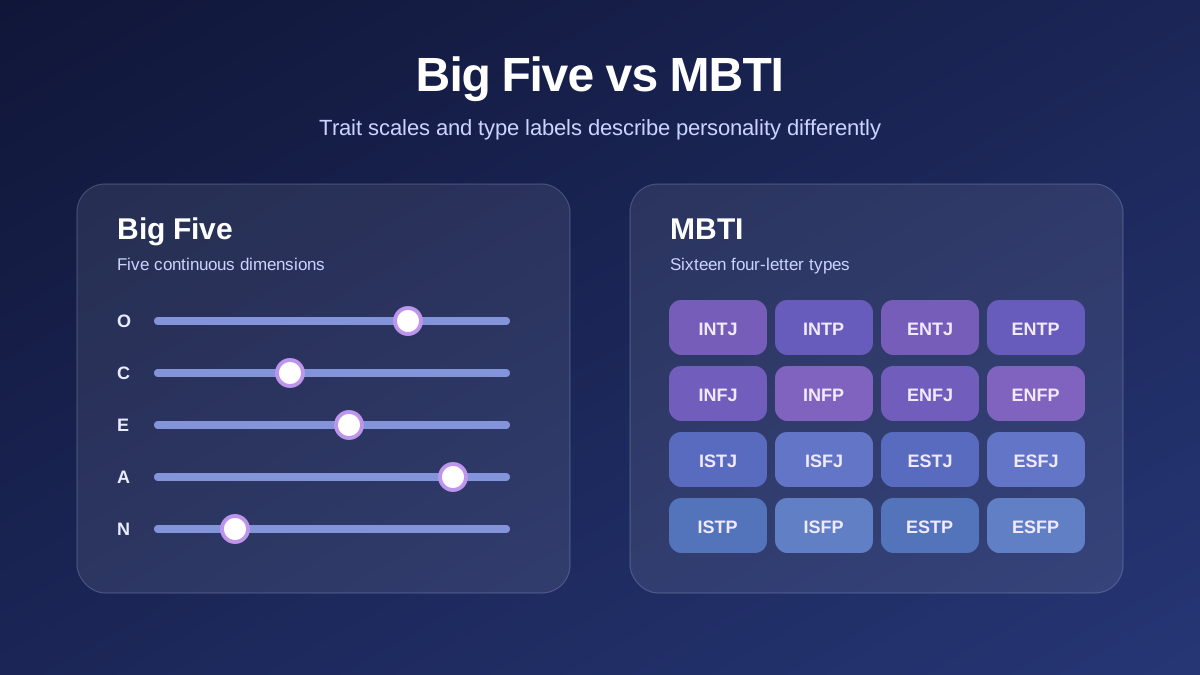
The short answer: If you want a research-based description of your personality, a well-validated Big Five questionnaire is usually the better choice. It shows where you fall on five continuous traits. The Myers–Briggs Type Indicator (MBTI) gives you a four-letter type that can be easy to discuss, but its 16 categories do not appear to represent 16 sharply separate kinds of people. Neither test can tell you everything about yourself.
The distinction matters because “accurate” can mean different things: Does a questionnaire measure consistently? Does its model fit the way personality varies? Does it help answer your particular question? Here is how the two approaches compare.
| Question | Big Five | MBTI |
|---|---|---|
| What is the result? | A position on each of five trait scales, often with more detailed facets | One of 16 four-letter types, based on four preference pairs |
| What does it describe? | Openness, conscientiousness, extraversion, agreeableness, and neuroticism | Extraversion–introversion, sensing–intuition, thinking–feeling, and judging–perceiving preferences |
| Are people put into categories? | Not by the model itself; scores are continuous | Yes, the headline result is a type, though official reports also show information about preference clarity or repeatability |
| What is the main strength? | A detailed trait profile grounded in a large research literature | Memorable language for discussing preferences |
| What is the main limitation? | Broad traits do not capture every motive, situation, or change in behavior | A type label can hide how close someone is to a category boundary |
Why the Big Five usually wins on scientific accuracy
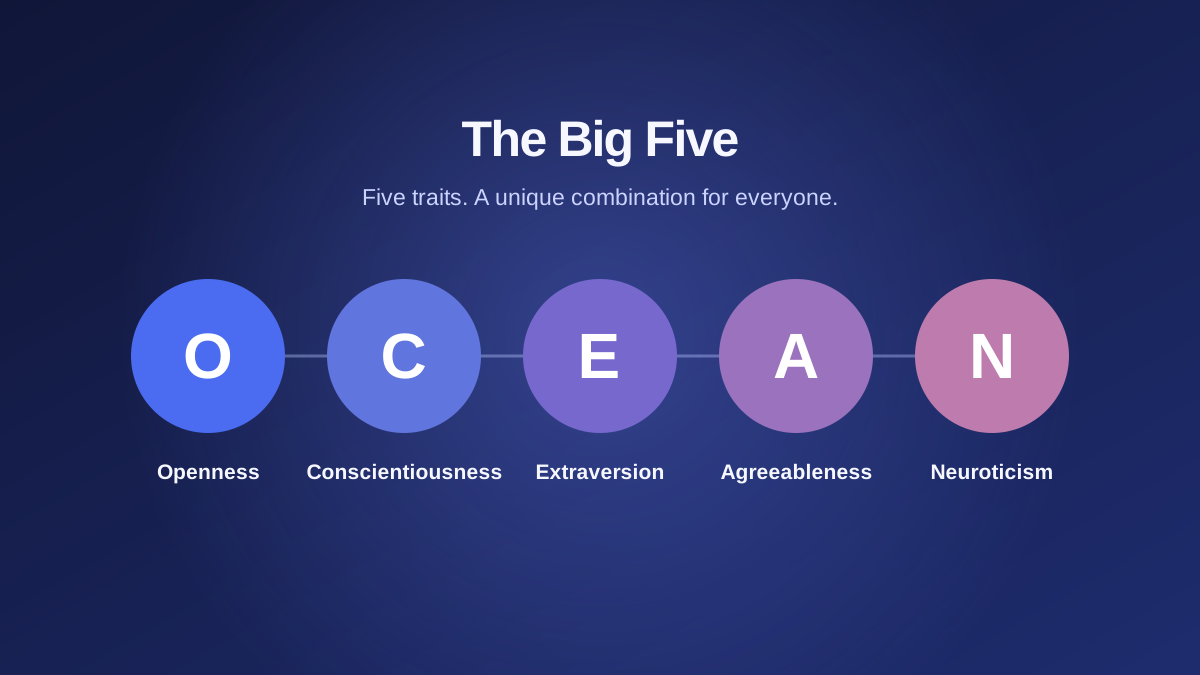
The Big Five, also called the OCEAN model, describes personality as five dimensions rather than fixed types. Someone can be moderately extraverted, highly conscientious, and lower in openness at the same time. Scores preserve differences that a single label may flatten.
This is not just a matter of taste. In a direct comparison of the MBTI and a five-factor inventory, McCrae and Costa found no support for the idea that MBTI preferences divide people into genuinely distinct types. The MBTI scales did, however, capture aspects of four Big Five dimensions. That is a more useful conclusion than saying MBTI measures nothing: some of its questions reflect real personality differences, but the leap from scale scores to fixed types is harder to justify.
The Big Five also has many separately developed questionnaires. One example is the IPIP-NEO-120 used on this site: its 120 items measure the five broad domains and 30 more specific facets. In the original validation study, the shorter inventory showed evidence of reliability and agreement with other personality measures and acquaintance ratings. That supports the instrument as a way to describe traits; it does not make any single result an infallible reading of a person. Translations and the setting in which you take a test matter too.
Does that mean the MBTI is useless?
No. A four-letter type can give people a convenient starting point for talking about preferred ways of interacting or making decisions. The Myers–Briggs Company itself describes the assessment as a tool for understanding preferences, not as a prediction of job performance. It also provides more detail than a bare four-letter label in its official reports.
The problem comes when a type is treated as a hard boundary. Two people who answer almost identically near an introversion–extraversion cutoff can receive different letters. Conversely, two people with the same four letters can differ considerably in the strength of their preferences and in traits the MBTI does not report. If you want a fuller discussion of the type model's research limitations, read our separate article on the MBTI evidence.
Can you translate an MBTI type into Big Five scores?
Not reliably. The frameworks overlap, but they are not interchangeable. MBTI extraversion–introversion has an obvious connection to Big Five extraversion; the other MBTI scales also relate to aspects of some Big Five traits. But the concepts and questionnaires are not identical, and an MBTI code leaves out a direct equivalent of neuroticism (often described from the other end as emotional stability). The McCrae and Costa comparison found relationships between the scales, not a one-to-one conversion rule.
So an “INFP to Big Five” chart might suggest a pattern, but it cannot give you your actual scores. If you want a Big Five profile, take a Big Five questionnaire and look at your own five results.
Which test should you take?
Choose a Big Five test if you want to explore your traits in more detail or compare changes in your answers over time. Choose the official MBTI assessment if you specifically want its preference framework for a conversation or workshop, while keeping the type label in perspective. This site's free test is a Big Five test, not an MBTI test.
Neither result is a diagnosis, a measure of worth, or a sound basis for putting someone in a job or ruling them out. Even the MBTI publisher says its assessment is not intended for hiring or selection. For personal use, the most useful question may be: Which parts of this result help me notice patterns, and which parts do not fit?
Frequently asked questions
Is the Big Five more reliable than MBTI?
There is no honest single reliability number for either model: reliability depends on the particular questionnaire, language, group of people, and time between tests. The stronger claim is that the Big Five's continuous-trait framework and many of its established instruments have substantial empirical support. A categorical MBTI letter can be especially unstable for someone whose answers lie near a cutoff, even when the underlying scale changes only a little. Official MBTI reports include additional information beyond the letters, so judge the instrument and its intended use—not just an online type quiz.
Is MBTI the same as 16Personalities?
No. 16Personalities says it uses a different, Big Five–influenced framework, despite sharing the familiar four-letter format. Check which questionnaire you are taking before applying claims about its research or scoring to a different test.
What do the percentages on this site's Big Five test mean?
They show your position on this test's response scale, not your percentile among other people. A 70% score does not mean you scored higher than 70% of test takers. You can read how the questions and scoring work before interpreting your profile.
What if my result changes when I retake a test?
Small changes in answers are normal, especially near a type cutoff or when mood and circumstances differ. Look at the overall pattern, not one letter or percentage point. If a description does not fit, treat that as useful information rather than forcing yourself into the result.
See your own trait profile
Take the free Big Five personality test to see your five broad traits and 30 facets. It takes 120 answers and gives you a profile you can explore, rather than a fixed four-letter type.
Sources
- McCrae, R. R., & Costa, P. T. (1989). Reinterpreting the Myers-Briggs Type Indicator from the perspective of the five-factor model of personality. Journal of Personality, 57(1), 17–40.
- Johnson, J. A. (2014). Measuring thirty facets of the Five Factor Model with a 120-item public domain inventory: Development of the IPIP-NEO-120. Journal of Research in Personality, 51, 78–89.
- The Myers–Briggs Company. MBTI facts and intended uses.
- 16Personalities. MBTI vs. 16Personalities: What's the difference?