Enneagram vs Big Five: What the Research Says About the Nine Types
What the nine Enneagram types are, how reliable Enneagram tests are, and how each type lines up with the Big Five traits, based on a review of 104 studies.

The short answer: The Enneagram describes nine personality types, each built around a core motivation and a core fear. Many people find it a useful language for self-reflection. But as a measurement of personality, its research support is mixed. A systematic review of 104 studies found that Enneagram tests are only partly reliable, that the data rarely split cleanly into nine types, and that ideas such as wings and stress movement are not supported. The Big Five is the model researchers use to measure personality. Interestingly, the nine types line up with Big Five traits in fairly consistent ways.
Key findings
- The Enneagram has nine types, often called the Reformer, Helper, Achiever, Individualist, Investigator, Loyalist, Enthusiast, Challenger and Peacemaker.
- A 2021 systematic review in the Journal of Clinical Psychology looked at 104 samples and found mixed evidence for reliability and validity.
- Factor analyses usually find fewer than nine distinct factors, and in one study fewer than half of the participants had a clear top type.
- There is little or no support for wings and for the idea that types move to another type under stress.
- Each type shows a typical Big Five pattern. For example, Type 1 goes with high conscientiousness and Type 5 with low extraversion.
- Some studies suggest the Enneagram can help with self-awareness and personal growth, but the results are mixed.
What is the Enneagram?
The Enneagram (from the Greek for "nine" and "drawing") is a nine-pointed figure inside a circle. Each point stands for a personality type. Unlike most personality models, the Enneagram focuses less on behaviour and more on why you act as you do: each type is described by a core desire, a core fear and a "passion", an emotional habit that protects you but can also hold you back.
| Type | Typical description | Core desire | Core fear |
|---|---|---|---|
| 1 – Reformer | Principled, purposeful, self-controlled, perfectionistic | To be perfect | Being bad, defective or corrupt |
| 2 – Helper | Demonstrative, generous, people-pleasing, possessive | To be needed | Being unloved |
| 3 – Achiever | Adaptive, excelling, driven, image-conscious | To succeed | Being worthless |
| 4 – Individualist | Dramatic, self-absorbed, temperamental | To be special | Having no identity or significance |
| 5 – Investigator | Perceptive, innovative, secretive, isolated | To understand | Being helpless or incompetent |
| 6 – Loyalist | Engaging, responsible, anxious, suspicious | To be sure | Being without support and guidance |
| 7 – Enthusiast | Spontaneous, versatile, distractible, scattered | To avoid pain | Being trapped in pain and deprivation |
| 8 – Challenger | Self-confident, decisive, wilful, confrontational | To stand their ground | Being harmed or controlled |
| 9 – Peacemaker | Receptive, reassuring, agreeable, complacent | To avoid conflict | Being lost and separated |
The descriptions follow the summary in the review by Hook and colleagues, based on Riso and Hudson.
Each type also has neighbours on the circle, called wings, and lines that connect it to other types. According to the theory, people move along these lines in times of stress and growth.
Where does the Enneagram come from?
The Enneagram is often presented as ancient wisdom, and the nine-pointed symbol was used by the philosopher George Gurdjieff in the early 20th century. But the personality system as we know it is modern. In the 1950s and 1960s, Oscar Ichazo, founder of the Arica School in Chile, linked the symbol to personality types. In the early 1970s, the Chilean psychiatrist Claudio Naranjo translated the types into the language of Western psychology. Popular books in the 1980s and 1990s, including those of Don Riso and Russ Hudson, then made the Enneagram widely known.
In other words, the Enneagram was not developed through research the way the Big Five was. It grew out of spiritual and therapeutic traditions, and researchers have only tested it afterwards.
What does the research say?
In 2021, Joshua Hook and colleagues published the most thorough review so far in the Journal of Clinical Psychology. They went through 104 independent samples. Only about half had been published, and just 9 studies appeared in mainstream psychology journals. Most of the unpublished studies were doctoral dissertations.
Are Enneagram tests reliable?
Partly. The two most studied questionnaires, the Riso-Hudson Enneagram Type Indicator (RHETI) and the Wagner Enneagram Personality Style Scales (WEPSS), gave fairly stable scores when people took them again. But some scales were weak, and the tests did not always agree with each other: in one study, only 42 percent of people got the same type from the RHETI and the WEPSS.
Do people really fall into nine types?
This is the central problem. When researchers analyse how people answer Enneagram questions, they usually find fewer than nine clear factors. In one study, fewer than half of the participants had a top score that clearly stood out from their second-highest type. Many people fit several types almost equally well. And no study has yet used methods designed to find natural groups of people to see whether nine types actually appear in the data.
Typing interviews by experts did not do better. In one study, trained judges agreed on people's types only slightly more than chance would predict.
Wings and stress lines
The Enneagram's more specific claims have little support. In a study of wings, people did not see neighbouring types as more similar than other types. Two studies of stress movement did not find that anxious people scored higher on the type their own type supposedly moves to under stress. The review notes that the studies are few and have weaknesses, but as things stand, the evidence does not support these ideas.
Does it help personal growth?
This is where the Enneagram has its strongest supporters. Qualitative studies describe more self-knowledge, self-awareness and spiritual growth. But the quantitative results are mixed: some studies found improvements in areas such as communication and relationships, while others found no effect on well-being, self-acceptance or emotional intelligence.
How the Enneagram types relate to the Big Five
Nine of the studies in the review compared Enneagram types with the Big Five personality traits. The patterns were fairly consistent and fit the type descriptions well:
| Enneagram type | Typical Big Five pattern | Studies that found it |
|---|---|---|
| 1 – Reformer | Higher conscientiousness | 9 of 9 |
| 2 – Helper | Higher extraversion and higher agreeableness | 9 and 7 of 9 |
| 3 – Achiever | Higher extraversion and conscientiousness, lower agreeableness | 5–6 of 9 |
| 4 – Individualist | Higher neuroticism and openness, lower conscientiousness | 6–8 of 9 |
| 5 – Investigator | Lower extraversion | 9 of 9 |
| 6 – Loyalist | Higher neuroticism, lower extraversion and openness | 5–8 of 9 |
| 7 – Enthusiast | Higher extraversion and openness, lower conscientiousness | 6–9 of 9 |
| 8 – Challenger | Lower agreeableness, higher extraversion, lower neuroticism | 6–9 of 9 |
| 9 – Peacemaker | Higher agreeableness | 9 of 9 |
This overlap is useful. It suggests the Enneagram types partly describe the same differences as the Big Five, but packaged as nine stories instead of five scales. It also means that much of what an Enneagram type tells you can be measured more precisely with a Big Five test.
Types versus traits
The main difference is how the two models see people:
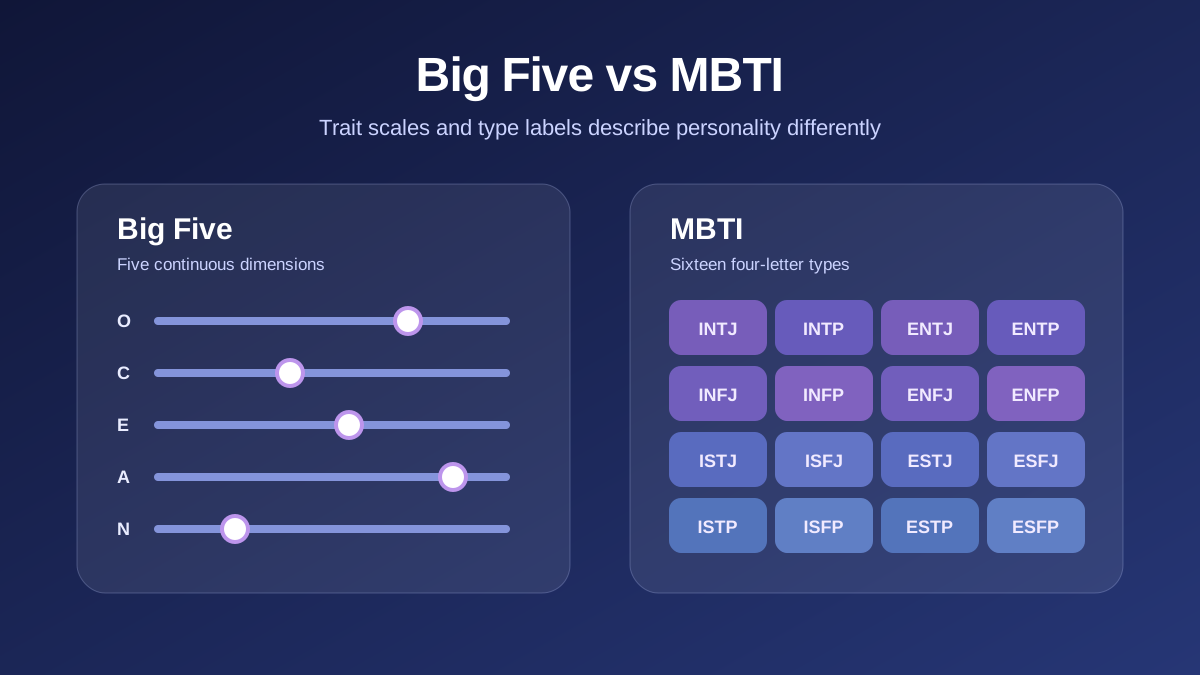
- The Enneagram is a type model. You get one type out of nine. Two people with the same type are treated as alike, even if one barely fits it and the other fits it strongly.
- The Big Five is a trait model. You get a score on each of five traits and 30 facets. Most people are somewhere in the middle on most traits, and the model shows exactly where.
Most personality research finds that people differ along continuous dimensions rather than falling into distinct groups. That is why researchers prefer traits. It is the same problem that affects the MBTI: a type is easy to remember, but it hides how much you actually have of each quality.
So should you take an Enneagram test?
It depends on what you want:
- For reflection and conversation, the Enneagram can be a rich vocabulary for motives and fears, and many people find it meaningful. Treat your type as a starting point for reflection, not as a measurement.
- For an accurate, research-based description, a Big Five test is the better choice. It is more reliable, it is used in thousands of studies, and it shows nuances that a single type hides.
- To get the best of both, take a Big Five test and compare your profile with the table above. If you score high on openness and extraversion and low on conscientiousness, the description of Type 7 might feel familiar.
Frequently asked questions
Is the Enneagram scientifically valid?
Only partly. The most thorough review found mixed evidence. Some Enneagram scales are fairly reliable and relate to the Big Five in expected ways, but the nine-type structure, wings and stress movement are poorly supported.
Is the Enneagram better than the Big Five?
Not as a measurement. The Big Five is more reliable and better researched. The Enneagram focuses more on motives and personal growth, which some people find more engaging.
Can I find my Enneagram type from the Big Five?
Not exactly, because the models measure personality in different ways. But the table above shows which Big Five patterns usually go with each type, so your Big Five profile can hint at which types will feel most familiar.
Find out where you score on the five traits
The Enneagram gives you one of nine types. The Big Five shows how much of each trait you have, from conscientiousness to openness, with 30 facets that add detail.
Take the free Big Five personality test and compare your profile with the Enneagram types.
Sources
- Hook, J. N., Hall, T. W., Davis, D. E., Van Tongeren, D. R., & Conner, M. (2021). The Enneagram: A systematic review of the literature and directions for future research. Journal of Clinical Psychology, 77(4), 865–883. doi:10.1002/jclp.23097
- Newgent, R. A., Parr, P. H., Newman, I., & Wiggins, K. K. (2004). The Riso-Hudson Enneagram Type Indicator: Estimates of reliability and validity. Measurement and Evaluation in Counseling and Development, 36(4), 226–237. doi:10.1080/07481756.2004.11909744
- Wagner, J. P., & Walker, R. E. (1983). Reliability and validity study of a Sufi personality typology: The Enneagram. Journal of Clinical Psychology, 39(5), 712–717. doi:10.1002/1097-4679(198309)39:5<712::AID-JCLP2270390511>3.0.CO;2-3