Your relationship satisfaction
A made-up example that shows what you get after the test. Take the test to get your own result.
Satisfied with the relationship
Your score is above 104.5, the point the authors of the scale use to separate satisfied from dissatisfied partners. Your answers describe a relationship that mostly works for you. That does not mean everything is perfect, and the sections below show where you answered lower.
What the score means
The score is the sum of your answers. Each answer gives 0 to 5 points, and the first question gives 0 to 6. In the study that introduced the scale, 5,315 people in relationships scored 121 on average, and scores below 104.5 pointed to notable dissatisfaction. Most of them were young American women, so these are guide marks and not norms for your country.
Typical scores by stage of the relationship
Satisfaction tends to be highest early on and lower in longer relationships. Find the group closest to you. A score that looks low against the overall average can be ordinary for your stage.
Typical score in the group (median)Your score: 122
- Dating, age 18–19about 136
- Dating, age 20–29about 127
- Dating, age 30–39about 114
- Engaged, age 20–29about 139
- First year of marriageabout 141
- Married 1–5 yearsabout 125
- Married 5–10 yearsabout 119
- Married 10–25 yearsabout 104
The figures are medians read from charts in a talk by Ronald Rogge, one of the scale’s authors, so each is accurate to within a few points. They come from American online samples of 270 to 2,200 people per group, mostly young women. Use them as a rough guide and not as norms.
Where the score comes from
The questions fall into six groups. The grouping is ours and follows the layout of the questionnaire. The scale itself has only one score, so read the bars as a guide to your own answers.
- OverallHighestHow happy you are in the relationship, how often things go well and whether you ever wish you had not entered it.14 of 16
- AgreementLowestHow much the two of you agree about time together, major decisions and showing affection.6 of 15
- Bond and commitmentConnection, trust, feeling like a team and being sure this is the person you want.47 of 60
- Needs and expectationsHow rewarding the relationship is and how well it meets your needs and what you hoped for.20 of 25
- Time togetherHow often you enjoy each other's company and have fun together.5 of 10
- Gut feelingYour first impression of the relationship on seven word pairs, such as good or bad and sturdy or fragile.30 of 35
Your lowest answers
These are the questions where you gave the lowest answers. They can be a place to start a conversation.
- Amount of time spent togetherYou answered: Frequently disagree
- Making major decisionsYou answered: Frequently disagree
- Demonstrations of affectionYou answered: Frequently disagree
- Do you enjoy your partner's company?You answered: Once or twice a month
How you can use this
- Notice what works well between you, and say it out loud to your partner.
- Look at the group where you scored lowest. Is there one small thing you would like more of?
- Take the test again in a busy or difficult period. The score moves with what is happening in your lives.
If you are afraid of your partner, or your partner controls, threatens or hurts you, this is not something a test or better communication can fix. Contact a helpline for domestic violence where you live, or the emergency number if you are in danger.
Ask your partner to take it too
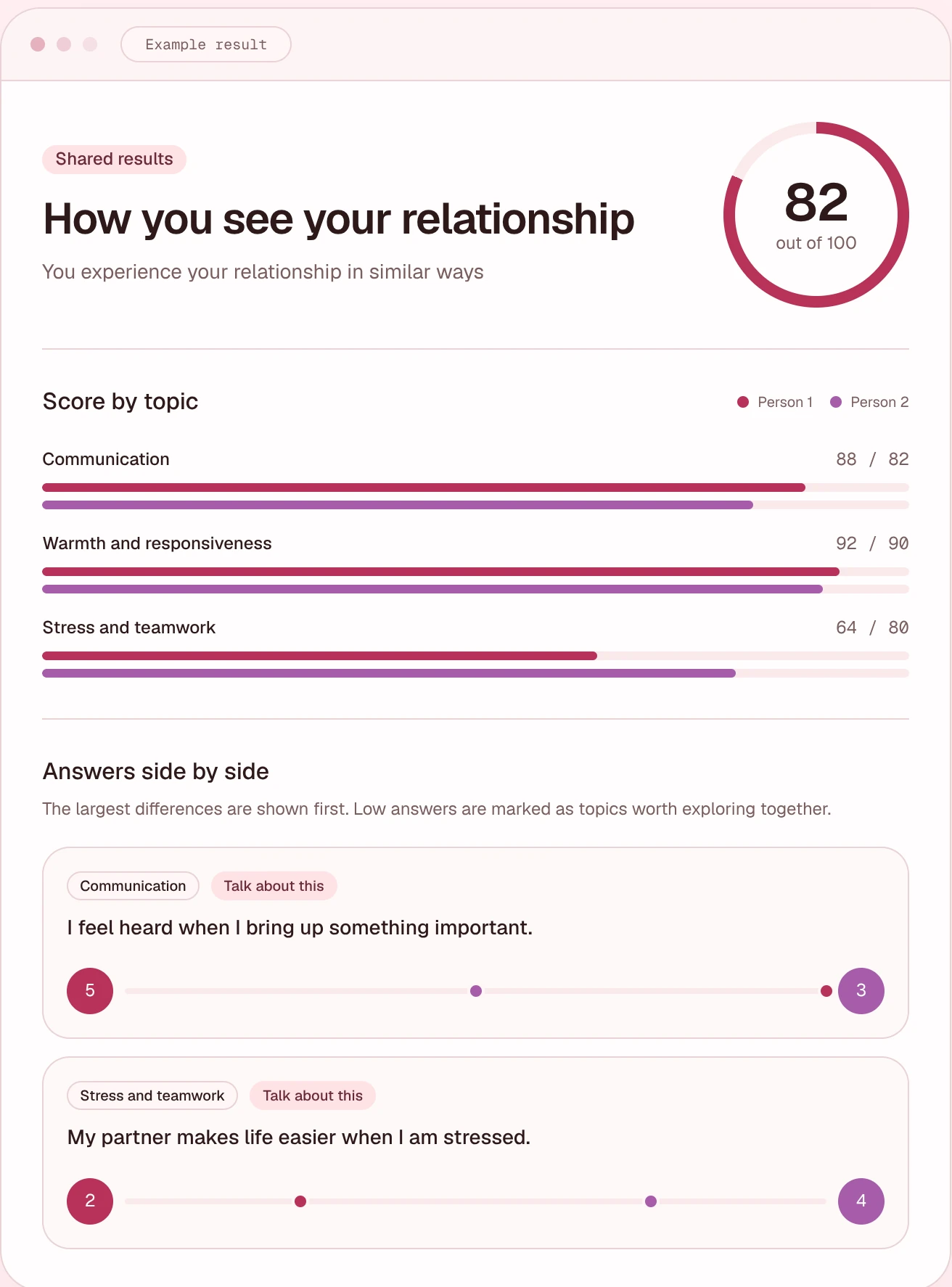
Each of you answers alone and gets a separate result. Comparing the two often tells you more than one score, because partners rarely see the relationship the same way.
What this test can tell you
- The test shows how you see the relationship. Your partner may see it differently and get a different score.
- Your answers reflect how things are now. A recent argument or a good weekend can move the score.
- The score says how satisfied you are, not whether the relationship is healthy or right for you. That is your judgement.
- The cut-off and the average come from one American online study from 2007. We have no norms of our own.
Sources
See your relationship from both sides.
Pair Perspective is our relationship test. Answer 57 questions separately, then explore the strengths you share and the differences worth talking about.
- Free, no account
- Private and secure
- About 8 minutes