Are Women’s Personalities Different from Men’s?
Yes, on average. Women score higher on neuroticism and agreeableness, men on assertiveness and intellect. Here is how big the differences are, and why they are largest in the most gender-equal countries.

لم تُترجم هذه المقالة بعد، وتُعرض بالإنجليزية.
The short answer: Yes, on average. Across dozens of countries, women score higher on neuroticism and agreeableness, and men score higher on assertiveness and on the intellectual side of openness. Each single difference is small to moderate, so most men and women overlap. But when you look at many traits at once, the average man and the average woman are clearly different, and the differences are largest in the richest and most gender-equal countries.
John Gray's 1992 bestseller Men Are from Mars, Women Are from Venus made the idea famous. Personality research tells a more precise story: not two planets, but two overlapping populations with real, measurable differences.
Key findings
- Women score higher on average on neuroticism (anxiety, worry, mood swings) and agreeableness (compassion, politeness).
- Men score higher on average on assertiveness and intellect (interest in abstract ideas).
- One trait at a time, men and women overlap by roughly 80–85%.
- Combine many traits, and the overlap shrinks a lot. One large study found an overlap of only about 10%.
- The differences are larger, not smaller, in prosperous and gender-equal countries such as Norway and Sweden.
- The differences show up when friends and family rate people, not only when people rate themselves.
- Most people already guess the differences correctly: gender stereotypes about personality match the measured differences closely.
- The single biggest psychological sex difference is not in the Big Five at all, but in interests: things versus people.
Trait by trait
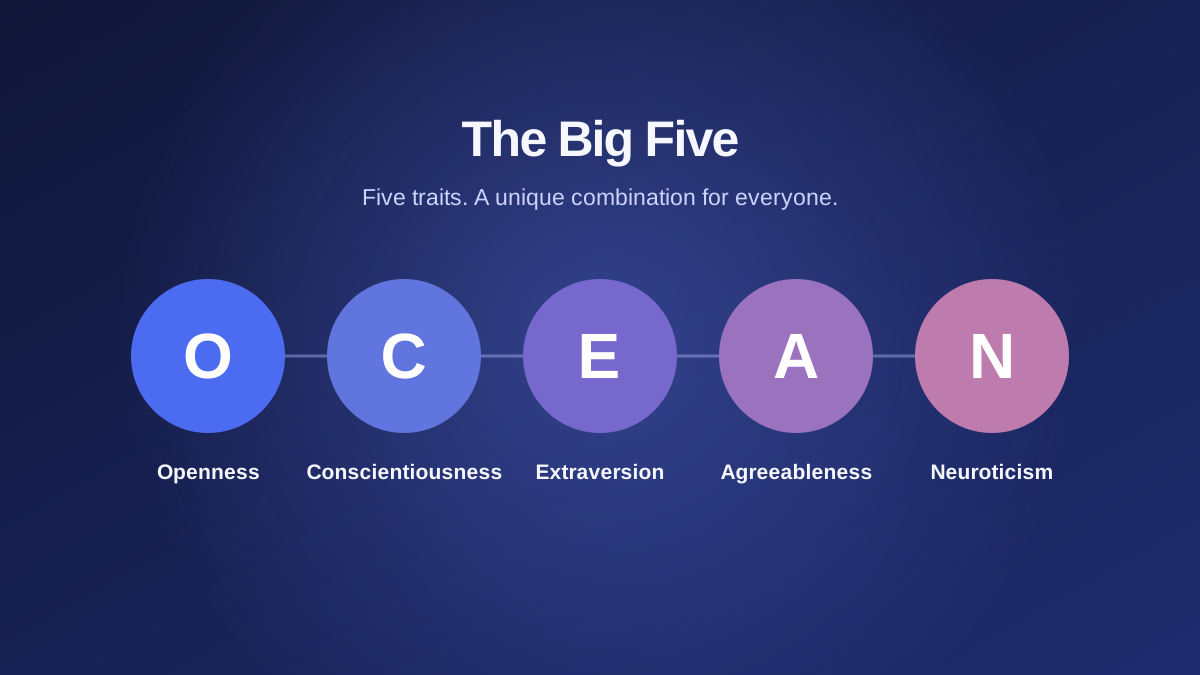
The Big Five describe personality with five broad traits. Each trait has two narrower aspects, and that is where the differences really show up. A study of 2,643 people by Weisberg, DeYoung and Hirsh found that some differences are hidden when you only look at the broad traits, because men and women differ in opposite directions on the two aspects of the same trait.
| Trait | Who scores higher on average | What it looks like |
|---|---|---|
| Neuroticism | Women | More anxiety, worry, sadness and emotional ups and downs |
| Agreeableness | Women | More compassion, warmth and politeness |
| Extraversion | Women: enthusiasm. Men: assertiveness | Women are more sociable and cheerful, men more dominant and forceful |
| Openness | Women: aesthetics and feelings. Men: intellect and ideas | Women lean towards art and emotions, men towards abstract ideas and debate |
| Conscientiousness | Women: orderliness, slightly | Small differences; men and women are about equally hard-working |
Neuroticism and agreeableness show the largest and most consistent differences. In the Weisberg study, the gap was about half a standard deviation for agreeableness and four tenths for neuroticism. Costa, Terracciano and McCrae found the same pattern in 26 cultures, and Schmitt and colleagues found it in 55 nations.
It is not just how people describe themselves
A common objection is that women and men simply describe themselves the way they think they are supposed to. To test this, McCrae and Terracciano asked students in 50 cultures to rate the personality of a man or woman they knew well. Across almost 12,000 people rated by someone else, the same sex differences appeared, and again they were largest in Western cultures.
For extraversion and openness, the broad scores look almost equal, but the aspects split. Women are higher in enthusiasm and men in assertiveness. Women are higher in openness to feelings and aesthetics, men in intellect. That is why older summaries sometimes claim that "men and women are equally extraverted". At the level of the aspects, they are not.
How big are the differences?
Psychologists measure differences in standard deviations. A difference of 0.5, about the size of the gap in agreeableness, means:
- About two out of three women score above the average man.
- At the same time, the two groups overlap by about 80%.
So both of these statements are true: there is a clear average difference, and plenty of men are more agreeable than plenty of women. You cannot guess one person's personality from their sex.
One trait at a time, or the whole profile?
Psychologist Janet Hyde argued in 2005 that men and women are more alike than different on most psychological measures. One trait at a time, that holds for personality too.
In 2012, Marco Del Giudice and colleagues asked a different question: how different are men and women when you look at their whole personality profile at once? Using 15 personality traits from more than 10,000 Americans, they found a multivariate difference that left only about 10% overlap between men and women, after correcting for measurement error. Without that correction the difference was smaller, but still large.
The finding has since been replicated. Kaiser, Del Giudice and Booth used an open online dataset of more than 30,000 people from English-speaking countries and found a somewhat smaller, but still large, difference.
The two views are not in conflict. Many small differences, all pointing in the same direction, add up to a large difference in the overall pattern. That is why it is easy to tell men and women apart on average, even though no single trait does the job.
Most people already know
Are gender stereotypes about personality just prejudice? Löckenhoff and colleagues asked more than 3,000 people in 26 countries to describe the typical man and woman. The differences people expected matched the differences that personality tests actually measure closely. In this case, folk wisdom is largely right about the averages. Where it goes wrong is when it is applied to individuals.
When do the differences appear?
Not at birth, at least not in full. De Bolle and colleagues compared ratings of almost 5,000 adolescents aged 12 to 17 in 23 cultures. The differences grow during the teenage years, girls show the adult pattern earlier than boys, and by age 17 the differences look much like those between adult men and women. The pattern emerged in the same way across cultures.
The biggest difference: things versus people
The largest psychological sex difference is not a Big Five trait. In a meta-analysis of interest inventories from more than half a million people, Su, Rounds and Armstrong found that men are much more interested in working with things (machines, tools, systems) and women in working with people. The difference was close to one standard deviation, about twice the size of the gap in agreeableness. It helps explain why men and women still choose very different careers, even where they are free to choose.
Larger in more equal countries
If personality differences were mainly created by traditional gender roles, you would expect them to shrink in countries where men and women are most equal. The opposite happens.
- Costa and colleagues (2001) found the largest sex differences in European and American cultures, and smaller ones in Asian and African cultures.
- Schmitt and colleagues (2008) studied 55 nations and found larger differences in prosperous, healthy and egalitarian countries.
- Mac Giolla and Kajonius (2019) studied more than 130,000 people in 22 countries using the IPIP-NEO-120, the same test used on this site. Countries with high gender equality, such as Norway and Sweden, had personality differences around twice as large as countries like China and Malaysia.
This is often called the gender equality paradox. One explanation is that when people have more freedom and resources, they can follow their own preferences more, and average differences become more visible. Researchers still debate the details, but the pattern itself has replicated several times.
Why do the differences exist?
Most researchers agree that both biology and culture play a part. A few observations point towards more than social roles alone:
- The same pattern of differences shows up across very different cultures.
- The differences do not disappear in egalitarian societies; they grow.
- The biggest gap, things versus people, appears consistently across countries and decades.
At the same time, culture clearly shapes how traits are expressed and how people answer questionnaires. The honest answer is that we know a lot about what the differences are, and less about exactly how much each cause contributes.
What this means for you
- Averages are not destinies. Your own scores matter more than your sex. Many women are more assertive than the average man, and many men are more anxious than the average woman.
- In a relationship, compare the two of you, not men and women. The difference between two individual partners is often much larger than the average difference between the sexes. Our compare feature shows exactly where you and your partner are alike and where you differ.
- Couples are not as alike as you might think. A meta-analysis of almost 200 studies by Horwitz and colleagues found that partners are strongly matched on political values (a correlation of 0.58), but barely on personality. For extraversion the correlation was only 0.08, close to what you would get by pairing people at random. Opposites do not especially attract, but neither do lookalikes.
- Some friction is predictable. If one partner is higher in agreeableness and the other in assertiveness, that pattern shapes arguments more than who is from Mars and who is from Venus.
Find out where you score
The free Big Five personality test measures all five traits and 30 facets, so you can see where you fall compared with other people, regardless of sex. Afterwards, invite your partner or a friend and compare your results.
Sources
- Costa, P. T., Terracciano, A., & McCrae, R. R. (2001). Gender differences in personality traits across cultures: Robust and surprising findings. Journal of Personality and Social Psychology, 81(2), 322–331. doi:10.1037/0022-3514.81.2.322
- Del Giudice, M., Booth, T., & Irwing, P. (2012). The distance between Mars and Venus: Measuring global sex differences in personality. PLoS ONE, 7(1), e29265. doi:10.1371/journal.pone.0029265
- De Bolle, M., De Fruyt, F., McCrae, R. R., et al. (2015). The emergence of sex differences in personality traits in early adolescence: A cross-sectional, cross-cultural study. Journal of Personality and Social Psychology, 108(1), 171–185. doi:10.1037/a0038497
- Feingold, A. (1994). Gender differences in personality: A meta-analysis. Psychological Bulletin, 116(3), 429–456. doi:10.1037/0033-2909.116.3.429
- Horwitz, T. B., Balbona, J. V., Paulich, K. N., & Keller, M. C. (2023). Evidence of correlations between human partners based on systematic reviews and meta-analyses of 22 traits and UK Biobank analysis of 133 traits. Nature Human Behaviour, 7, 1568–1583. doi:10.1038/s41562-023-01672-z
- Hyde, J. S. (2005). The gender similarities hypothesis. American Psychologist, 60(6), 581–592. doi:10.1037/0003-066X.60.6.581
- Kaiser, T., Del Giudice, M., & Booth, T. (2020). Global sex differences in personality: Replication with an open online dataset. Journal of Personality, 88(3), 415–429. doi:10.1111/jopy.12500
- Löckenhoff, C. E., Chan, W., McCrae, R. R., et al. (2014). Gender stereotypes of personality: Universal and accurate? Journal of Cross-Cultural Psychology, 45(5), 675–694. doi:10.1177/0022022113520075
- Mac Giolla, E., & Kajonius, P. J. (2019). Sex differences in personality are larger in gender equal countries: Replicating and extending a surprising finding. International Journal of Psychology, 54(6), 705–711. doi:10.1002/ijop.12529
- McCrae, R. R., Terracciano, A., & 79 members of the Personality Profiles of Cultures Project. (2005). Universal features of personality traits from the observer's perspective: Data from 50 cultures. Journal of Personality and Social Psychology, 88(3), 547–561. doi:10.1037/0022-3514.88.3.547
- Schmitt, D. P., Realo, A., Voracek, M., & Allik, J. (2008). Why can't a man be more like a woman? Sex differences in Big Five personality traits across 55 cultures. Journal of Personality and Social Psychology, 94(1), 168–182. doi:10.1037/0022-3514.94.1.168
- Su, R., Rounds, J., & Armstrong, P. I. (2009). Men and things, women and people: A meta-analysis of sex differences in interests. Psychological Bulletin, 135(6), 859–884. doi:10.1037/a0017364
- Weisberg, Y. J., DeYoung, C. G., & Hirsh, J. B. (2011). Gender differences in personality across the ten aspects of the Big Five. Frontiers in Psychology, 2, 178. doi:10.3389/fpsyg.2011.00178