Does Your Dog Have a Personality? Here Is What Science Says
Every dog owner knows their dog is one of a kind. For decades, scientists called that wishful thinking. Now research shows that dog personality can be measured, that it is fairly stable, and that breed explains less than you might think.

Ask any dog owner to describe their dog, and you rarely hear "an average dog". You hear about the one who greets every stranger like a long-lost friend, the one who hides behind the sofa when the doorbell rings, and the one who will do absolutely anything for a piece of cheese.
For a long time, many scientists would have called this anthropomorphism: people seeing human traits in animals because they want to. Personality was something humans had.
That view has changed. Over the past few decades, researchers have tested dog personality with the same tools they use on people. The results are more interesting than most dog owners expect.
Can an animal have a personality at all?
In personality research, a personality is simply a set of stable differences in how individuals tend to behave, feel and react. By that definition, the question is not philosophical. It can be tested: do individuals differ consistently, and can those differences be measured reliably?
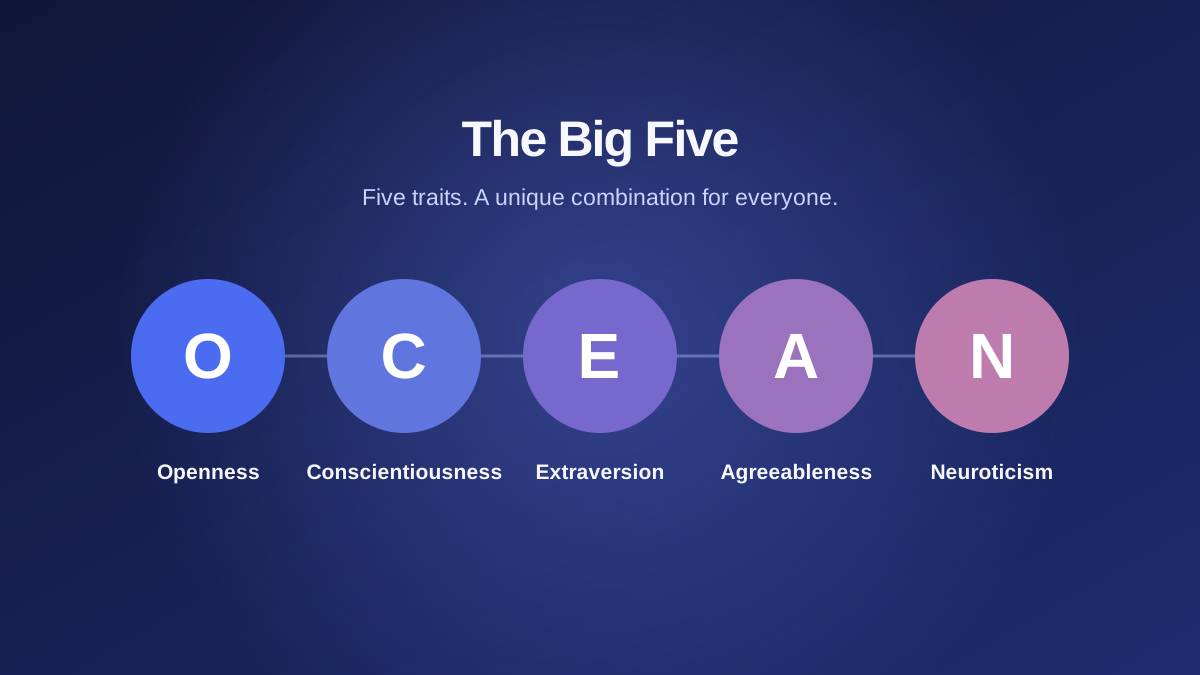
In 1999, psychologists Samuel Gosling and Oliver John reviewed 19 studies of personality in 12 species other than humans. They used the human Big Five as a rough framework.
Three dimensions turned up again and again across species: something like extraversion, something like neuroticism and something like agreeableness. Something like openness came next. A separate conscientiousness dimension appeared in only one species besides humans: chimpanzees, our closest relatives.
Are dog owners just imagining it?
The obvious objection is that owners see what they want to see. So in 2003, Gosling and colleagues tested dogs and humans side by side, using parallel procedures and questionnaires for both species.
They asked three questions that personality researchers ask about any measurement:
| Criterion | The question |
|---|---|
| Internal consistency | Do the questions about a trait hang together? |
| Consensus | Do different people who know the dog agree about it? |
| Correspondence | Do the ratings match independent assessments of the same dog? |
On all three, judgments of dogs were as accurate as judgments of humans. Your neighbour and your partner are about as likely to agree on your dog's personality as on yours.
What does a dog's personality look like?
One of the largest studies used data from the Swedish Working Dog Association's dog mentality assessment, a standardised outdoor test with ten parts. Among other things, the dogs met a stranger, were invited to play, chased a "fleeing" object and faced several startling and potentially threatening situations.
Kenth Svartberg and Björn Forkman analysed tests of 15,329 dogs from 164 breeds, collected between 1997 and 2001. They found five narrower traits:
| Dog trait | What it covers | Roughly comparable human trait* |
|---|---|---|
| Playfulness | Eager to play with people | Extraversion |
| Curiosity/fearlessness | Approaches new and startling things | Low neuroticism, openness |
| Chase-proneness | Goes after moving objects | – |
| Sociability | Friendly towards strangers | Extraversion, agreeableness |
| Aggressiveness | Threatens or attacks when provoked | Low agreeableness |
*Our own rough comparison, not the authors'.
All except aggressiveness were linked, forming one broad dimension running from shy to bold. The authors compare it to the shyness–boldness axis found in humans and many other animals, which in people resembles a mix of extraversion and emotional stability. The same pattern appeared in different breed groups, which suggests that it belongs to dogs as a species.
Is your dog's personality stable?
If personality is real, it should be fairly consistent over time. A 2013 meta-analysis by Jamie Fratkin and colleagues pooled 31 studies that tested the same dogs twice.
The overall consistency was r = 0.43. That is substantial, but far from fixed. The details are revealing:
- Consistency was higher in older dogs, and when the two tests were closer in time.
- In puppies, aggression and submissiveness were the most consistent. Responsiveness to training, fearfulness and sociability were the least consistent.
- So-called puppy tests predicted adult behaviour about as well as they predicted behaviour later in puppyhood.
For a rough comparison, a classic review of human studies found that people's traits become more stable with age too, with consistency rising from 0.31 in childhood to around 0.74 between ages 50 and 70. The studies differ in methods and time intervals, so the comparison is loose, but the pattern is the same: personality settles with age, in dogs as well as in people.
Old dog, new tricks
In 2019, William Chopik and Jonathan Weaver surveyed the owners of 1,681 dogs, and the title of their article sums up one of the findings.
As expected, older dogs were less active and excitable than younger dogs. But responsiveness to training did not peak in puppyhood. It was highest among dogs aged 6 to 8. So, interestingly, were aggression towards people and aggression towards other animals.
Personality also mattered for the dogs' lives. It was linked to chronic health conditions, biting history and the relationship between dog and owner. Owners reported a better relationship when their dogs were more active and excitable and more responsive to training, and when the owners themselves were more agreeable.
Does your dog resemble you?
It is a popular joke that dogs look like their owners. When it comes to personality, there may be something to it.
Borbála Turcsán and colleagues studied owners and their dogs in Austria and Hungary. Owners rated both themselves and their dog. The two were positively correlated on all five dimensions. When a friend rated the dog instead of the owner, four of them still matched:
| Trait | Owner rates the dog | Friend rates the dog |
|---|---|---|
| Neuroticism | 0.46 | 0.34 |
| Extraversion | 0.31 | 0.32 |
| Conscientiousness | 0.28 | 0.63 |
| Agreeableness | 0.25 | 0.42 |
Correlations between the owner's personality and the dog's, as reported in Chopik and Weaver's review of the study. 0 means no link; 1 would mean a perfect match.
Chopik and Weaver found similar patterns in their own data: extraverted owners rated their dogs as more active and excitable, conscientious owners rated their dogs as more responsive to training, agreeable owners rated their dogs as less aggressive, and anxious owners rated their dogs as more fearful.
Why would this happen? There are three plausible explanations, and they can all be true at once:
- We choose dogs that suit us. An active person may pick a lively dog, just as people tend to choose partners and friends who resemble them.
- We shape each other. Dogs and owners share a daily life. A nervous owner may, without meaning to, give the dog more reasons to be nervous.
- We see ourselves in our dogs. Owners may describe their dog through their own lens. The friend ratings argue against this being the whole story, but they do not rule it out.
Is it all in the breed?
Breed descriptions are full of personality: loyal, stubborn, gentle, independent. So how much does breed really say about an individual dog?
A team including Kathleen Morrill and Elinor Karlsson surveyed owners of 18,385 purebred and mixed-breed dogs and analysed the DNA of 2,155. Their results, published in Science in 2022, cut both ways:
- Behaviour is partly inherited. Most behavioural traits had a heritability above 25%.
- But breed explained just 9% of the variation in behaviour between individual dogs.
- Breed tendencies did line up with what the breeds were originally bred for, but only weakly.
The authors suggest that many behaviours we think of as typical of a breed are much older than the breeds themselves, and that modern breeds differ mainly in looks. In other words, a breed can tell you something about the odds. It tells you much less about the dog in front of you.
What about cats?
Cats have been studied far less, but they are not left out. In the "Feline Five" study, owners described 2,802 pet cats in South Australia and New Zealand. The researchers found five dimensions: neuroticism, extraversion, dominance, impulsiveness and agreeableness.
The authors also point to a practical use. An unusually irritable cat with low agreeableness may be in pain or ill, and a highly impulsive cat may be reacting to something stressful in its home.
Why does this matter?
It is fun to know that your dog's personality is real. But the research is also used for practical purposes:
- Choosing working dogs. Behaviour tests help select service dogs and detection dogs, and help breeders choose breeding animals.
- Matching dogs and homes. Knowing that personality is only partly stable, and that breed explains little, can help shelters and new owners look at the individual dog.
- Animal welfare. Changes in personality, such as a friendly animal becoming irritable, can be an early sign of pain, illness or stress.
What the research cannot tell us
- It mostly relies on owners. Even when friends or strangers rate the dog, they rate what they see, through human eyes.
- The samples are not random. Many studies recruit engaged owners online or through dog clubs. Chopik and Weaver, for example, recruited participants online and among university students.
- Different studies use different traits. There is no single agreed "Big Five for dogs", so results do not always line up neatly.
- Similarity is not causation. The owner–dog correlations do not show whether owners shape dogs, choose dogs, or simply see dogs in a certain way.
- Most studies are from Western countries. Dogs in other parts of the world, including the many free-ranging dogs, are less studied.
What about you?
We cannot test your dog, but you can test yourself. Our free Big Five test shows where you stand on extraversion, neuroticism, agreeableness and the other traits that researchers also look for in animals.
Then ask someone who knows you both: are you as sociable as your dog? As easily startled? If you mainly want to know where you stand between introvert and extrovert, try our introvert–extrovert test.
Take the Big Five test and see whether you and your dog have more in common than you thought.
Sources and further reading
- Chopik, W. J. & Weaver, J. R. (2019). Old dog, new tricks: Age differences in dog personality traits, associations with human personality traits, and links to important outcomes. Journal of Research in Personality, 79, 94–108.
- Fratkin, J. L., Sinn, D. L., Patall, E. A. & Gosling, S. D. (2013). Personality consistency in dogs: A meta-analysis. PLoS ONE, 8(1), e54907.
- Gosling, S. D. & John, O. P. (1999). Personality dimensions in nonhuman animals: A cross-species review. Current Directions in Psychological Science, 8(3), 69–75.
- Gosling, S. D., Kwan, V. S. Y. & John, O. P. (2003). A dog's got personality: A cross-species comparative approach to personality judgments in dogs and humans. Journal of Personality and Social Psychology, 85(6), 1161–1169.
- Litchfield, C. A., Quinton, G., Tindle, H., Chiera, B., Kikillus, H. & Roetman, P. (2017). The 'Feline Five': An exploration of personality in pet cats (Felis catus). PLoS ONE, 12(8), e0183455.
- Morrill, K., Hekman, J. P., Li, X., McClure, J., Logan, B., Goodman, L., … Karlsson, E. K. (2022). Ancestry-inclusive dog genomics challenges popular breed stereotypes. Science, 376(6592), eabk0639.
- Roberts, B. W. & DelVecchio, W. F. (2000). The rank-order consistency of personality traits from childhood to old age: A quantitative review of longitudinal studies. Psychological Bulletin, 126(1), 3–25.
- Svartberg, K. & Forkman, B. (2002). Personality traits in the domestic dog (Canis familiaris). Applied Animal Behaviour Science, 79(2), 133–155.
- Turcsán, B., Range, F., Virányi, Z., Miklósi, Á. & Kubinyi, E. (2012). Birds of a feather flock together? Perceived personality matching in owner–dog dyads. Applied Animal Behaviour Science, 140(3–4), 154–160.