Which Country Is the Most Extraverted? The Big Five in 48 Countries
A world map of the Big Five from 584,535 people in 48 countries. The Netherlands and Norway come out most extraverted, Brazil least. Explore every trait and country, and see why country comparisons need care.
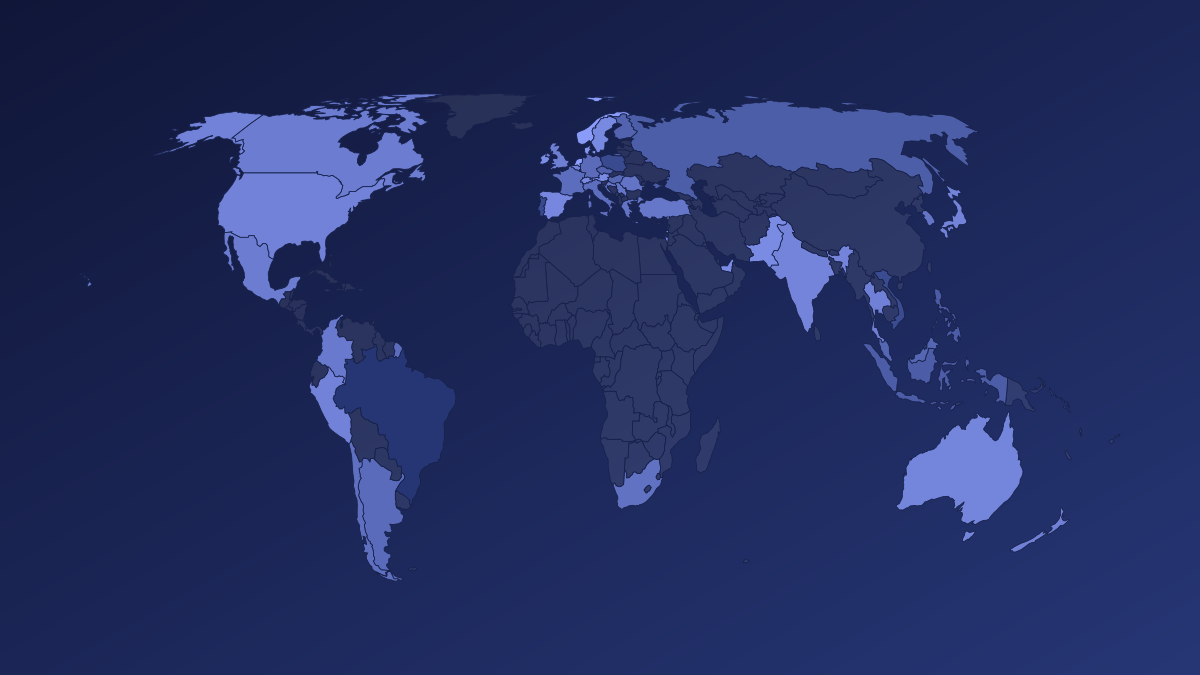
The short answer: In a large online sample, the Netherlands, Norway and Denmark come out as the most extraverted countries, and Brazil, Portugal and Poland as the least. But the differences between countries are small next to the differences between people in the same country, and comparing countries on self-reports has pitfalls. Explore the map yourself below, and read why the numbers deserve a little skepticism.
Key findings
- Most extraverted: the Netherlands, Norway, Denmark and Ireland. Least: Brazil, Portugal, Poland and Vietnam.
- Calmest (lowest neuroticism): the Netherlands, Switzerland, Thailand, Sweden and Norway. Highest: Greece, Russia, Poland and the Philippines.
- Most open to experience: Switzerland, Israel, Germany and France.
- Norway stands out: second most extraverted of 48 countries, among the most conscientious and agreeable, and among the calmest.
- Finland is the Nordic exception, with lower extraversion and agreeableness than its neighbours.
- Even between the most and least extraverted country, the difference is only about half of how much people vary within one country. Most countries differ by less than that.
Explore the map
LowerHigherToo few people
United StatesAverage of 48 countries
- Openness74 · 73Hardly any difference#28 of 48
- Conscientiousness60 · 56Small difference · 4 points higher#3 of 48
- Extraversion48 · 47Hardly any difference#16 of 48
- Agreeableness71 · 66Small difference · 5 points higher#2 of 48
- Neuroticism51 · 53Hardly any difference#39 of 48
I feel little concern for others
Agree lessUnited States 2.0 · average 2.6I am easily disturbed
Agree lessUnited States 2.7 · average 3.1I follow a schedule
Agree moreUnited States 3.3 · average 3.0I shirk my duties
Agree lessUnited States 2.4 · average 2.7
Each score has a margin of error of about half a point to a point, so countries less than a point apart are effectively tied.
Data: 584,535 people in 48 countries who took a 50-statement Big Five test online in English in 2016–2018 (Open Psychometrics). Scores from 0 to 100. Only countries with at least 1,000 people are shown. Differences are compared with how much people vary within a country: under a fifth of that is hardly any difference.
Norway and the quiet Scandinavian
Norwegians are often described, not least by themselves, as reserved: they keep to themselves on the bus and need a few drinks before they talk to strangers. In this data, Norwegians describe themselves as more outgoing than people in almost any other country, and as calm and conscientious.
How can both be true? A personality test asks how you see yourself compared with the people around you. Many questions are about behaviour among people you know: talking to many people at parties, starting conversations. The stereotype is often about how strangers behave in public. And Norwegians who take an English personality test online are not all Norwegians. Finland, on the other hand, matches its quiet reputation better: it is among the least extraverted countries here.
Why country comparisons are tricky
The test was in English. Everyone took the same 50 statements in English. For most people outside the English-speaking world, that is a second language. Openness is measured partly with statements like "I have a rich vocabulary" and "I use difficult words", so it is no surprise that countries where English is a second language score lower on openness.
The samples are not the population. The people who take an English personality test online in Brazil or Vietnam are younger, more educated and more used to English than the average person there. In the United States, the sample is broader.
People compare themselves with those around them. When you rate how organised you are, you compare yourself with your own culture. This is called the reference-group effect. One study found that the countries whose people rated themselves as least conscientious, such as Japan, scored among the highest on behaviour that reflects conscientiousness, such as punctuality and the accuracy of public clocks (Heine, Buchtel & Norenzayan, 2008).
Stereotypes rarely match. A study of 49 cultures compared what people believe about the typical person in their country with measured personality in the same country. The beliefs had almost nothing to do with the measurements (Terracciano et al., 2005).
The differences are small. People within the same country differ far more than countries do. Knowing someone's country tells you very little about their personality.
What larger studies find
Researchers have compared countries with translated tests and more careful sampling. The largest of these studied 56 nations and found regional patterns, but also that the differences between countries are modest and partly shaped by how people answer questionnaires (Schmitt et al., 2007). The safest conclusion is the same as here: there are some real average differences, but they are small, and self-reports alone cannot settle them.
Where the data comes from
The numbers come from the open research data of Open Psychometrics, where people took a 50-statement version of the Big Five test (Goldberg's IPIP Big-Five Factor Markers) between 2016 and 2018. The country was determined from the internet address, not asked. We kept one answer per internet address, removed incomplete and implausibly fast or slow answers, and show countries with at least 1,000 people: 584,535 people in 48 countries. Scores run from 0 to 100.
The 50 statements are not the same as in our test, so you cannot compare your own result directly with the map. For that, see how women and men of different ages score, which uses the same statements as our test.
Sources
- Open Psychometrics. IPIP Big-Five Factor Markers data, 2016–2018. openpsychometrics.org/_rawdata.
- Goldberg, L. R. (1992). The development of markers for the Big-Five factor structure. Psychological Assessment, 4(1), 26–42. IPIP.
- Heine, S. J., Buchtel, E. E., & Norenzayan, A. (2008). What do cross-national comparisons of personality traits tell us? The case of conscientiousness. Psychological Science, 19(4), 309–313. doi:10.1111/j.1467-9280.2008.02085.x
- Schmitt, D. P., Allik, J., McCrae, R. R., & Benet-Martínez, V. (2007). The geographic distribution of Big Five personality traits: Patterns and profiles of human self-description across 56 nations. Journal of Cross-Cultural Psychology, 38(2), 173–212. doi:10.1177/0022022106297299
- Terracciano, A., et al. (2005). National character does not reflect mean personality trait levels in 49 cultures. Science, 310(5745), 96–100. doi:10.1126/science.1117199