History and Background of The Big Five Test
Who developed the Big Five personality model? Follow its research history and learn how the IPIP-NEO-120 test used here differs from the model itself.

Αυτό το άρθρο δεν έχει μεταφραστεί ακόμα και εμφανίζεται στα αγγλικά.

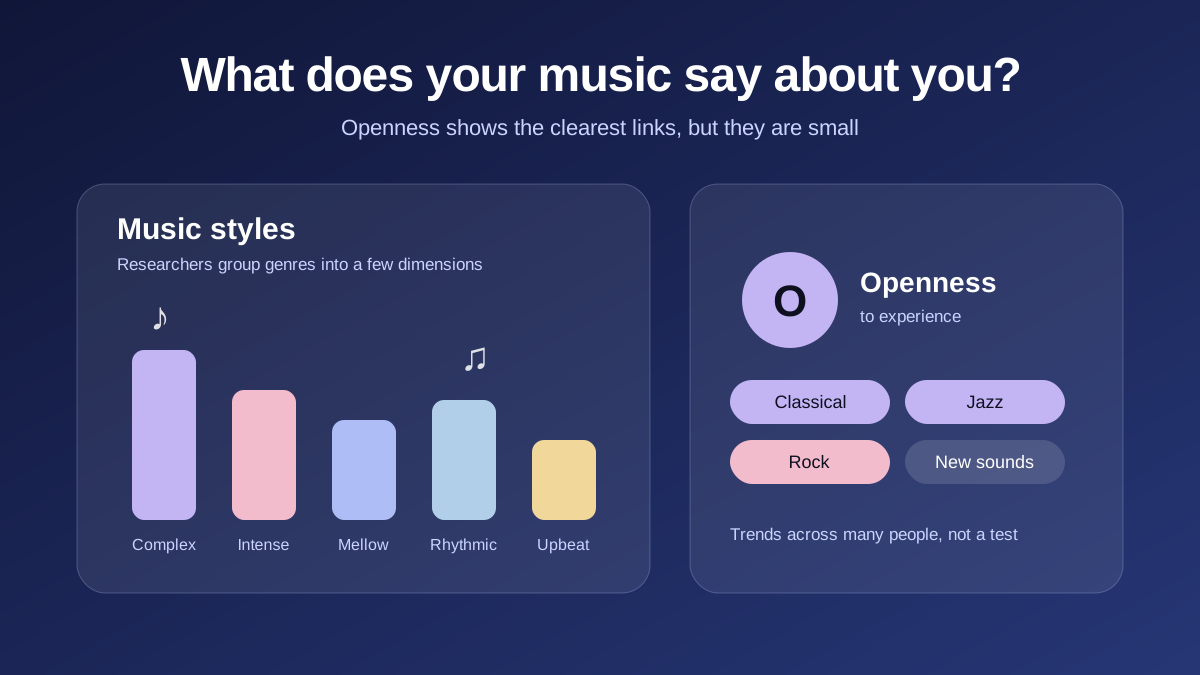
Since Sigmund Freud launched his personality model based on his psychodynamic theory around 1900, psychologists have continuously tried to coin lexical terms to identify personality traits. In 1936, Gordon Allport and Henry Odbert listed 4,500 terms that described personality differences. By means of factor analysis and the present emerging computer technology, other researchers tried to narrow down the terms associated with personality - to 16 - and eventually to 5. Lewis Goldberg and McCrae & Costa along with other colleagues are credited for the Big Five model we use today. According to this model personality is measured along 5 broad dimensions which appear to be quite stable throughout life. These primary personality traits can be identified by the acronyms OCEAN.
(E) Extraversion
(A) Agreeableness
(N) Neuroticism
Who created the Big Five personality test?
No single researcher invented the Big Five model. Allport and Odbert catalogued personality-related words; later, Tupes and Christal found a recurring five-factor pattern in trait ratings. Norman and Goldberg replicated and developed that line of research, and Goldberg gave it the name Big Five. This is the history of the model, not of one particular questionnaire. The International Personality Item Pool explains the sequence.
The 120-item IPIP-NEO test used on this site is a later questionnaire developed by John A. Johnson. His 2014 paper describes the inventory and its 30 facets.
For a practical explanation of all five dimensions and how to read your scores, see our guide to the Big Five personality traits.
Each primary trait contains two opposite poles, e.g. regarding Openness to experience: curious versus cautious, and numerous subcategories, such as imagination or fantasy, adventurousness and curiosity in intellectual matters. The test taker is going to rate which description or adjective is most accurate to represent their own personality on a scale from Strongly Disagree to Strongly Agree.
On this site, the percentages in your report show where your answers fall on each trait's response scale. They are not percentile rankings against other test takers. Researchers can compare trait scores across groups, but a single score cannot tell the whole story of a person. Most people fall somewhere between the extremes of a trait, such as curious and cautious.
Compared to other time consuming methods, psychometric testing, such as the Big Five, provides a quite concise view into the test taker’s personality, even if there might be some bias due to the person’s readiness to give answers that might convey what they think is a more favourable impression.
Since the 1990s, the Big Five has become one of the most widely used frameworks in personality research. Trait measures are used in research and sometimes in educational or workplace settings, but their usefulness depends on the specific questionnaire and purpose. No personality score should be treated as a definitive judgment about someone's suitability for a job. However, it is important to have in mind that the Big Five has shortcomings. It does neither provide a comprehensive description of an individual’s personality nor fully account for individual differences (John & Srivastava, 1999)
The Big Five Test available here uses the 120-item IPIP-NEO inventory developed by John A. Johnson, Ph.D., Professor Emeritus of Psychology at the Pennsylvania State University.
Sources
- Allport, G., & Odbert, H. (1936). Trait-names: A psycho-lexical study. Psychological Monographs
- Mulltimethod replication of the ABSC model of personality traits
- Cattell, R. (1957). Personality and motivation structure and measurement. Yonkers-on-Hudson, NY: World Book
- Goldberg, L. (1990). An alternative “description of personality”: The Big-Five factor structure. Journal of Personality and Social Psychology
- Johnson, J. A. (2014). Measuring thirty facets of the Five Factor Model with a 120-item public domain inventory.