Career Interests and Personality: What You Like Matters as Much as Who You Are
Your interests are not just your personality at work. They are among the most stable traits you have, and they predict job satisfaction, performance and choices in life. Take the free career interest test.
이 아티클은 아직 번역되지 않아 영어로 표시됩니다.
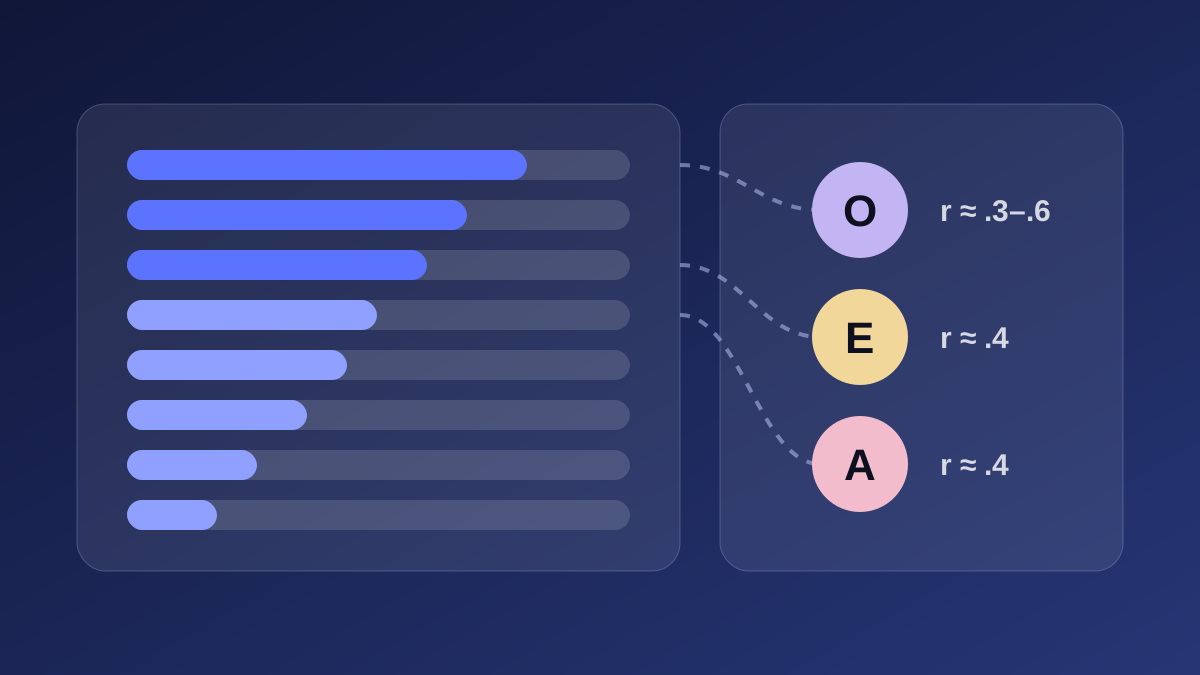
The short answer: Your personality describes how you tend to think, feel and behave. Your interests describe what you like to do. The two are related, but much less than most people think. Extraverts are more often drawn to leadership, agreeable people to caring for others and open people to art and ideas. But interests are a separate part of who you are, they are remarkably stable over life, and they predict your career choices and job satisfaction in ways personality does not.
You can find out where you stand with our free career interest test. It takes about nine minutes.
Key findings
- Interests and personality overlap only partly. Even the strongest links explain a minority of the differences between people.
- The clearest links are extraversion with leadership, agreeableness with caring for others and openness with creativity and learning.
- Conscientiousness and neuroticism have almost nothing to do with which work people find interesting.
- Interests become very stable from the age of about 18 and stay that way for decades. They are more stable than personality traits.
- Interests predict performance and persistence at work and in education, especially when the job matches what you like.
- Interests measured at the end of school predicted life outcomes ten years later, over and above IQ and the Big Five.
- The largest psychological sex difference is found in interests: on average, men prefer working with things and women with people.
What are career interests?
Career interests, or vocational interests, are the activities and environments you are drawn to. Some people light up when they get to fix an engine, others when they can teach, write, analyse data or lead a team.
The most widely used model was developed by the psychologist John Holland. It sorts interests into six types, often called RIASEC:
| Type | Likes to | Typical jobs |
|---|---|---|
| Realistic | Work with tools, machines, plants and animals | Carpenter, mechanic, farmer |
| Investigative | Investigate, analyse and solve problems | Scientist, programmer, doctor |
| Artistic | Create and express themselves | Designer, musician, writer |
| Social | Help, teach and care for others | Teacher, nurse, social worker |
| Enterprising | Lead, persuade and sell | Manager, salesperson, politician |
| Conventional | Organise, plan and keep track | Accountant, administrator, controller |
The test on this site uses the Oregon Vocational Interest Scales (ORVIS), a free scientific measure from the International Personality Item Pool. It measures eight interest areas: leadership, organization, altruism, creativity, analysis, practical work, adventure and erudition (languages, books and knowledge). Six of them correspond closely to the RIASEC types. Adventure and erudition are extra.
How strongly are interests and personality related?
Psychologists have compared interests and the Big Five in many studies. A meta-analysis by Larson, Rottinghaus and Borgen combined 24 samples and found that only a handful of the 30 possible links between the six interest types and the five personality traits were substantial. The clearest ones were openness with artistic and investigative interests, extraversion with enterprising and social interests, and agreeableness with social interests.
The researchers behind ORVIS found the same pattern. In a community sample, these were the strongest correlations between the Big Five and the eight interest areas:
| Personality trait | Interest area | Correlation (r) |
|---|---|---|
| Agreeableness | Altruism (helping others) | .42 |
| Extraversion | Leadership | .38 |
| Openness (intellect) | Erudition | .34 |
| Openness (intellect) | Creativity | .30 |
| Openness (intellect) | Leadership | .29 |
A correlation of .40 is a clear link, but it also means that most of the differences in interests are not explained by personality. Many introverts enjoy leading, and many agreeable people have no wish to work in care.
Two traits stand out by being almost irrelevant. Conscientiousness had only a weak link with organization (.20), and emotional stability (the opposite of neuroticism) was practically unrelated to every interest area. Being organised and calm says a lot about how you work, but little about what you want to work with.
Mount, Barrick, Scullen and Rounds analysed interests and personality together and concluded that they are best understood as related but separate parts of the person, organised along dimensions such as working with people versus working with things.
Interests are surprisingly stable
You might think interests change with every new hobby. The research says otherwise. Low, Yoon, Roberts and Rounds reviewed longitudinal studies following people from age 12 to 40. Interests were moderately stable during adolescence, became markedly more stable during the college years (18 to 22) and stayed at that level for the next two decades. Over time, interests were more stable than personality traits.
Practical and artistic interests were the most stable. Scientific, social, enterprising and clerical interests changed somewhat more.
This means that a career interest test taken in your late teens or later says something lasting about you, not just about your mood that week. Rounds and Su argue that this stability is one reason to see interests as distinct dispositions in their own right, rather than as personality traits applied to work.
Do interests predict success?
For a long time, employers ignored interests and focused on abilities and personality. Two large meta-analyses suggest that was a mistake, but they also show the limits.
- Nye, Su, Rounds and Drasgow reviewed more than 60 years of research, with about 568 correlations from 60 studies. Interests were related to both performance and persistence at work and in education. The fit between a person's interests and their job or field was an even better predictor than the interest scores alone.
- Van Iddekinge, Roth, Putka and Lanivich analysed 74 studies and found more modest numbers. A single interest scale predicted job performance at .14 and training performance at .26, and higher interest was linked to lower turnover. The links were stronger when the interest was clearly relevant to the job.
In other words, liking the work does not guarantee you will be good at it, but it helps, and it makes you more likely to stay.
Interests predict life, not just work
Stoll and colleagues followed more than 3,000 German school leavers for ten years. The interests they reported at the end of school predicted seven of nine later life outcomes in work, relationships and health, over and above IQ and the Big Five. Interests are not just a career question. They shape the life you build.
Men, women and things versus people
The biggest psychological sex difference researchers have found is not in personality but in interests. In a meta-analysis of more than 500,000 people, Su, Rounds and Armstrong found that men on average prefer working with things and women with people, with a large difference of almost one standard deviation (d = 0.93). Men had stronger realistic and investigative interests, and women stronger artistic, social and conventional interests.
The ORVIS data show the same pattern: the largest sex difference was in adventure, where men scored more than a standard deviation higher, followed by analysis (men higher) and altruism (women higher). As always, these are averages with large overlap. Read more in our article on personality differences between women and men.
How to use your results
- Look at your top three, not one. Most jobs combine several interests. A doctor combines analysis and helping others; an architect combines creativity and practical work.
- Interests are not abilities. The test measures what you would enjoy, not what you would be good at. Use the result to explore, then check what education and skills a field requires.
- Combine interests and personality. The two together say more than either alone. Someone with strong analytical interests and high extraversion may thrive in consulting or teaching science; someone with the same interests and high introversion may prefer research or programming.
- Notice the specific things you love. Broad interest areas can hide specific passions. Our result page also lists the activities you rated "strongly like", because they often say more than the averages.
Take the test
The free career interest test has 92 short activities and jobs. You rate how much you would like each one, and you get your scores in eight interest areas, your strongest interests and occupations that match your profile. The occupation suggestions are based on interest profiles for more than 900 occupations from the O*NET database of the U.S. Department of Labor.
Then take the Big Five personality test to see how your personality fits with your interests.
Sources
- Larson, L. M., Rottinghaus, P. J., & Borgen, F. H. (2002). Meta-analyses of Big Six interests and Big Five personality factors. Journal of Vocational Behavior, 61(2), 217–239. doi:10.1006/jvbe.2001.1854
- Low, K. S. D., Yoon, M., Roberts, B. W., & Rounds, J. (2005). The stability of vocational interests from early adolescence to middle adulthood: A quantitative review of longitudinal studies. Psychological Bulletin, 131(5), 713–737. doi:10.1037/0033-2909.131.5.713
- Mount, M. K., Barrick, M. R., Scullen, S. M., & Rounds, J. (2005). Higher-order dimensions of the Big Five personality traits and the Big Six vocational interest types. Personnel Psychology, 58(2), 447–478. doi:10.1111/j.1744-6570.2005.00468.x
- Nye, C. D., Su, R., Rounds, J., & Drasgow, F. (2012). Vocational interests and performance: A quantitative summary of over 60 years of research. Perspectives on Psychological Science, 7(4), 384–403. doi:10.1177/1745691612449021
- Pozzebon, J. A., Visser, B. A., Ashton, M. C., Lee, K., & Goldberg, L. R. (2010). Psychometric characteristics of a public-domain self-report measure of vocational interests: The Oregon Vocational Interest Scales. Journal of Personality Assessment, 92(2), 168–174. doi:10.1080/00223890903510431
- Rounds, J., & Su, R. (2014). The nature and power of interests. Current Directions in Psychological Science, 23(2), 98–103. doi:10.1177/0963721414522812
- Stoll, G., Rieger, S., Lüdtke, O., Nagengast, B., Trautwein, U., & Roberts, B. W. (2017). Vocational interests assessed at the end of high school predict life outcomes assessed 10 years later over and above IQ and Big Five personality traits. Journal of Personality and Social Psychology, 113(1), 167–184. doi:10.1037/pspp0000117
- Su, R., Rounds, J., & Armstrong, P. I. (2009). Men and things, women and people: A meta-analysis of sex differences in interests. Psychological Bulletin, 135(6), 859–884. doi:10.1037/a0017364
- Van Iddekinge, C. H., Roth, P. L., Putka, D. J., & Lanivich, S. E. (2011). Are you interested? A meta-analysis of relations between vocational interests and employee performance and turnover. Journal of Applied Psychology, 96(6), 1167–1194. doi:10.1037/a0024343