What Does Your Music Taste Say About Your Personality? What the Research Shows
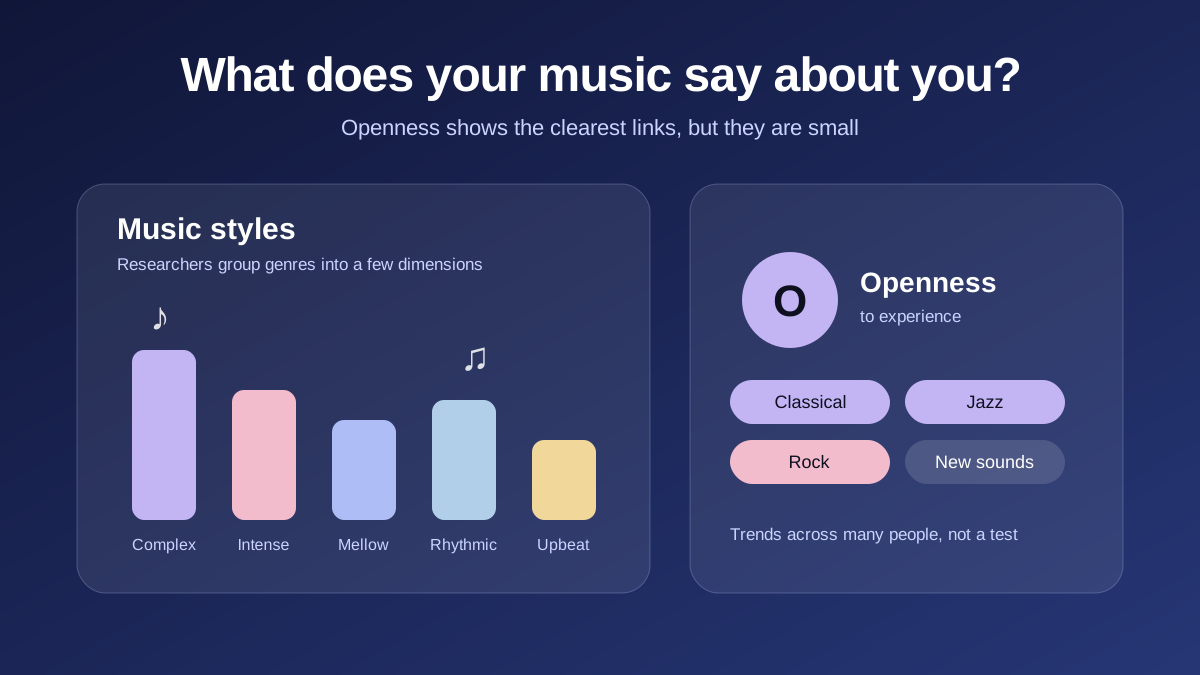
People high in openness lean towards complex, unconventional music. But the links between music taste and personality are smaller than most people think.
Оваа статија сè уште не е преведена и е прикажана на англиски.
The short answer: Your music taste says something about your personality, but much less than online quizzes suggest. The clearest and most replicated link is with openness to experience: people who score high on openness tend to enjoy more complex, varied and unconventional music, such as classical, jazz and experimental styles. The other Big Five traits show weaker and less consistent links, and even the openness effect is small.
Music is one of the first things people share when they get to know each other. Researchers have studied why for more than two decades, and the results are more interesting, and more modest, than the idea that your favourite genre reveals who you are.
Key findings
- Openness to experience shows the clearest links with music taste. People higher in openness tend to prefer complex, sophisticated and intense music.
- Music taste can be grouped into a few broad dimensions, such as complex, intense, mellow, rhythmic and upbeat music, rather than dozens of separate genres.
- Large studies show that reactions to music, and even Facebook Likes for musicians, can predict personality to some degree, most notably openness and extraversion.
- A meta-analysis of earlier studies found that most links between personality and preferred music styles are close to zero. The strongest ones, for openness, are still small.
- Music taste is a statistical hint, not a personality test. Age, culture, friends and simple exposure shape it too.
From genres to music dimensions
The modern research on this question started with a series of studies by psychologists Peter Rentfrow and Samuel Gosling, published in 2003. Analysing the music preferences of more than 3,500 people, they found that preferences for individual genres clustered into four broader dimensions:
- Reflective and complex, such as classical, jazz, blues and folk
- Intense and rebellious, such as rock, alternative and heavy metal
- Upbeat and conventional, such as pop, country and soundtracks
- Energetic and rhythmic, such as rap, soul and electronic music
Each dimension was linked to a different pattern of personality traits, self-views and abilities. The most consistent link was with openness to experience: people higher in openness tended to prefer reflective and complex music as well as intense and rebellious music.
A later model from Rentfrow and colleagues moved away from genre labels and asked people to react to short music excerpts instead. Their analyses pointed to five underlying dimensions, often called the MUSIC model: mellow, urban (rhythmic and percussive), sophisticated (such as classical, opera, world music and jazz), intense, and campestral (direct, rootsy styles such as country and singer-songwriter music).
Why openness and music go together
Openness to experience describes curiosity, imagination, aesthetic sensitivity and an interest in new ideas and feelings. You can read more about the trait in our article on openness to experience.
It makes intuitive sense that this trait shows up in music. Complex music with unusual harmonies, long structures or improvisation rewards curiosity and close listening. People high in openness also tend to seek out novelty, so they may simply have explored more styles.
Research on the attributes of music, rather than genres, supports this. In a 2016 study with 9,454 participants, David Greenberg and colleagues found that the qualities people hear in music can be organised into three dimensions: arousal (how energetic it is), valence (how positive it sounds) and depth (how intellectually and emotionally complex it is). People's preferences for these attributes reflected their personality, even after accounting for age and other demographics. Openness is the trait most often linked to enjoying music with depth.
Openness is not a single thing, though. A study by Fabio Setti and Jeffrey Kahn looked at the separate facets of openness in 374 students and found that the facets related to music preference in ways that disappear when openness is measured as one overall score. In other words, the aesthetic, intellectual and adventurous sides of openness may each connect to music differently.
Can your music predict your personality?
To test whether these links hold up outside questionnaires, a team led by Gideon Nave ran two large online studies, published in Psychological Science in 2018.
- In the first study, 22,252 people rated short, unfamiliar music excerpts. Their reactions predicted differences in personality, most notably openness and extraversion, beyond what age and other demographic information could explain.
- In the second study, 21,929 people shared their Facebook Likes. Which musical artists they had liked also predicted their personality.
This is the strongest evidence that music preferences carry real information about personality. But "predict" in this kind of research means better than chance across many people. It does not mean you can look at one person's playlist and know their personality.
How strong are the links really?
This is the most important part of the story. In 2017, Thomas Schäfer and Claudia Mehlhorn pooled the results of earlier studies in a meta-analysis to see how strongly the Big Five traits are linked to preferences for different music styles.
Most of the correlations they found were close to zero. Only a few were small but meaningful, at roughly .1 to .2 on a scale where 1 would be a perfect relationship. Openness was the trait with the clearest links, especially with preferring complex and intense music, but even these effects were modest.
What does that mean in practice? Knowing that someone loves jazz makes it a little more likely that they score above average on openness. Plenty of jazz lovers will still score low, and plenty of people who mostly listen to pop will score high.
What about the other traits?
The links for the other Big Five traits are weaker and less consistent across studies:
- Extraversion has been linked to enjoying energetic, rhythmic and upbeat music, and it was one of the two traits best predicted by music reactions in the 2018 studies.
- Agreeableness and conscientiousness have in some studies been linked to preferring upbeat, conventional music.
- Neuroticism shows the least consistent pattern.
Liking mainstream pop does not mean you are closed-minded. Music taste is also shaped by age, culture, the music your friends listen to, what you heard growing up and what is simply played around you.
What this means for you
Your playlist is part of who you are, but it is a poor personality test. The research suggests three useful takeaways:
- Taste reflects curiosity more than character. The clearest signal in music is openness to new and complex experiences.
- Single genres say little. Patterns across many styles, and why you like them, say more than one favourite genre.
- To know your personality, measure it directly. Validated questionnaires describe your traits far more accurately than your music history can.
What is your personality profile?
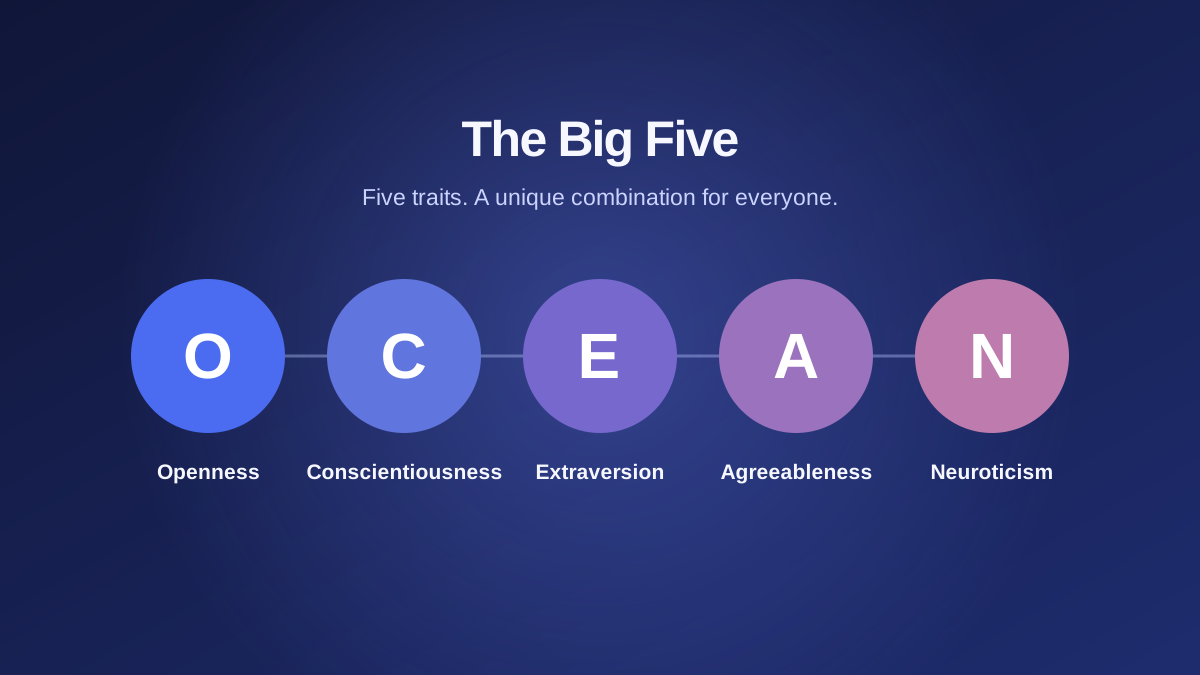
Curious whether your taste in music matches your personality? Our free test measures all five traits, openness, conscientiousness, extraversion, agreeableness and neuroticism, along with six facets for each trait.
Take the free Big Five personality test and see where you score on openness to experience.
Sources
- Greenberg, D. M., Kosinski, M., Stillwell, D. J., Monteiro, B. L., Levitin, D. J., & Rentfrow, P. J. (2016). The song is you: Preferences for musical attribute dimensions reflect personality. Social Psychological and Personality Science, 7(6), 597–605. doi:10.1177/1948550616641473
- Nave, G., Minxha, J., Greenberg, D. M., Kosinski, M., Stillwell, D., & Rentfrow, J. (2018). Musical preferences predict personality: Evidence from active listening and Facebook likes. Psychological Science, 29(7), 1145–1158. doi:10.1177/0956797618761659
- Rentfrow, P. J., & Gosling, S. D. (2003). The do re mi's of everyday life: The structure and personality correlates of music preferences. Journal of Personality and Social Psychology, 84(6), 1236–1256. doi:10.1037/0022-3514.84.6.1236
- Rentfrow, P. J., Goldberg, L. R., & Levitin, D. J. (2011). The structure of musical preferences: A five-factor model. Journal of Personality and Social Psychology, 100(6), 1139–1157. doi:10.1037/a0022406
- Schäfer, T., & Mehlhorn, C. (2017). Can personality traits predict musical style preferences? A meta-analysis. Personality and Individual Differences, 116, 265–273. doi:10.1016/j.paid.2017.04.061
- Setti, F., & Kahn, J. H. (2024). Evaluating how facets of openness to experience predict music preference. Musicae Scientiae, 28(1), 143–158. doi:10.1177/10298649231174751