Big Five SLOAN Explained: What Your Five-Letter Personality Code Means
Decode your SLOAN personality code, see how it connects to the Big Five, and learn why scores near the middle matter more than a type label.
Acest articol nu a fost tradus încă și este afișat în engleză.
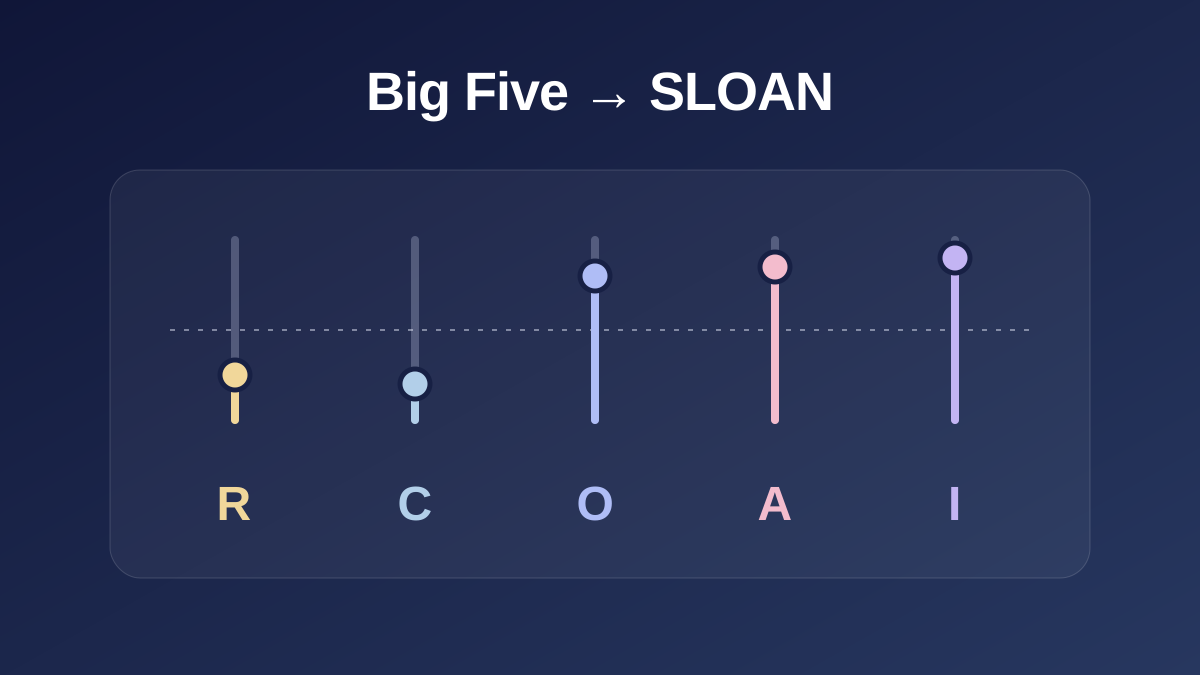
You have taken a personality test and found a code like RCOAI. It looks a little like an MBTI type, but has five letters. What does it actually tell you?
SLOAN is a shorthand for a personality profile based on the Big Five. It turns five dimensions into a compact code. That makes a profile easier to remember and discuss, but the code leaves out how far you lean in each direction. Two people with the same letters can still have quite different scores.
On this site, your Big Five result includes a small, expandable SLOAN section in every supported language. It is an approximate code derived from your IPIP answers, not the result of a separate Global Five questionnaire. No extra questions are needed.
What do the SLOAN letters mean?
SLOAN is the notation used by SimilarMinds for its Global Five adaptation of the Big Five. Read the positions from left to right:
| Position | Related Big Five trait | Above the midpoint in our approximation | Below the midpoint |
|---|---|---|---|
| 1 | Extraversion | S — Social | R — Reserved |
| 2 | Neuroticism | L — Limbic | C — Calm |
| 3 | Conscientiousness | O — Organized | U — Unstructured |
| 4 | Agreeableness | A — Accommodating | E — Egocentric |
| 5 | Openness | I — Inquisitive | N — Non-curious |
These are the original labels from the SimilarMinds explanation of SLOAN. The two choices in each of five positions give 32 possible letter combinations. That is a way of dividing up profiles, not evidence that humanity comes in 32 separate kinds.
The labels need some care. Here we describe L as emotionally reactive, E as more self-oriented, and N as preferring the familiar. They are brief descriptions of a direction on a scale. An E is not a verdict on your character, and an N is not an intelligence score.
Also notice the order: E, N, C, A, O in Big Five terms. The C in a SLOAN code means Calm, not conscientiousness; the N means Non-curious, not neuroticism. Reading the letters as OCEAN initials will give you the wrong interpretation.
How to read a code: three examples
RCOAI combines reserved, calm, organised, accommodating and inquisitive tendencies. Imagine someone who prefers a quiet evening, likes planning a project, and enjoys exploring an unfamiliar subject. The code suggests directions to explore; it does not establish that this person behaves that way in every situation.
SLUAI combines social, emotionally reactive, less structured, accommodating and inquisitive tendencies. Compared with the first example, the differences concern sociability, emotional reactions and structure. Both codes retain the same final two letters.
RCOAN differs from RCOAI only in the final position: the openness score falls on the other side of the dividing line. Without the actual scores, you cannot tell whether the difference is large or tiny.
For that reason, the useful follow-up is always: what are the scores behind these letters?
Why 49% and 51% should not define two different people
Suppose two people score 49% and 51% on our extraversion answer scale. A rule that divides scores at 50% puts one on the R side and the other on the S side. Yet they are only two percentage points apart.
Now compare someone at 51% with someone at 90%. Both get S under that rule, even though their scores are much further apart. The letter preserves the side of the boundary and loses the distance from it.
This is why we keep your full five-trait profile as the main result. The individual facets add further detail: a broad extraversion score, for example, can bring together different levels of sociability and assertiveness. Research on the IPIP-NEO-120 examines these five domains and 30 facets, rather than treating a five-letter code as the measurement itself.
How we calculate your approximate SLOAN code
Our rule is deliberately transparent:
- We use the five domain scores from your completed 120- or 300-question IPIP-NEO test, after reverse scoring the relevant answers.
- Each domain is compared with an average answer score of 3 on the 1–5 scale, equivalent to 50% on our answer-scale display. Above and below that midpoint select the letters shown in the table.
- An exact midpoint gets x, meaning that we do not choose either direction. We borrow this midpoint notation from SLOAN+, but do not implement the full SLOAN+ system.
- Scores from 45% through 55%, calculated before rounding, are marked near the midpoint. This is our display convention, not a statistical confidence interval or a validated cutoff.
For example, an extraversion score exactly at the midpoint might produce xCOAI. The other four positions can still be read normally.
These percentages are not population percentiles. A score of 50% does not mean that you are more extraverted than half the population. The separate percentile comparison answers that different question. Changing the age or sex comparison group therefore does not change your SLOAN code.
The validation study for the IPIP-NEO-120 supports that questionnaire's measurement properties. It does not validate our conversion into SLOAN letters. Different questionnaires and dividing rules may give you a different code.
Is SLOAN the same as OCEAN or MBTI?
OCEAN names the five Big Five traits. It is not a personal type code: everyone receives a score on each of those dimensions. SLOAN is a way of summarising directions on related dimensions with letters. The Global Five labels and measures are not identical to the IPIP-NEO domains, so the correspondence is approximate.
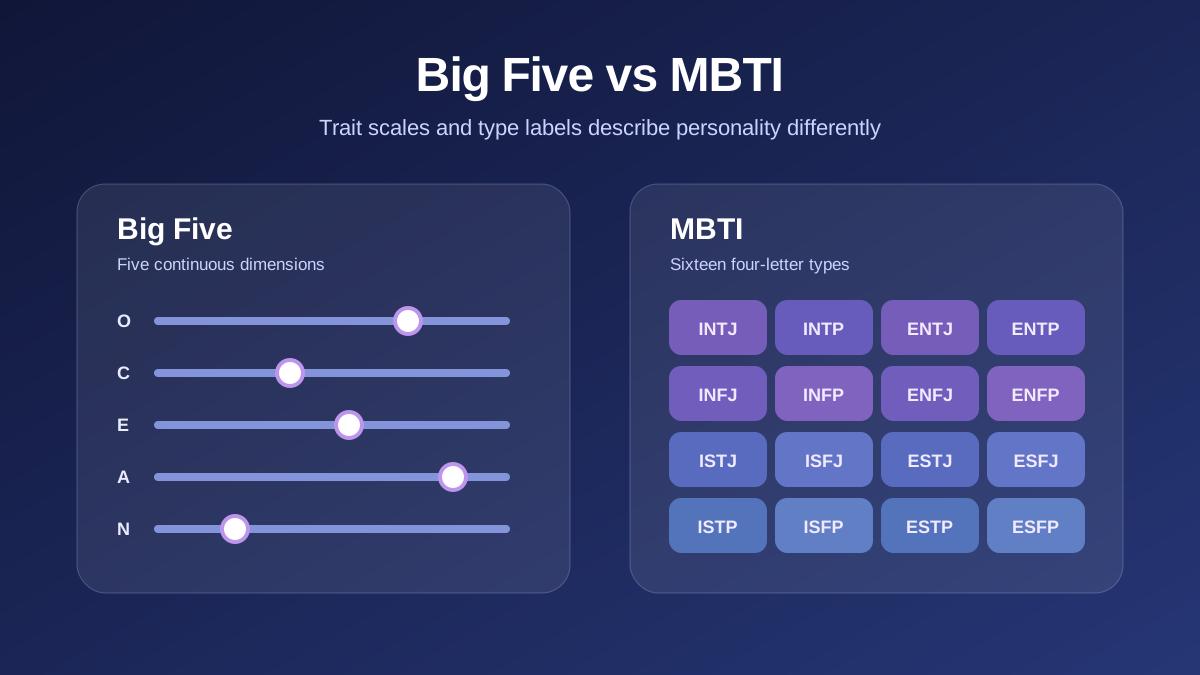
MBTI uses another framework and four-letter codes. You should not translate a SLOAN code directly into an MBTI type. Our Big Five vs MBTI comparison explains what the two approaches measure and what is lost when continuous scores become categories.
Find your code, then look beyond it
Take the free Big Five test, then open the SLOAN row beneath the five scores. Each letter has a short explanation, and positions close to the dividing line are marked.
Use the code as a conversation starter: “Does this description fit me, and in which situations?” When a letter seems too simple, open the corresponding trait and read its facets. The interesting part is often the detail that five letters cannot hold.
Source: the SLOAN notation and its letter labels come from SimilarMinds' Global Five; see their explanation of SLOAN.