Adventurousness: why do some people crave change while others love routine?
Same breakfast every day, or something new every week? What the adventurousness facet means, what research says about novelty and routine, and how it is measured.

Some people order the same dish every time they go to their favourite restaurant. Why risk a disappointment when you know what you like?
Others look at the menu, find the one dish they have never heard of, and order that. Just to see.
The same pattern shows up in bigger things: holidays, jobs, homes, the way home from work. Some people thrive on the familiar. Others get restless as soon as life becomes too predictable.
In the Big Five model, this is described by the facet adventurousness. It is one of six facets of openness to experience, and it is about how much a person seeks out new activities, places and ways of doing things, rather than sticking with what they know.
What does adventurousness mean?
The word "adventurous" may make you think of mountain climbing and backpacking in the jungle. The facet is broader and more everyday than that. It is about your attitude to variety and change in general.
People who score high often recognise themselves in this:
- You prefer variety to routine.
- You like trying new food, new places and new ways of doing things.
- Change feels more exciting than threatening.
- You may take a different route home just because it is different.
- Doing things "the way we always have" is not a good argument in itself for you.
Adventurousness is not mainly about danger or adrenaline. A person can score high without ever wanting to go skydiving.
The key is not how much risk you take, but how much you are drawn to the new rather than the familiar.
Why the familiar feels good
To understand adventurousness, it helps to start with the opposite: why so many of us like what we already know.
In 1968, the psychologist Robert Zajonc published a series of studies on what he called the mere exposure effect. He showed that repeated exposure to something, such as unfamiliar words or symbols, was enough to make people rate it more positively. Nothing else needed to happen. Familiarity alone increased liking.
This is a general tendency, not a personality trait. But it explains why routines feel safe and pleasant for most of us, and why it takes a certain pull to keep choosing the unfamiliar. People who score high on adventurousness seem to feel that pull more strongly.
Variety can lift your mood
If familiarity feels good, can variety also feel good? A study from 2020 suggests it can.
Researchers used geolocation to track where participants went, and regularly asked them how they felt. On days when people visited a greater variety of places, they reported more positive emotions.
The effect was stronger in people whose brains showed tighter coupling between the hippocampus, which is involved in memory and new experiences, and the striatum, which is part of the reward system.
The study did not measure personality. But it suggests that new experiences can be rewarding for the brain, and that people differ in how much they get out of them. That fits with the idea behind this facet.
Who goes abroad, and does it change them?
A German study from 2013 followed more than 1,100 university students over an academic year. Some went abroad for one or two semesters, while others stayed at home.
Before they left, the students who chose a full year abroad were already higher in openness and extraversion. In other words, the more open seek out new experiences.
But the journey also changed them. Students who went abroad increased more in openness and agreeableness, and decreased more in neuroticism, than those who stayed at home, even after taking into account who chose to go. Much of the change was explained by the new international relationships they formed.
This illustrates something important: adventurousness both shapes which experiences you seek out, and is shaped by them in return.
Adventurousness is not the same as excitement-seeking
This is the most common mix-up for this facet.
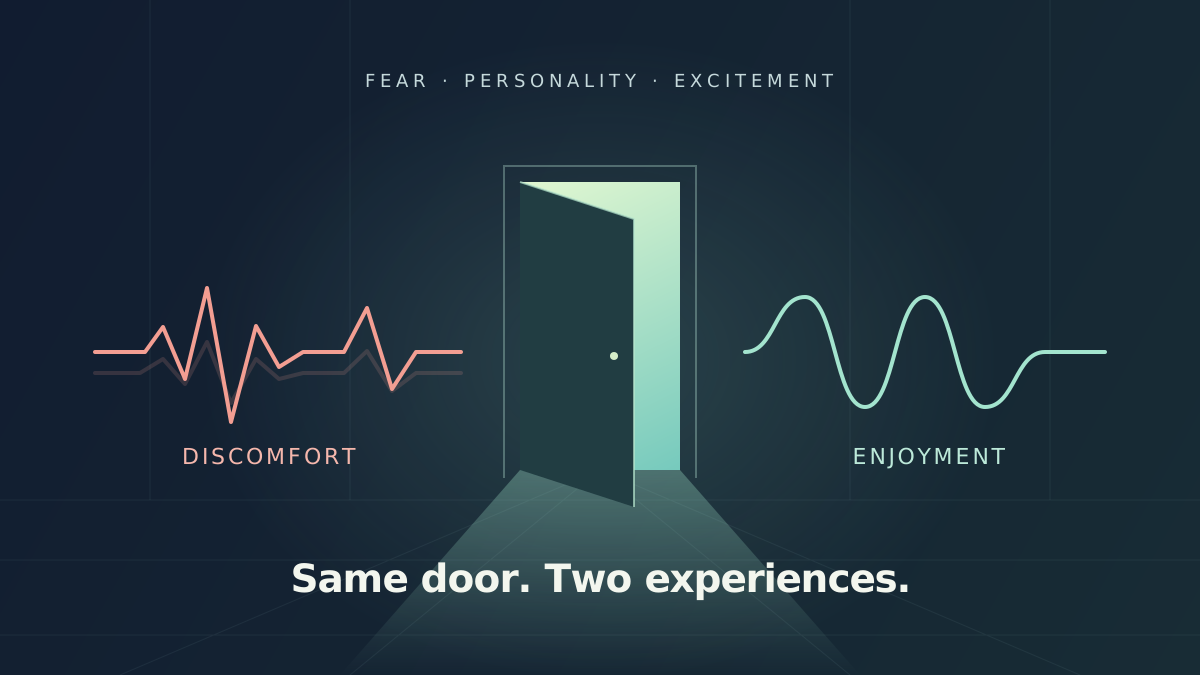
Excitement-seeking is a facet of extraversion. It is about craving stimulation, noise and adrenaline: roller coasters, loud parties, risky sports.
Adventurousness, on the other hand, is about novelty and variety. It does not need to be loud or dangerous. Trying a new cuisine, learning a strange language or rearranging your daily routine can be just as satisfying.
Imagine two people on holiday. One wants to try bungee jumping because it gives a rush. The other wants to go to a small village where no tourists go, to see how people live there. The first is excitement-seeking, the second is adventurousness. Many people have both, but they are different drives.
If you are curious about the thrill side, read why some people love being scared.
What does a high or low score mean?
High adventurousness
You get energy from novelty and variety. You are quick to try new things and often see change as an opportunity. You may be good at adapting when circumstances change.
The downside can be that routine work feels dull, that you lose interest once something becomes predictable, or that you change course before you have given something a real chance.
Low adventurousness
You value the familiar and predictable. You like knowing what to expect, and you are happy to stick with what works. Change may feel uncomfortable, especially when it comes suddenly.
This is often a strength. Low scorers can be stable, loyal and reliable, and good at building on what already works rather than starting over.
Both descriptions are about typical tendencies, not rules that hold in every situation.
In everyday life
- At work: High scorers often thrive with varied tasks, new projects and reorganisations that others find tiring. Low scorers often do well in roles where stability and consistent quality matter.
- In relationships: A couple where one wants a new holiday destination every year and the other wants to go back to the same cabin is a classic. Taking turns, or combining the familiar with a little novelty, often works.
- When things change: Low scorers often handle change better when they get time to prepare and understand why it is happening.
- In leisure time: High scorers often collect new experiences, such as hobbies, food and places. Low scorers often find deep satisfaction in getting better at a few things over time.
Can adventurousness change?
Personality is fairly stable, but not fixed. A large meta-analysis from 2006 found that openness to experience on average increases in adolescence and decreases in old age.
The study of students abroad also shows that major new experiences can push openness upwards. You do not need to move to another country to benefit from this, but the principle is the same: small doses of novelty can make the new feel less threatening.
- Change one small habit at a time, such as a new route, a new recipe or a new place for lunch.
- If you score high: pick a few routines worth keeping, so variety does not come at the expense of stability.
- If you score low: give yourself time to get used to change, and look for what stays the same.
- Remember that familiarity grows by itself. What feels foreign the first time often feels better the third.
Frequently asked questions
Do adventurous people travel more?
Often, yes. Research on students shows that those with higher openness are more likely to choose a long stay abroad. But travel is only one expression. Adventurousness can just as well show up in food, hobbies or new ideas at work.
Is low adventurousness the same as being boring?
No. Low scorers often appreciate depth, stability and tradition, which many others value highly. A familiar routine can be a source of security and joy.
Is adventurousness linked to political views?
Not directly. Adventurousness is about everyday preferences for variety. Attitudes to authority and tradition in society are measured by another facet, liberalism.
How is adventurousness measured in the Big Five test?
Our test is based on the IPIP-NEO-120, where each facet is measured with four statements. For adventurousness, they are about preferring variety to routine, and, scored in reverse, preferring to stick with what you know, disliking change and holding on to conventional ways of doing things. Read the score as a sign of a pattern, not as a complete description of you.
Find out where you score
Adventurousness is only one of the six facets of openness to experience. You can score high here and still be low on artistic interests or imagination.
Take the Big Five test and see your whole profile, with all 30 facets.
Sources
- Zajonc, R. B. (1968). Attitudinal effects of mere exposure. Journal of Personality and Social Psychology, 9(2, Pt. 2), 1–27.
- Heller, A. S., Shi, T. C., Ezie, C. E. C., Reneau, T. R., Baez, L. M., Gibbons, C. J. & Hartley, C. A. (2020). Association between real-world experiential diversity and positive affect relates to hippocampal–striatal functional connectivity. Nature Neuroscience, 23(7), 800–804.
- Zimmermann, J. & Neyer, F. J. (2013). Do we become a different person when hitting the road? Personality development of sojourners. Journal of Personality and Social Psychology, 105(3), 515–530.
- Roberts, B. W., Walton, K. E. & Viechtbauer, W. (2006). Patterns of mean-level change in personality traits across the life course: A meta-analysis of longitudinal studies. Psychological Bulletin, 132(1), 1–25.
- Johnson, J. A. (2014). Measuring thirty facets of the Five Factor Model with a 120-item public domain inventory: Development of the IPIP-NEO-120. Journal of Research in Personality, 51, 78–89.