Excitement-seeking: why do some people need adrenaline?
Some people book a skydive, others get dizzy on a stepladder. What excitement-seeking means, what research says about thrill-seekers and how it is measured.

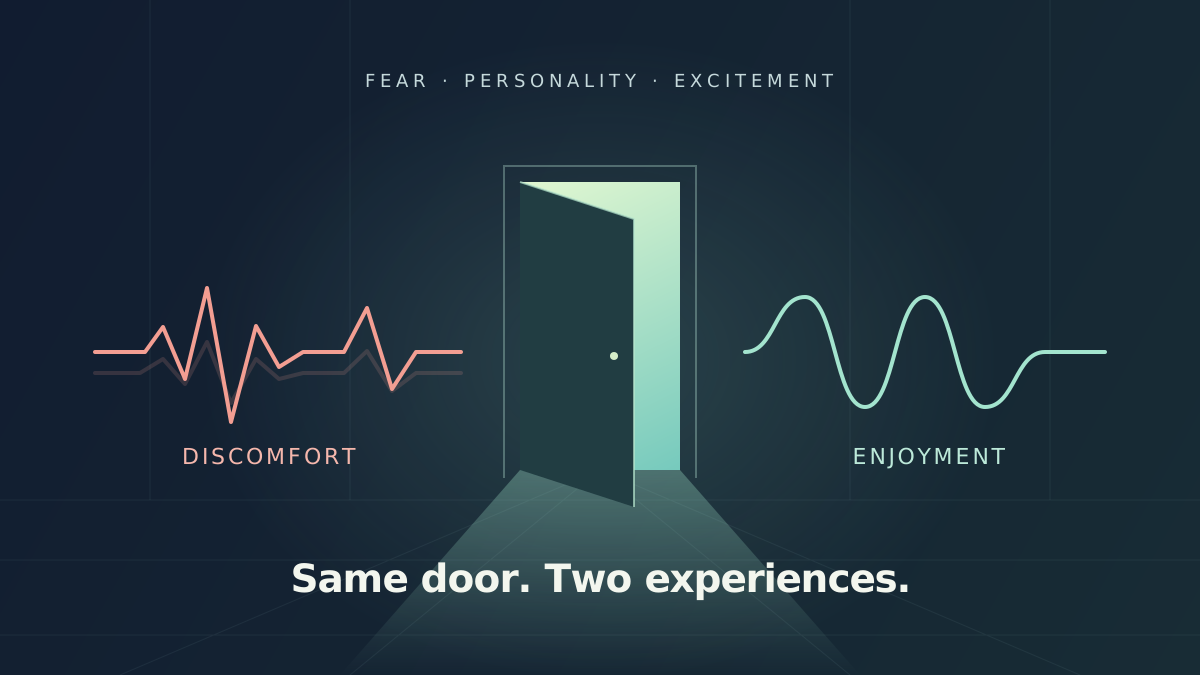
Two friends are standing at the top of the tallest roller coaster in the amusement park. One is grinning and wants to go again before the ride is even over. The other has his eyes closed and is counting the seconds until it ends.
Later the same year, the first one books a skydiving course. The second is happy with a walk in the forest.
Why do some people seek out exactly the things that make others' hearts race in the wrong way?
Part of the explanation lies in what psychologists call excitement-seeking. In the Big Five model, it is one of six facets of extraversion. The facet describes how much you need stimulation, thrills and intensity to feel that life is interesting.
What does excitement-seeking mean?
In personality psychology, excitement-seeking describes a need for strong sensations and a tendency to get bored when things are calm. Researchers often use a closely related concept, sensation seeking, which has been studied for decades.
People who score high often recognise themselves in this:
- You love excitement and get bored easily without it.
- You seek out adventure and new thrills.
- You sometimes take chances without thinking it through.
- You can let go completely and act wild and crazy.
- Loud music, crowds and fast-paced settings feel energising rather than stressful.
People who score low prefer calm and predictability. Noise, commotion and risk feel unpleasant rather than exciting. That does not mean they are boring. They simply get enough stimulation from a quieter life.
The key is not courage, but how much intensity you need before life feels exciting.
Thrill-seekers take more risks in many areas
Does a love of excitement show up only in extreme sports? Research suggests it is broader.
In a study of 260 university students, researchers looked at risk-taking in six areas: smoking, drinking, drugs, sex, driving and gambling. They combined these into a measure of general risk-taking across all six areas. General risk-taking was linked to impulsive sensation seeking, aggression and sociability, but not to neuroticism or to the questionnaire's scale for activity.
The same article reviewed biological research on sensation seeking, including links to a dopamine receptor gene and to the enzyme monoamine oxidase. The authors also pointed to similar behaviour in other animals.
This does not mean thrill-seeking is fixed by genes. But it suggests that the need for excitement has roots that go deeper than upbringing and habits.
BASE jumpers are not who you think
When people imagine extreme athletes, many picture reckless daredevils. A study of BASE jumpers, people who parachute from bridges, cliffs and buildings, gives a more nuanced picture.
Researchers measured the personality of 98 jumpers the day before a jump from a bridge, and measured stress hormones in saliva before and after the jump. As a group, the jumpers were highly resilient, self-directed, persistent and willing to take risks.
But they were not all the same. The researchers identified three types: experienced jumpers with a strong sense of mastery, trusting and cooperative jumpers who showed little stress-hormone response and had social support before the jump, and courageous jumpers who jumped despite anxiety and little experience.
The study used a different personality questionnaire than the Big Five. But it shows that a love of excitement does not have to mean poor judgement. Many thrill-seekers prepare carefully and are very much in control.
If you are the one hiding behind the cushion during a horror film, you might enjoy our article on why some people love being scared.
Thrill-seeking peaks in adolescence
Many parents notice that teenagers suddenly seem to crave risk. Research supports that impression.
A study of 935 people aged 10 to 30 measured sensation seeking and impulsivity separately, using both questionnaires and behavioural tasks. Sensation seeking increased between ages 10 and 15 and then declined or levelled off. Impulsivity, on the other hand, declined steadily from age 10.
The researchers suggested that the combination of a strong urge for excitement and still-developing self-control may explain why risk-taking is so common in the mid-teens.
Excitement-seeking is not the same as impulsivity
This is an important distinction, and the study above shows why.
Excitement-seeking is about what you are drawn to: intensity, novelty and thrills. Impulsivity is about how well you can stop yourself. In the Big Five, giving in to cravings and urges is captured by the facet immoderation, under neuroticism.
You can love excitement and still plan carefully, like many of the BASE jumpers. And you can be impulsive without seeking thrills, for example by eating, shopping or scrolling more than you intended.
Excitement-seeking is also different from adventurousness, a facet of openness. Adventurousness is about preferring variety and new experiences, such as trying new food or travelling to unfamiliar places. Excitement-seeking is about intensity. You can love exploring new cultures and still have no wish to jump out of a plane.
What does a high or low score mean?
High excitement-seeking
You enjoy intensity, speed and adventure. You get bored easily in calm periods and often seek out new experiences that get your pulse up.
The flip side can be that you take risks that are hard to undo, for example with money, alcohol, driving or your health.
Low excitement-seeking
You prefer calm, predictable settings and do not need thrills to enjoy life. Loud environments and risky activities feel uncomfortable rather than fun.
That can make you a stable and safe person to rely on. The risk is mainly that you miss out on experiences you would actually have enjoyed.
Both descriptions are about typical tendencies, not rules that hold in every situation.
In everyday life
- At work: High scorers often thrive in jobs with variety, pace and some risk. Low scorers often prefer stable roles with clear routines.
- In relationships: One partner may want spontaneous trips and new adventures, while the other values routines and security. Alternating between the two can work well.
- With money: High scorers may be drawn to gambling or risky investments. It can help to set limits in advance, before the excitement takes over.
- In traffic: Speed can be a tempting outlet for thrill-seeking. A track day or a sport is a safer place to get a similar rush.
Can excitement-seeking change?
Yes, and it changes noticeably with age.
In a large long-term study of adults, measured with the questionnaire our test's facets are modelled on, excitement-seeking declined most in early adulthood. By age 30, it had already fallen considerably from its peak in adolescence.
That does not mean you need to suppress your need for excitement. But you can steer it in a safer direction:
- Find activities that give intensity with control, such as climbing, martial arts or team sports.
- Decide on your limits for money, alcohol and speed before you are in the situation.
- Notice when boredom drives you towards risks you would not otherwise take.
- If you score low, try a small step outside your comfort zone now and then. It can be more fun than expected.
If risk-taking leads to problems with gambling, alcohol, drugs or dangerous behaviour, it can be wise to talk to your doctor or a psychologist. A Big Five score is not a diagnosis, but it can help you understand what drives you.
Frequently asked questions
Are people high in excitement-seeking more likely to have accidents?
They take more risks on average, so the chance of something going wrong is higher. But many thrill-seekers are careful and well prepared. Risk-seeking and recklessness are not the same thing.
Can I be introverted and still love excitement?
Yes. You can prefer small groups and quiet evenings, yet still love fast skiing, horror films or travelling alone in remote places. The six facets of extraversion do not always go together.
Is thrill-seeking a sign of ADHD or addiction?
Not in itself. Excitement-seeking is a normal personality difference. ADHD and addiction are clinical conditions that require a professional assessment and cannot be diagnosed with a personality test.
How is excitement-seeking measured in the Big Five test?
Our test is based on the IPIP-NEO-120, where each facet is measured with four statements. For excitement-seeking, they are about loving excitement, seeking adventure, enjoying being reckless and acting wild and crazy. Read the score as a sign of a pattern, not as a complete description of you.
Find out where you score
Excitement-seeking is only one of the six facets of extraversion. You can love adrenaline and still be quiet in groups, or avoid risk and still be the life of the party.
Take the Big Five test and see your whole profile, with all 30 facets.
Sources
- Zuckerman, M. & Kuhlman, D. M. (2000). Personality and risk-taking: Common biosocial factors. Journal of Personality, 68(6), 999–1029.
- Monasterio, E., Mei-Dan, O., Hackney, A. C., Lane, A. R., Zwir, I., Rozsa, S. & Cloninger, C. R. (2016). Stress reactivity and personality in extreme sport athletes: The psychobiology of BASE jumpers. Physiology & Behavior, 167, 289–297.
- Steinberg, L., Albert, D., Cauffman, E., Banich, M., Graham, S. & Woolard, J. (2008). Age differences in sensation seeking and impulsivity as indexed by behavior and self-report: Evidence for a dual systems model. Developmental Psychology, 44(6), 1764–1778.
- Terracciano, A., McCrae, R. R., Brant, L. J. & Costa, P. T. (2005). Hierarchical linear modeling analyses of the NEO-PI-R scales in the Baltimore Longitudinal Study of Aging. Psychology and Aging, 20(3), 493–506.
- Johnson, J. A. (2014). Measuring thirty facets of the Five Factor Model with a 120-item public domain inventory: Development of the IPIP-NEO-120. Journal of Research in Personality, 51, 78–89.