Who created the Big Five? The history of the model and the test
Who created the Big Five? No single person. Allport and Odbert, Cattell, Tupes and Christal, Goldberg, Costa and McCrae built it over 60 years. Timeline and sources.

Bài viết này chưa được dịch và đang hiển thị bằng tiếng Anh.

The Big Five personality model was not created by one person. It took shape over six decades of research. Gordon Allport and Henry Odbert catalogued the trait words of the English language in 1936. Raymond Cattell reduced them to 16 factors in the 1940s. Ernest Tupes and Raymond Christal found five recurring factors in 1961, Warren Norman confirmed them in 1963, and Lewis Goldberg gave them the name Big Five in 1981. Paul Costa and Robert McCrae built the NEO questionnaires between 1985 and 1992 that made the model the standard in research. The test on this site, the IPIP-NEO-120, was developed by John A. Johnson and published in 2014.
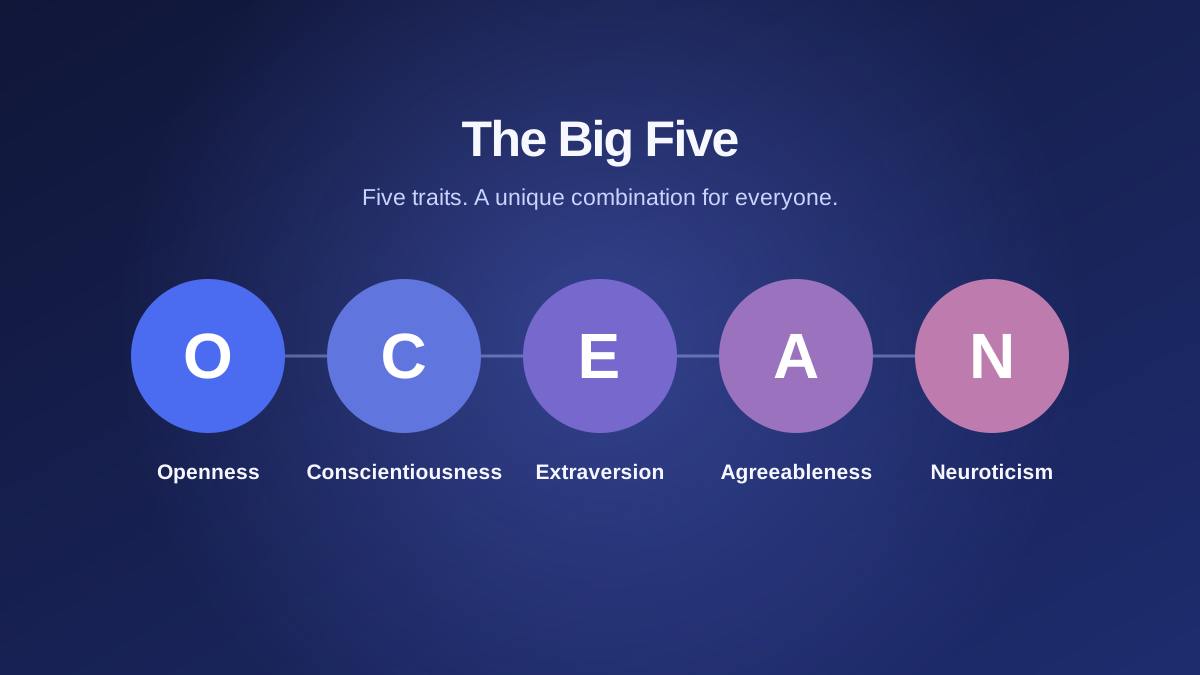
The five dimensions are remembered by the acronym OCEAN:
(E) Extraversion
(A) Agreeableness
(N) Neuroticism
Who created the Big Five? A timeline
- 1936: Gordon Allport and Henry Odbert list about 18,000 words that describe people, of which roughly 4,500 name stable traits.
- 1940s: Raymond Cattell uses factor analysis to condense the list to 16 personality factors.
- 1961: Ernest Tupes and Raymond Christal, working for the US Air Force, reanalyse Cattell's rating data and find five broad factors that recur in every sample.
- 1963: Warren Norman replicates the five factors and proposes names for them.
- 1981: Lewis Goldberg calls the factors the "Big Five" and argues that any list of trait words will produce them.
- 1985 to 1992: Paul Costa and Robert McCrae publish the NEO Personality Inventory and its revision, the NEO PI-R, which divides each factor into six facets.
- 1999: Goldberg starts the International Personality Item Pool (IPIP), a public-domain library of questions anyone can use.
- 2014: John A. Johnson publishes the IPIP-NEO-120, the questionnaire this site uses.
From Freud to the lexical hypothesis
Since Sigmund Freud launched his personality model around 1900, psychologists have tried to describe personality systematically rather than through case studies. The breakthrough came from an idea called the lexical hypothesis: if a difference between people matters, language will have developed a word for it. Count the words, sort them into groups, and the groups should reveal the basic dimensions of personality.
Allport and Odbert put that idea to work in 1936. They went through an unabridged dictionary and pulled out about 18,000 person-describing terms, then sorted them into categories. About 4,500 described stable traits rather than moods, judgements or physical features. The list was far too long to be a model, but it was raw material.
Cattell and the 16 factors
Raymond Cattell took Allport and Odbert's list and reduced it, first by hand to 171 clusters and then with factor analysis, a statistical method that finds which ratings rise and fall together. Working with the computing power of the 1940s, he arrived at 16 factors and built a questionnaire around them, the 16PF. Later researchers could not reproduce all 16 factors, but Cattell's rating data turned out to hold a simpler structure.
Tupes and Christal: five factors
In 1961, Ernest Tupes and Raymond Christal of the US Air Force reanalysed eight sets of ratings, including Cattell's, to see which structure held up across samples. Five broad factors appeared every time. Their report was published as a technical note and went largely unnoticed for years; it was reprinted in the Journal of Personality in 1992, by which time the result had been rediscovered several times over.
Norman, Goldberg and the name "Big Five"
Warren Norman replicated the five factors in 1963 and gave them the labels that are still roughly in use: extroversion, agreeableness, conscientiousness, emotional stability and culture. In the late 1970s and 1980s, Lewis Goldberg returned to the lexical approach with new word lists and new samples and found the same five factors again. In 1981 he called them the Big Five, "big" because each is broad and contains many narrower traits, not because there are only five things to say about a person. Goldberg's 1990 paper is the classic demonstration that the structure survives different word lists and methods.
Costa and McCrae: the NEO questionnaires and the 30 facets
Paul Costa and Robert McCrae came to the same five factors from a different direction, questionnaires rather than word lists. Their NEO Personality Inventory of 1985 measured three of the factors; the 1992 revision, the NEO PI-R, measured all five and split each into six facets, 30 in all. That facet structure is what most Big Five tests use today, including the one here. Costa and McCrae called their version the five-factor model, a name that is now used interchangeably with Big Five.
Who created the test used on this site?
The questions come from the International Personality Item Pool, which Goldberg started in 1999 so that researchers would have personality measures in the public domain instead of behind commercial licences. In 2014, John A. Johnson, Professor Emeritus of Psychology at the Pennsylvania State University, published the IPIP-NEO-120: 120 statements, four for each of the 30 facets, chosen to track the NEO PI-R as closely as possible. His 2014 paper describes the inventory and the data behind it. That is the test you take on bigfive-test.com.
So the short answer to "who created the Big Five test?" has two parts: the model is the work of many researchers over sixty years, and the questionnaire used here is Johnson's. For a practical explanation of all five dimensions, see our guide to the Big Five personality traits.
What the scores mean
Each trait runs between two poles, for example curious versus cautious for openness, and contains six narrower facets such as imagination, adventurousness and intellect. You rate how accurately each statement describes you, from very inaccurate to very accurate.
On this site, the report shows two numbers for every trait. The percentage is your position on the answer scale. The percentile below it compares you with more than 400,000 people who answered the same questions, in a comparison group you choose by sex and age. Most people land somewhere between the poles on most traits, and a single score never tells the whole story of a person. See how the scoring works.
Strengths and limits
Compared with interviews or projective methods, a Big Five questionnaire gives a concise and well-researched picture of a personality in about ten minutes. It is still a self-report: people can shade their answers toward what they think looks good, and answers vary a little with mood.
Since the 1990s the Big Five has become the most used framework in personality research, and trait measures turn up in education and workplaces too. Their usefulness depends on the questionnaire and the purpose. No personality score should be treated as a verdict on someone's suitability for a job. The model also has known limits: it describes broad tendencies, not the whole of a person, and it does not explain where the differences come from (John & Srivastava, 1999).
Frequently asked questions
When was the Big Five developed?
The five factors were first found in 1961 by Tupes and Christal, confirmed in 1963 by Norman, named in 1981 by Goldberg and turned into the standard questionnaire by Costa and McCrae in 1992. If you need one date, 1961 is when the five-factor structure was first reported.
Who coined the term "Big Five"?
Lewis Goldberg, in a 1981 chapter on the language of personality. He meant "big" as in broad: each factor gathers many narrower traits.
Is the Big Five the same as the five-factor model?
In everyday use, yes. Strictly, "Big Five" comes from Goldberg's lexical research on trait words, and "five-factor model" from Costa and McCrae's questionnaire research. The two lines of work found the same five dimensions, and the names are now used for both.
Who made the Big Five test on this site?
John A. Johnson, who developed the IPIP-NEO-120 and published it in 2014. The questions are in the public domain through the International Personality Item Pool.
Sources
- Allport, G. W., & Odbert, H. S. (1936). Trait-names: A psycho-lexical study. Psychological Monographs, 47(1).
- Cattell, R. B. (1957). Personality and motivation structure and measurement. World Book.
- Tupes, E. C., & Christal, R. E. (1992). Recurrent personality factors based on trait ratings. Journal of Personality, 60(2), 225–251. (Original work published 1961.)
- Norman, W. T. (1963). Toward an adequate taxonomy of personality attributes. Journal of Abnormal and Social Psychology, 66(6), 574–583.
- Goldberg, L. R. (1990). An alternative "description of personality": The Big-Five factor structure. Journal of Personality and Social Psychology, 59(6), 1216–1229.
- Goldberg, L. R. (1993). The structure of phenotypic personality traits. American Psychologist, 48(1), 26–34.
- McCrae, R. R., & John, O. P. (1992). An introduction to the five-factor model and its applications. Journal of Personality, 60(2), 175–215.
- John, O. P., & Srivastava, S. (1999). The Big Five trait taxonomy: History, measurement, and theoretical perspectives.
- Johnson, J. A. (2014). Measuring thirty facets of the Five Factor Model with a 120-item public domain inventory: Development of the IPIP-NEO-120. Journal of Research in Personality, 51, 78–89.
- International Personality Item Pool: Finding scales to measure particular constructs.