The Big Five personality traits (OCEAN), explained
The five Big Five traits (OCEAN) and their 30 facets, where the model comes from, how it is measured, and what high and low scores say about you.
Aquest article encara no s’ha traduït i es mostra en anglès.
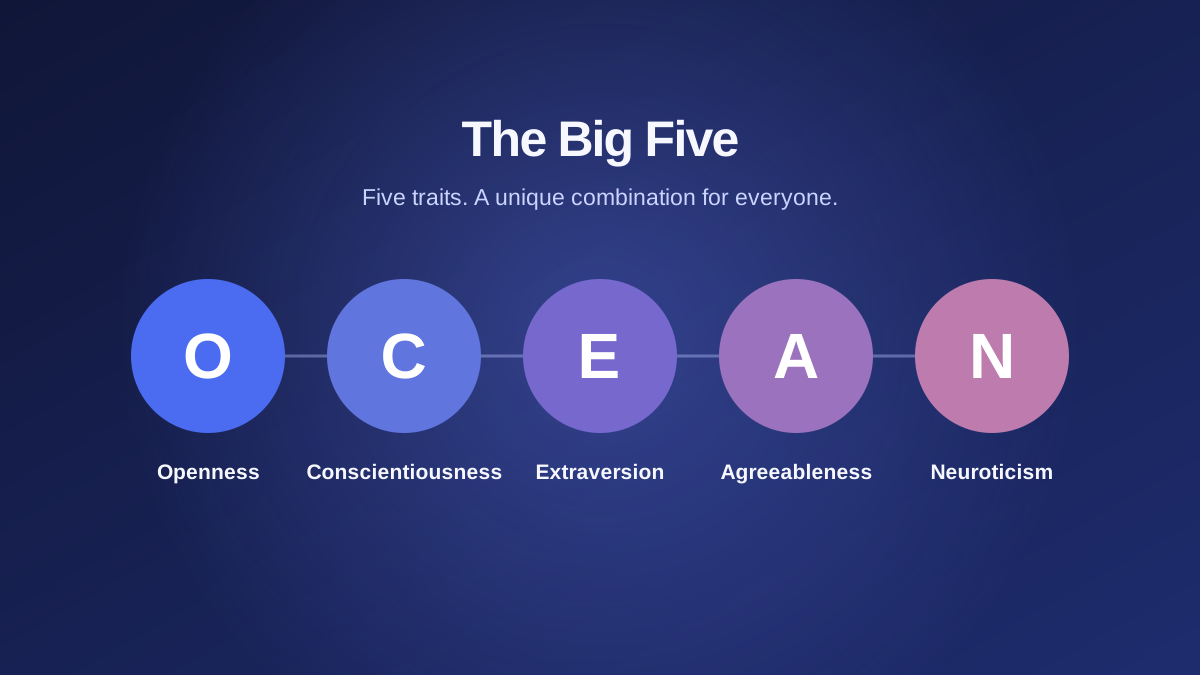
The Big Five personality traits are five broad dimensions that describe how people differ in their usual ways of thinking, feeling and behaving: openness to experience, conscientiousness, extraversion, agreeableness and neuroticism. Their initials spell OCEAN. Everyone has a position on all five. A Big Five result is a set of scores on a continuum, not a personality type.
The model is also called the five-factor model. It is the most researched and most widely used description of personality in psychology, and it emerged from the words people use to describe each other rather than from one researcher's theory. A score can help explain why you often react a certain way; it cannot tell your whole story or dictate what you will do next. For the research behind the model, see John and Srivastava's overview of the Big Five trait taxonomy.
| Trait | Higher scores often involve | Lower scores often involve |
|---|---|---|
| Openness | Curiosity, imagination, interest in new ideas | Preference for the familiar, concrete and practical |
| Conscientiousness | Planning, persistence, attention to commitments | Flexibility, spontaneity, less reliance on plans |
| Extraversion | Social energy, assertiveness, seeking stimulation | Reserve, quieter settings, more time alone |
| Agreeableness | Cooperation, trust, concern for others | Skepticism, bluntness, willingness to challenge |
| Neuroticism | Stronger or more frequent reactions to stress | Greater calm under pressure, emotional steadiness |
These are not rankings of good and bad. A trait is useful in some situations and costly in others. The interesting question is not “Which score should I want?” but “What does this tendency help me do, and where does it get in my way?”
Where the Big Five comes from
The Big Five grew out of the lexical hypothesis: if a difference between people matters, language will have a word for it. In 1936, Gordon Allport and Henry Odbert pulled about 18,000 such words from an English dictionary. Raymond Cattell boiled them down to 16 factors in the 1940s. When Ernest Tupes and Raymond Christal reanalysed Cattell's data in 1961, five broad factors kept appearing, and Warren Norman confirmed them in 1963.
Lewis Goldberg gave the five factors their name, the “Big Five”, in 1981. In the 1980s and 1990s, Paul Costa and Robert McCrae built the NEO Personality Inventory, which split each trait into six narrower facets and made the model the standard in research. Goldberg then started the International Personality Item Pool (IPIP), an open library of questions anyone can use, and in 2014 John A. Johnson published the IPIP-NEO-120, the 120-statement questionnaire this site uses. Read the full history of the Big Five test.
1. Openness: how much you want to explore
Openness to experience is about your appetite for ideas, imagination, art and unfamiliar experiences. Someone high in openness might spend a weekend learning a new instrument or happily argue about an abstract question over dinner. Someone lower might choose the restaurant they already know, trust a method that works, and prefer a clear answer to an open-ended debate.
Neither style is a measure of intelligence. Openness describes what tends to attract your attention, not how clever you are. Its six facets are imagination, artistic interests, emotionality, adventurousness, intellect and liberalism, and someone can be imaginative without being especially drawn to new activities. Read more about openness and its facets.
2. Conscientiousness: how you handle plans and follow-through
Conscientiousness covers organization, self-discipline and persistence. High scorers are more likely to make a plan, keep track of details and finish what they start. Lower scorers may work in bursts, adapt as they go, or find strict routines stifling.
Picture two capable colleagues facing the same deadline. One starts early and works through a checklist; the other produces their best work in a late sprint. The first may be reliable but rigid. The second may be adaptable but easier to derail. A score describes a usual pattern, not effort, talent, or what someone can achieve when the stakes change. The facets are self-efficacy, orderliness, dutifulness, achievement-striving, self-discipline and cautiousness. Explore conscientiousness in more detail.
3. Extraversion: where your social energy tends to go
Extraversion includes sociability, assertiveness and enjoyment of stimulation. A high scorer may come alive in a lively room, think out loud and be quick to start a conversation. A lower scorer may prefer a quiet evening, a one-to-one conversation, or time to think before speaking.
This is not a test of social skill. A reserved person can be warm, funny and confident; an outgoing person can still need solitude. The useful distinction is often how much stimulation feels energizing versus draining. The facets are friendliness, gregariousness, assertiveness, activity level, excitement-seeking and cheerfulness. Learn more about extraversion.
4. Agreeableness: how you balance cooperation and challenge
Agreeableness describes tendencies around trust, cooperation and consideration. Higher scorers often look for common ground and give people the benefit of the doubt. Lower scorers are more inclined to question a claim, negotiate hard, or say plainly when they disagree.
At work, the agreeable person may keep a team from turning every decision into a fight. The more skeptical person may catch a weak assumption everyone else accepted. Either style can help; either can go too far. Agreeableness is not a kindness score, and a lower score does not mean someone is cruel. The facets are trust, morality, altruism, cooperation, modesty and sympathy. See the different aspects of agreeableness.
5. Neuroticism: how strongly stress tends to register
Neuroticism reflects a tendency to experience worry, frustration, sadness or other difficult emotions more readily. A higher scorer may spot risks early and feel uncertainty intensely. A lower scorer is more likely to stay even-tempered when plans unravel. The opposite pole is often called emotional stability.
Sensitivity can make problems harder to set aside, but it can also make warning signs hard to miss. Calm can help in a crisis, but it does not guarantee that a person notices every risk. Neuroticism is a personality dimension, not a mental-health diagnosis. The facets are anxiety, anger, depression, self-consciousness, immoderation and vulnerability. Read the full guide to neuroticism.
Why the Big Five uses scores, not personality types
Each trait is a dimension. You can land high on one, low on another, and somewhere in the middle on the rest. Two people who both call themselves introverts might differ sharply in curiosity, organization, or willingness to challenge others. Five scores preserve that combination; one type label throws much of it away.
That is one important difference from the Myers–Briggs Type Indicator (MBTI), which sorts preferences into categories. Research has found that the sharp either/or divisions are difficult to support, even though some MBTI scales overlap with Big Five traits. Compare Big Five and MBTI, read about MBTI's limitations, see how the Enneagram holds up, or read McCrae and Costa's original comparison.
Curious about your own profile? Take the free Enneagram test and explore your scores across all nine types.
How the Big Five is measured
Big Five questionnaires ask you to rate statements such as “I make plans and stick to them” on a scale from very inaccurate to very accurate. The reference instrument in research is Costa and McCrae's NEO PI-R with 240 items; shorter forms include the Big Five Inventory (44 items) and the open IPIP-NEO with 120 or 300 items. About half of the statements are reversed, so that agreeing always with “very accurate” does not inflate a score.
This site's test uses the IPIP-NEO-120: 120 statements, four for each of the 30 facets. The result shows two numbers for every trait. The percentage is your position on the answer scale, where 0% means you answered “very inaccurate” to everything. The percentile is the share of other test takers who scored lower than you, drawn from more than 400,000 people who answered the same questions, with a comparison group you choose by sex and age. Averages below 2.5 out of 5 count as low, above 3.5 as high, and everything in between as average. See how the scoring works, or take the 300-statement version for a more precise profile.
Two related models are worth knowing. HEXACO adds a sixth trait, honesty-humility, and shifts some content between agreeableness and neuroticism. The Big Five Aspect Scales split each of the five traits into two aspects, such as industriousness and orderliness within conscientiousness.
Does personality change? Age, sex and culture
Personality is fairly stable from one year to the next and still changes across a life. A meta-analysis of 92 longitudinal studies found that people tend to become more conscientious, more agreeable and less neurotic from young adulthood into middle age, a pattern often called the maturity principle (Roberts, Walton and Viechtbauer, 2006). People who set out to change a trait can move a little in the direction they choose, slowly (Hudson and Fraley, 2015). See how the Big Five changes with age.
On average, women score somewhat higher than men on neuroticism and agreeableness, with large overlap between the groups (Costa, Terracciano and McCrae, 2001). Twin studies put the heritability of the Big Five at roughly 40 percent (Vukasović and Bratko, 2015); the rest comes from experience. Countries differ too, but less than people within any country differ from each other. See what our own data show about the Big Five by age and sex and the Big Five by country.
What the Big Five predicts
The traits predict real outcomes, modestly. Conscientiousness is the trait most consistently linked to job performance across occupations (Barrick and Mount, 1991) and to grades, health behaviour and longevity. Neuroticism is linked to lower well-being and to anxiety and mood problems. Extraversion goes with positive emotions and with being noticed as a leader; agreeableness with relationship quality and teamwork; openness with creativity and with liberal political attitudes. All of these are tendencies over many situations, not predictions about one person on one day. Read more about personality and job performance.
How to read your Big Five results
Look at the combination before fixating on a single high or low score. A person might be highly outgoing but cautious about new ideas; another might be quiet, curious and extremely organized. The combination is more revealing than a headline such as “introvert” or “creative type.”
Then look at the facets, the narrower components beneath each broad trait. A middle score on extraversion, for example, can hide high assertiveness alongside low excitement-seeking. Facets help explain why two people with similar top-line scores can behave differently.
Treat the result as a useful snapshot, not a verdict. It does not diagnose a condition or predict a particular choice, and your answers can shift a little with mood and life situation. If something looks wrong, retake the test when you are rested and answer for how you usually are, not how you were this week.
Frequently asked questions
Is the Big Five the same as OCEAN?
Yes. OCEAN is a mnemonic for the five traits: openness, conscientiousness, extraversion, agreeableness and neuroticism. Some textbooks use CANOE, the same letters in a different order. The five-factor model, FFM, is the name used in research.
What is the difference between the Big Five and MBTI?
The Big Five measures five continuous traits; the MBTI sorts people into 16 types from four either/or choices. The Big Five has the stronger scientific record: its scores are more stable when people retest, and they predict outcomes such as job performance better. Read the full comparison.
Which Big Five test is the most accurate?
Longer questionnaires are more reliable because each facet is measured by more statements. The NEO PI-R is the reference instrument but is commercial. The open IPIP-NEO correlates strongly with it: 120 statements give a solid profile in about ten minutes, and the 300-statement version is more precise for the facets.
Is there a best Big Five profile?
No. Every position on every trait has advantages and costs, and what counts as a good fit depends on the situation. Research does find that conscientiousness and emotional stability are linked to good outcomes across many settings, but a team or a family benefits from a mix of profiles.
Can I change my Big Five scores?
Slowly, yes. Traits drift with age, usually toward more conscientiousness and emotional stability, and deliberate effort moves them a little further. Habits, roles and relationships change faster than traits do, and that is often where the practical gains are.
Take the Big Five personality test
Take the free Big Five personality test to see your profile across all five traits and 30 facets. It uses 120 statements and takes about ten minutes. The result gives you something more useful than a label: a pattern you can compare with how you actually think, work and relate to other people.
Sources
- John, O. P., & Srivastava, S. (1999). The Big Five trait taxonomy: History, measurement, and theoretical perspectives.
- Johnson, J. A. (2014). Measuring thirty facets of the Five Factor Model with a 120-item public domain inventory: Development of the IPIP-NEO-120.
- McCrae, R. R., & Costa, P. T. (1989). Reinterpreting the Myers-Briggs Type Indicator from the perspective of the five-factor model of personality.
- Roberts, B. W., Walton, K. E., & Viechtbauer, W. (2006). Patterns of mean-level change in personality traits across the life course.
- Hudson, N. W., & Fraley, R. C. (2015). Volitional personality trait change: Can people choose to change their personality traits?
- Costa, P. T., Terracciano, A., & McCrae, R. R. (2001). Gender differences in personality traits across cultures.
- Vukasović, T., & Bratko, D. (2015). Heritability of personality: A meta-analysis of behavior genetic studies.
- Barrick, M. R., & Mount, M. K. (1991). The Big Five personality dimensions and job performance: A meta-analysis.