הפרופיל שלכם
 אלכס
מבחן האישיות Big Five
האישיות שלכם בחמש התכונות הגדולות וב-30 היבטים: פתיחות לחוויות, מצפוניות, מוחצנות, נעימות ונוירוטיות. אחר כך השוו את עצמכם לחברים ולבני הזוג.
קבלו תמונה רבת־גוונים של איך אתם חושבים, מרגישים ופועלים, והשוו את עצמכם עם בן/בת הזוג, המשפחה או הקולגות. המבחן בנוי על IPIP-NEO, מודל המחקר הפתוח שמאחורי חמש הגדולות. חינם, ללא הרשמה.
מאמין שאני יותר טוב מאחרים
מרמה לפעמים כדי להתקדם
מאמין שאין "נכון" ו"לא נכון" אבסולוטיים (מוחלטים)
נהנה ממאבק טוב
מאמין שצריך להיות תקיפים מאוד במלחמה בפשע
עוקף את הכללים
חמש תכונות. תמונה אחת שלמה.
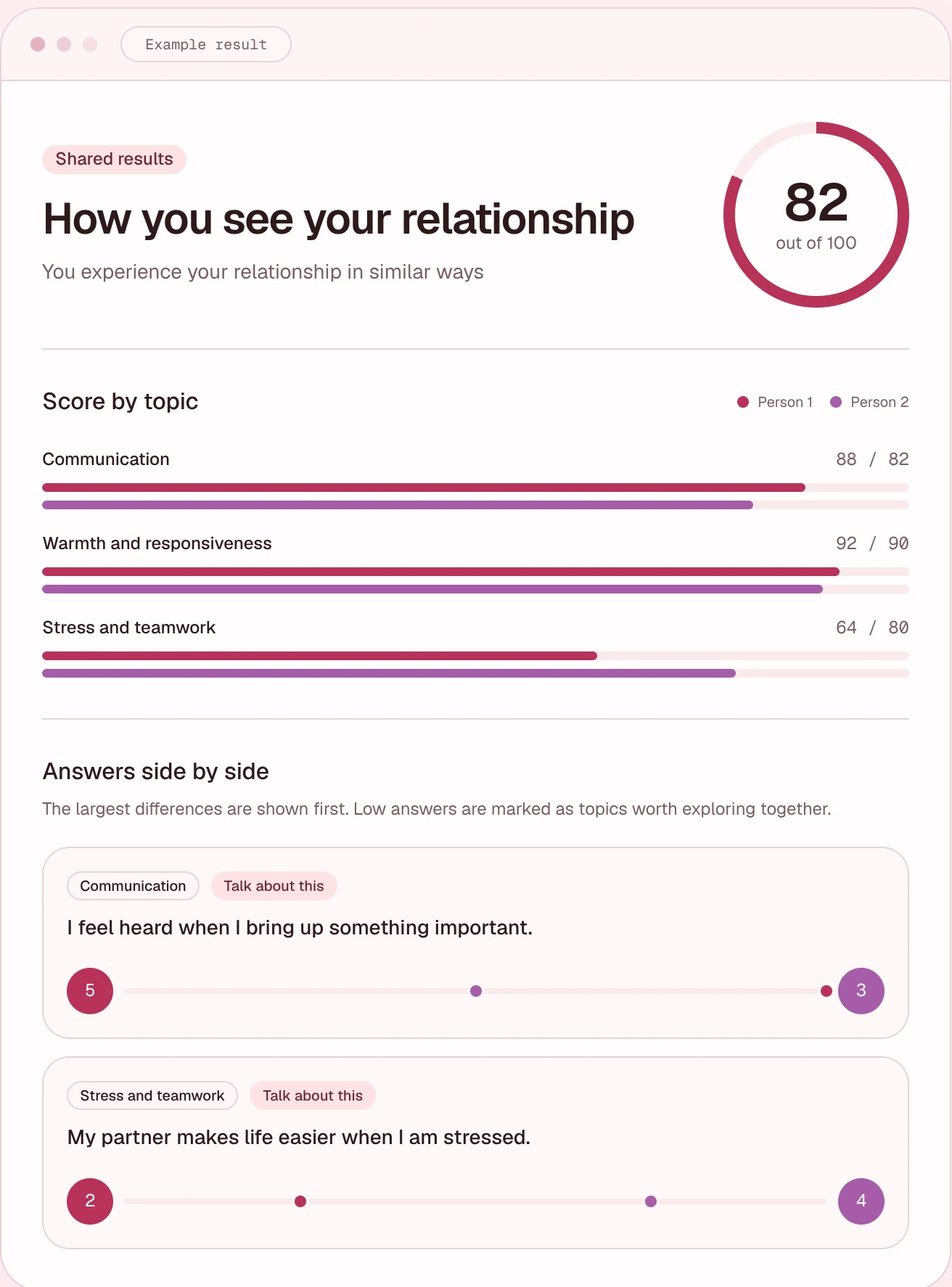
בן/בת הזוג, המשפחה, חברים או קולגות. אחרי ששניכם עשיתם את המבחן, תראו דמיון והבדלים זה לצד זה, עם נושאים קונקרטיים לשיחה.
התחילו עם הפרופיל הפרטי שלכם.
האדם השני עונה באופן עצמאי.
התוצאה מדגישה גם דמיון וגם הבדלים.
3נושאי שיחה ברורים
התייחסו להבדל כהזמנה לסקרנות, לא כגזר דין.
Pair Perspective הוא מבחן הזוגיות שלנו. ענו על 57 שאלות בנפרד, ואז חקרו את החוזקות המשותפות שלכם ואת ההבדלים ששווה לדבר עליהם.
חמש הגדולות מתארות את האישיות על פני חמישה ממדים בלתי תלויים. אף פרופיל אינו טוב יותר מאחר – הוא פשוט משקף חוזקות, צרכים ונטיות שונים.
מצאו את הדפוס שלכםסדר, משמעת עצמית ואיך אתם פועלים להשגת מטרות.
אתם מחפשים לעיתים קרובות נקודות מבט חדשות ונהנים מרעיונות שמאתגרים את המוכר.
התחילו בסקירה ברורה, ואז חקרו כל תכונת אישיות ומה הציונים שלכם עשויים לומר על חיי היומיום.
הפרופיל שלכם מתאר נטיות, לא אבחנה ולא תשובה סופית לשאלה מי אתם.
אישיות, חוזקות, תחומי עניין מקצועיים ועוד. תקבלו את התוצאה מיד.
לכל 53 המבחניםהאישיות שלכם בחמש התכונות הגדולות וב-30 היבטים: פתיחות לחוויות, מצפוניות, מוחצנות, נעימות ונוירוטיות. אחר כך השוו את עצמכם לחברים ולבני הזוג.
Explore nine personality types and the patterns you recognize in yourself. A free full profile for self-reflection.
Explore six sides of love, from chemistry and friendship to care. Get a personal profile and something to talk about.
How satisfied are you in your relationship? 32 questions and about five minutes, using a scale researchers and couples therapists use.
Is jealousy a feeling, a habit of checking, or a fear of losing someone? 16 statements, with a score on three sides.
A three-minute test of six broad traits: the Big Five plus honesty-humility. A quick overview; take the full Big Five test for facets and more detail.
אתם מופנמים, מוחצנים או איפשהו באמצע? 24 היגדים, עם המיקום שלכם וציון בשישה היבטים.
ה-IPIP-NEO-300 המלא עם 300 שאלות. הוא לוקח יותר זמן, אבל מספק פרופיל מדויק יותר של חמש התכונות ושל כל 30 ההיבטים.
Each Big Five trait split in two: compassion and politeness, industriousness and orderliness, and more. 100 public-domain statements give you ten aspects.
Six broad traits instead of five: the HEXACO model adds honesty-humility to the Big Five picture. 240 public-domain statements give you 24 facets.
Raymond Cattell's classic model with 16 factors, from warmth and dominance to vigilance and perfectionism. 163 public-domain statements give you a profile between opposite poles.
בעיות מילוליות, צורניות ומספריות ב־15 דקות, מתוך מבחן שפורסם בידי פסיכולוגים בכתב העת Intelligence. מראה את יכולת החשיבה הלוגית שלכם בשלושה תחומים. זה לא מבחן IQ.
Find your signature strengths among the 24 character strengths in Peterson and Seligman's classification, from curiosity and kindness to bravery and humor.
Find out which of eight interest areas suit you best, from leadership and creativity to analysis and practical work, and which occupations match your profile.
Which of Holland's six interest types fit you: Realistic, Investigative, Artistic, Social, Enterprising or Conventional? Get your three-letter code and matching careers, with the O*NET Interest Profiler used in career guidance across the United States.
What do you need from a job to be happy in it: results, freedom, recognition, good colleagues, a supportive employer or good conditions? Get your six work values ranked, with careers that offer most of what you value.
Your profile across seven components of emotional intelligence: noticing your feelings, showing joy and distress, empathy, being moved by others, and how much feelings guide your decisions.
How strongly do you feel with others, and how much do you show it? 17 statements, with a score on two sides of empathy.
How quickly do you catch fire, and does it reach other people? 27 statements, with a score on four sides of anger.
Is work taking over your life, or do you just work hard? 16 statements, with a score and what drives it.
Do you demand perfection, or do you just care about details? 16 statements, with a score and what lies behind it.
How strongly do you react to rewards and to risks? Four scales on drive, fun seeking, reward responsiveness and caution, based on Gray's model of the brain's approach and avoidance systems.
Do you believe your life is steered by your own choices, by powerful others, or by chance? Three scales from Levenson's classic model, with your orientation explained.
Ten statements on how you value yourself and your abilities, based on Rosenberg's classic self-esteem scale. Quick, with a short explanation of your score.
Do you tend to see possibilities or difficulties? Ten statements about your outlook on life, with an explanation of your optimism score.
How satisfied are you with your life as a whole? Five statements and one minute, using one of the most widely used scales in happiness research.
A checklist of five kinds of everyday habits linked with good mental health: enjoyment, thinking habits, goals, routines and connection. With ideas for small steps.
The Short Dark Tetrad (SD4) measures four socially aversive traits found in everyone to some degree: Machiavellianism, narcissism, psychopathy and sadism.
Four sides of narcissism: the urge to lead, the need for attention, a sense of entitlement and a willingness to exploit others. Based on public-domain research scales.
How bold, how mean and how impulsive are you compared with others? Nine traits grouped into the three sides of psychopathy in Patrick's triarchic model. Measures normal variation, not a diagnosis.
שאלון הסינון בן שש השאלות מתוך סולם הדיווח העצמי של ארגון הבריאות העולמי ל-ADHD במבוגרים (ASRS v1.1). מראה אם התשובות שלכם תואמות תסמינים של ADHD במבוגרים. לא אבחנה.
Ten questions about how you have felt over the past 30 days, from the Kessler scale used in national health surveys. Shows your level of psychological distress. Not a diagnosis.
Seven questions about worry and nervousness over the past two weeks, from the most widely used anxiety questionnaire. Shows how much the symptoms bother you. Not a diagnosis.
Yes-or-no questions about sudden anxiety attacks and their symptoms, from the Patient Health Questionnaire. Shows whether your answers fit the pattern of panic disorder. Not a diagnosis.
Fourteen questions about fear of vomiting: worry, avoidance, checking and nausea over the past week. Shows whether your answers suggest emetophobia. Not a diagnosis.
Nine questions about mood, sleep, energy and self-worth over the past two weeks, from the most widely used depression questionnaire. Shows how much the symptoms bother you. Not a diagnosis.
Fifteen questions about pain, dizziness, stomach problems, tiredness and sleep, from the Patient Health Questionnaire. Shows how much physical symptoms weigh on you. Not a diagnosis.
Ten questions about falling asleep, waking up, daytime energy and worrying about sleep. Shows whether your sleep problems may be insomnia. Not a diagnosis.
Yes-or-no questions about binge eating and ways of avoiding weight gain, from the Patient Health Questionnaire. Screens for bulimia and binge eating disorder. Not a diagnosis.
Twenty questions about how much memories, avoidance, mood and tension after a very stressful experience have bothered you in the past month. Not a diagnosis.
Eighteen questions from the ICD-11 trauma questionnaire. Shows whether your answers match the pattern for PTSD or complex PTSD, with its effects on emotions, self-image and relationships. Not a diagnosis.
22 questions on grief reactions after the death of someone close, scored against ICD-11 and DSM-5-TR prolonged grief disorder. Not a diagnosis.
Questions on stressful life changes, worry and coping, based on ICD-11 adjustment disorder. Shows whether a strain has become hard to adapt to. Not a diagnosis.
Twelve statements about checking, washing, order, numbers and unwanted thoughts, showing how well typical obsessive-compulsive symptoms fit you. Not a diagnosis.
Questions on worry about your appearance, checking, hiding and avoiding, from David Veale's scales. Shows whether your answers suggest body dysmorphic disorder. Not a diagnosis.
Nineteen statements about control, cutting down and consequences of sex and porn use, based on ICD-11. Shows whether you may be at high risk of compulsive sexual behaviour disorder. Not a diagnosis.
The World Health Organization's ten questions on how much you drink, signs of dependence and harm, with your risk level.
Eight questions about how often you use cannabis, how much and how it affects you. Shows whether your use may be risky. Not a diagnosis.
Eleven questions about drug use, loss of control and harm, the drug counterpart of the AUDIT alcohol test. Shows whether your use may cause problems. Not a diagnosis.
Four questions on the WHO's features of gaming disorder: control, priority, continuing despite problems and harm. Shows whether your gaming may be a problem. Not a diagnosis.
Thirteen questions about exhaustion in daily life and at work, from the Copenhagen Burnout Inventory. Shows how worn out you are compared with others. Not a diagnosis.
Fourteen statements from a research-based screener for autism in adults. Shows whether your answers resemble those common in autism. Not a diagnosis.
Build the missing figure in a matrix. Choose 12, 22 or 36 tasks. A free pilot with a raw score.
צלילה לעומק חמש התכונות, המחקר והאופן שבו אישיות מעצבת את חיי היומיום.
לכל המאמריםFive years after two doses of psilocybin and about eleven hours of therapy, 67 % of a small group of people with depression were in remission. The bigger trials tell a more modest story. A guide to the results, the doubts, the risks and where the treatment is allowed.
Researchers gave three AI models the stories of 220 children at a psychiatry clinic. With the child's own words the AI missed most problems. With the parent's words it found one in almost everyone, including the children who had none.
A study of 5,315 people found that the classic relationship questionnaires asked many questions that told almost nothing. The scale that replaced them shows how satisfaction differs between newlyweds and long marriages, and what goes with it.
In a classic experiment, two short sentences of thanks doubled the share of people who helped again. Other studies show that we thank each other surprisingly rarely, and that we badly underestimate how much it means.
Scientists searched the DNA of more than one million people for personality and found 1,260 genetic variants. The most interesting part is how little each of them matters, and what that says about who you are.
Every dog owner knows their dog is one of a kind. For decades, scientists called that wishful thinking. Now research shows that dog personality can be measured, that it is fairly stable, and that breed explains less than you might think.
המבחן מבוסס על מודל IPIP הפתוח, חינמי לשימוש ובקוד פתוח. השיטה והשאלות שלו זמינות לעיון.
חינם · קוד פתוח · ללא הרשמה · כ-10 דקות