The Big Five Personality Traits: What OCEAN Says About You
A clear guide to the Big Five personality traits: what each one measures, how high and low scores show up, and what your results can—and can't—tell you.
Questo articolo non è ancora stato tradotto e viene mostrato in inglese.
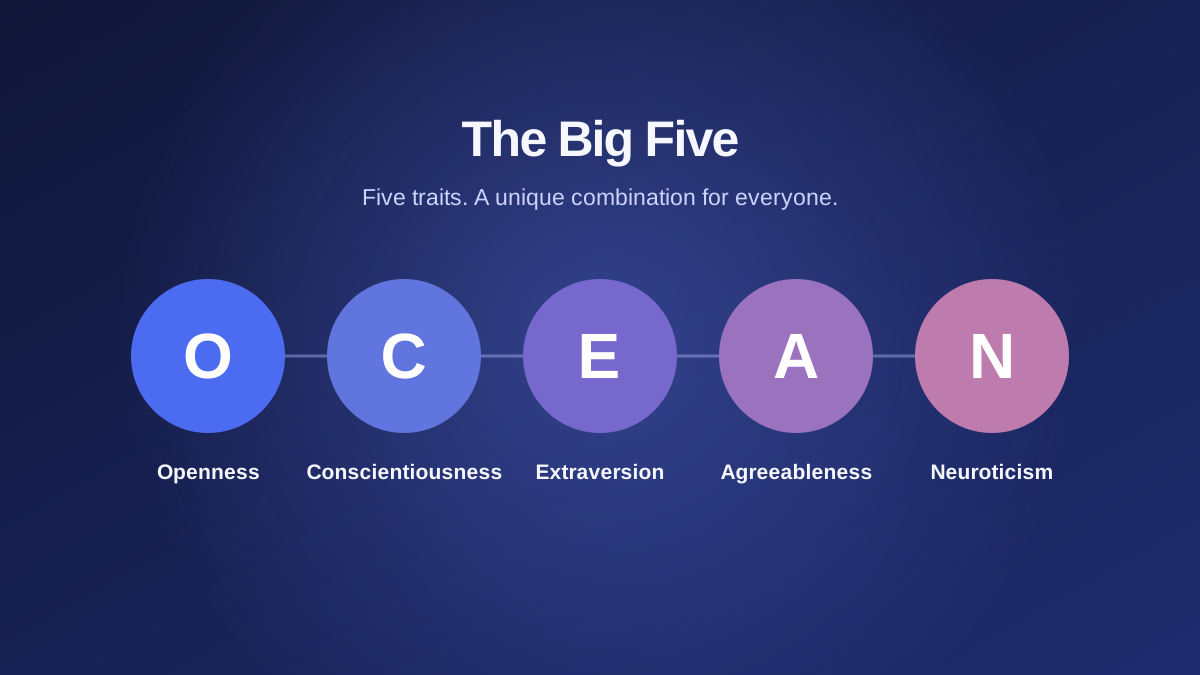
You can be the person who turns up early with a plan and still be the one who says yes to a last-minute trip. Personality is not a single label. The Big Five describes it as a pattern across five broad traits: openness, conscientiousness, extraversion, agreeableness, and neuroticism. Their initials spell OCEAN.
The model is also called the five-factor model. It is a map of recurring tendencies, not a set of boxes. A score can help explain why you often react a certain way; it cannot tell your whole story or dictate what you will do next. For the research behind the model, see John and Srivastava's overview of the Big Five trait taxonomy.
| Trait | Higher scores often involve | Lower scores often involve |
|---|---|---|
| Openness | Curiosity, imagination, interest in new ideas | Preference for the familiar, concrete and practical |
| Conscientiousness | Planning, persistence, attention to commitments | Flexibility, spontaneity, less reliance on plans |
| Extraversion | Social energy, assertiveness, seeking stimulation | Reserve, quieter settings, more time alone |
| Agreeableness | Cooperation, trust, concern for others | Skepticism, bluntness, willingness to challenge |
| Neuroticism | Stronger or more frequent reactions to stress | Greater calm under pressure, emotional steadiness |
These are not rankings of good and bad. A trait is useful in some situations and costly in others. The interesting question is not “Which score should I want?” but “What does this tendency help me do—and where does it get in my way?”
Openness: how much you want to explore
Openness to experience is about your appetite for ideas, imagination, art, and unfamiliar experiences. Someone high in openness might spend a weekend learning a new instrument or happily argue about an abstract question over dinner. Someone lower might choose the restaurant they already know, trust a method that works, and prefer a clear answer to an open-ended debate.
Neither style is a measure of intelligence. Openness describes what tends to attract your attention, not how clever you are. It also contains narrower facets: someone can be imaginative without being especially drawn to new activities, for example. Read more about openness and its facets.
Conscientiousness: how you handle plans and follow-through
Conscientiousness covers organization, self-discipline, and persistence. High scorers are more likely to make a plan, keep track of details, and finish what they start. Lower scorers may work in bursts, adapt as they go, or find strict routines stifling.
Picture two capable colleagues facing the same deadline. One starts early and works through a checklist; the other produces their best work in a late sprint. The first may be reliable but rigid. The second may be adaptable but easier to derail. A score describes a usual pattern—not effort, talent, or what someone can achieve when the stakes change. Explore conscientiousness in more detail.
Extraversion: where your social energy tends to go
Extraversion includes sociability, assertiveness, and enjoyment of stimulation. A high scorer may come alive in a lively room, think out loud, and be quick to start a conversation. A lower scorer may prefer a quiet evening, a one-to-one conversation, or time to think before speaking.
This is not a test of social skill. A reserved person can be warm, funny, and confident; an outgoing person can still need solitude. The useful distinction is often how much stimulation feels energizing versus draining. Learn more about extraversion.
Agreeableness: how you balance cooperation and challenge
Agreeableness describes tendencies around trust, cooperation, and consideration. Higher scorers often look for common ground and give people the benefit of the doubt. Lower scorers are more inclined to question a claim, negotiate hard, or say plainly when they disagree.
At work, the agreeable person may keep a team from turning every decision into a fight. The more skeptical person may catch a weak assumption everyone else accepted. Either style can help; either can go too far. Agreeableness is not a kindness score, and a lower score does not mean someone is cruel. See the different aspects of agreeableness.
Neuroticism: how strongly stress tends to register
Neuroticism reflects a tendency to experience worry, frustration, sadness, or other difficult emotions more readily. A higher scorer may spot risks early and feel uncertainty intensely. A lower scorer is more likely to stay even-tempered when plans unravel. The opposite pole is often called emotional stability.
Sensitivity can make problems harder to set aside, but it can also make warning signs hard to miss. Calm can help in a crisis, but it does not guarantee that a person notices every risk. Neuroticism is a personality dimension, not a mental-health diagnosis. Read the full guide to neuroticism.
Why the Big Five uses scores, not personality types
Each trait is a dimension. You can land high on one, low on another, and somewhere in the middle on the rest. Two people who both call themselves introverts might differ sharply in curiosity, organization, or willingness to challenge others. Five scores preserve that combination; one type label throws much of it away.
That is one important difference from the Myers–Briggs Type Indicator (MBTI), which sorts preferences into categories. Research has found that the sharp either/or divisions are difficult to support, even though some MBTI scales overlap with Big Five traits. Compare Big Five and MBTI, read about MBTI's limitations, or see McCrae and Costa's original comparison.
How to read your Big Five results
Look at the combination before fixating on a single high or low score. A person might be highly outgoing but cautious about new ideas; another might be quiet, curious, and extremely organized. The combination is more revealing than a headline such as “introvert” or “creative type.”
Then look at the facets—the narrower components beneath each broad trait. A middle score on extraversion, for example, can hide high assertiveness alongside low excitement-seeking. Facets help explain why two people with similar top-line scores can behave differently.
On this site's test, a percentage shows your position on the answer scale. It is not a percentile: 70% does not mean you scored higher than 70% of people. The report groups scores as low, average, or high using its scoring thresholds and explains all 30 facets. See how the test and scoring work.
Treat the result as a useful snapshot, not a verdict. It does not diagnose a condition or predict a particular choice. Personality has some stability, but it can also shift with age and life experience; longitudinal research has documented change across the life course.
Take the Big Five personality test
Take the free Big Five personality test to see your profile across all five traits and 30 facets. It uses 120 questions. The result gives you something more useful than a label: a pattern you can compare with how you actually think, work, and relate to other people.
Sources
- John, O. P., & Srivastava, S. The Big Five trait taxonomy: History, measurement, and theoretical perspectives.
- Johnson, J. A. (2014). Development of the IPIP-NEO-120.
- McCrae, R. R., & Costa, P. T. (1989). Reinterpreting the MBTI from the perspective of the five-factor model.
- Roberts, B. W., Walton, K. E., & Viechtbauer, W. (2006). Patterns of personality trait change across the life course.