Your Personality May Influence How Grown-Up You Feel, Study Finds
A new UK study of 714 adults found that people higher in conscientiousness and lower in neuroticism are more likely to feel like adults, regardless of age.
この記事はまだ翻訳されていないため、英語で表示しています。
Why do some people feel like fully fledged adults at 25, while others still feel like they are pretending at 40? Age, jobs, partners and children are the usual explanations. A new study suggests that personality is part of the answer too.
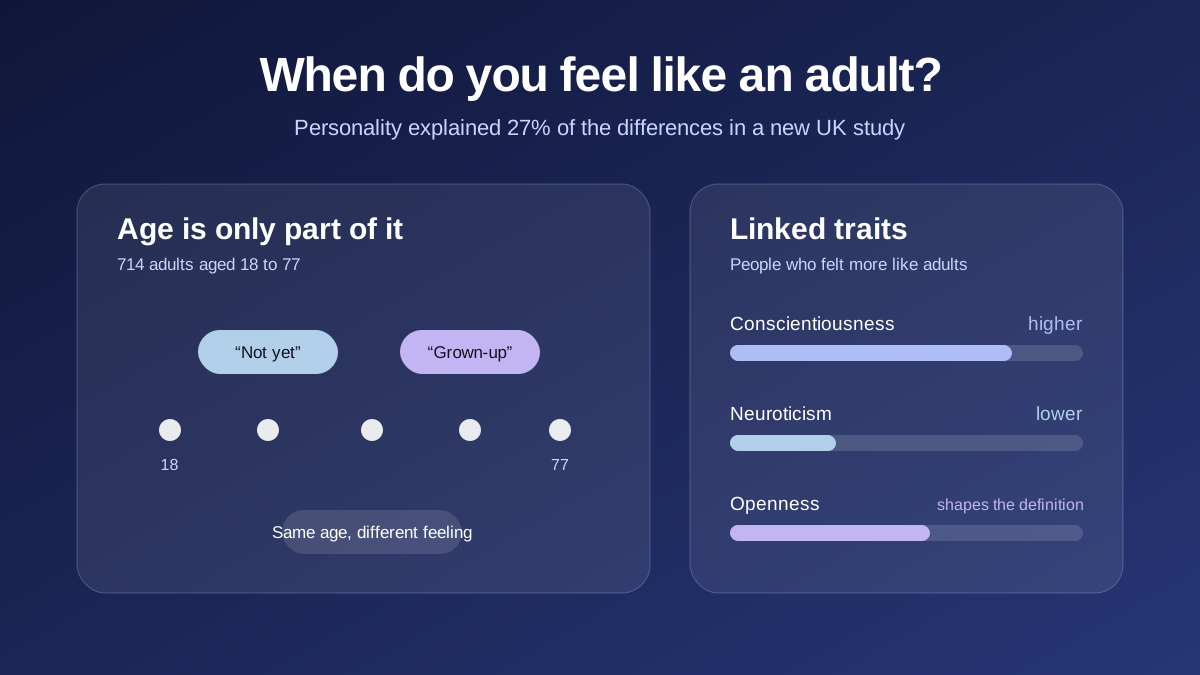
The study, published on 16 October 2026 in the Journal of Adult Development, found that people who are higher in conscientiousness and lower in neuroticism are more likely to feel like adults. Personality also seemed to shape something more subtle: what people think being an adult actually means.
Key findings
- 714 adults in the UK, aged 18 to 77 (average age 39), took part.
- Feeling like an adult was linked to lower neuroticism and higher conscientiousness.
- Personality traits on their own explained 27% of the differences in how adult people felt.
- People higher in openness put more weight on psychological maturity when defining adulthood, while people lower in openness and higher in neuroticism put more weight on traditional milestones.
- Extraversion was linked to endorsing every kind of adulthood marker.
Feeling like an adult is not the same as being one
Psychologists distinguish between objective markers of adulthood and subjective adult status. Objective markers are things you can tick off a list: turning 18, moving out, getting a full-time job, marrying or having children. Subjective adult status is simply whether you feel like an adult.
The two do not always line up. Since around 2000, researchers have described a stage called emerging adulthood, roughly the late teens through the twenties, when many people feel "in between": no longer adolescents, but not quite adults either. When asked what makes someone an adult, young people tend to name psychological qualities, such as accepting responsibility for yourself and making independent decisions, rather than marriage or a career.
The new study, by Megan Wright of the University of York, asked a different question: if age and milestones do not fully explain who feels grown-up, could personality fill in part of the gap?
Conscientiousness and emotional stability go with feeling grown-up
Participants completed a Big Five personality questionnaire, rated how much they felt like adults, and rated how important different markers are for being an adult. The analyses then tested how each trait related to these perceptions.
Two traits stood out for subjective adult status:
- Conscientiousness. People who are organised, dependable and goal-directed were more likely to feel like adults. This fits the everyday picture of adulthood as keeping commitments, planning ahead and taking care of responsibilities.
- Neuroticism. People who experience more worry, stress and negative emotion were less likely to feel like adults. One plausible reading is that feeling emotionally unsteady makes it harder to feel in control of your own life, which many people see as a core part of being grown-up.
Together, the five traits independently explained about 27% of the variation in how adult people felt. That is a sizeable share for a self-perception that people usually explain with age and life events.
Openness may shape what adulthood means to you
The study also looked at the Markers of Adulthood scale, which asks how important different criteria are for being an adult. The criteria fall into groups such as:
- Role transitions, like marriage, parenthood and a stable career
- Independence, like supporting yourself financially and living on your own
- Legal markers, like reaching the ages at which you can legally vote, drive or drink
- Relative maturity, like accepting responsibility for the consequences of your actions and being considerate of others
Here personality pointed in different directions. People higher in openness to experience, and people higher in conscientiousness, put more weight on relative maturity, the psychological side of adulthood. People lower in openness and higher in neuroticism put more weight on the more traditional markers: role transitions, independence and legal milestones.
Extraversion behaved differently again. More extraverted people rated all the markers as more important. They may simply be more engaged with the idea of adulthood, or more inclined to agree strongly with statements in general. The study cannot tell which.
What the study does not show
The findings are interesting, but they come with clear limits:
- Correlation, not causation. The study shows that traits and perceptions go together. It does not show that becoming more conscientious will make you feel more grown-up, or that feeling like an adult changes your personality.
- One point in time. Participants were surveyed once, so the study cannot show how these links develop as people age.
- One country. All participants lived in the UK. Ideas about what makes someone an adult vary between cultures.
- Self-report. Both personality and feelings about adulthood were measured with questionnaires.
Does personality change as we get older?
It does, a little, and in a direction that fits these results. A large meta-analysis of longitudinal studies by Roberts, Walton and Viechtbauer found that, on average, people become more conscientious and more emotionally stable between young adulthood and middle age. Psychologists sometimes call this the maturity principle.
The new study did not track people over time, so it cannot say whether these changes help people grow into feeling like adults. But it does suggest a link worth exploring: the traits that tend to increase with age are the same traits that go with feeling grown-up. You can read more about how traits shift across the lifespan in our article on personality change.
What this means for you
If you do not feel like an adult yet, you are in good company. The study suggests that this feeling depends partly on stable differences in personality, not only on whether you have reached certain milestones.
A few reflections:
- Feeling like an adult is not a test you pass or fail. People with different personalities experience and define adulthood differently.
- Milestones are not the only measure. If you are high in openness, psychological maturity may matter more to you than a mortgage or a wedding.
- Worry can make you feel less in control. If you score high on neuroticism, that may colour how settled you feel, even when your life looks stable from the outside.
What are your Big Five traits?
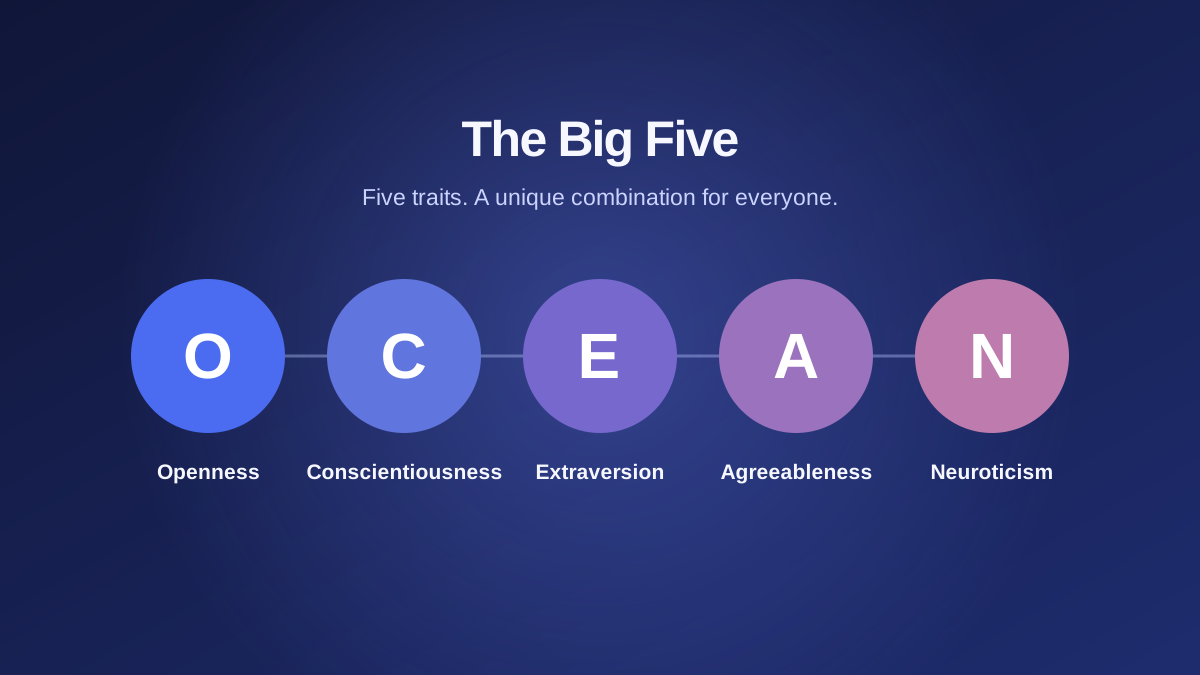
The traits in this study are the same five that our free personality test measures: conscientiousness, neuroticism, openness to experience, extraversion and agreeableness. Your result shows where you fall on each trait and on its six facets, so you can see which parts of your personality might shape how grown-up you feel.
Take the free Big Five personality test to explore your own profile.
Sources
- Wright, M. (2026). Big Five personality traits and subjective perceptions of adulthood. Journal of Adult Development. doi:10.1007/s10804-026-09581-x
- Arnett, J. J. (2000). Emerging adulthood: A theory of development from the late teens through the twenties. American Psychologist, 55(5), 469–480. doi:10.1037/0003-066X.55.5.469
- Roberts, B. W., Walton, K. E., & Viechtbauer, W. (2006). Patterns of mean-level change in personality traits across the life course: A meta-analysis of longitudinal studies. Psychological Bulletin, 132(1), 1–25. doi:10.1037/0033-2909.132.1.1