Profili yt
 Alex
Përgjigju 120 pohimeve
Zgjidh opsionin që të përshkruan më mirë. Nuk ka përgjigje të sakta ose të gabuara.
Merr një pamje të nuancuar të mënyrës si mendon, ndien dhe vepron, dhe krahasohu me partnerin, familjen ose kolegët. Testi bazohet në IPIP-NEO, modelin e hapur kërkimor që qëndron pas Big Five. Falas, pa regjistrim.
Besoj se jam më i mirë se të tjerët
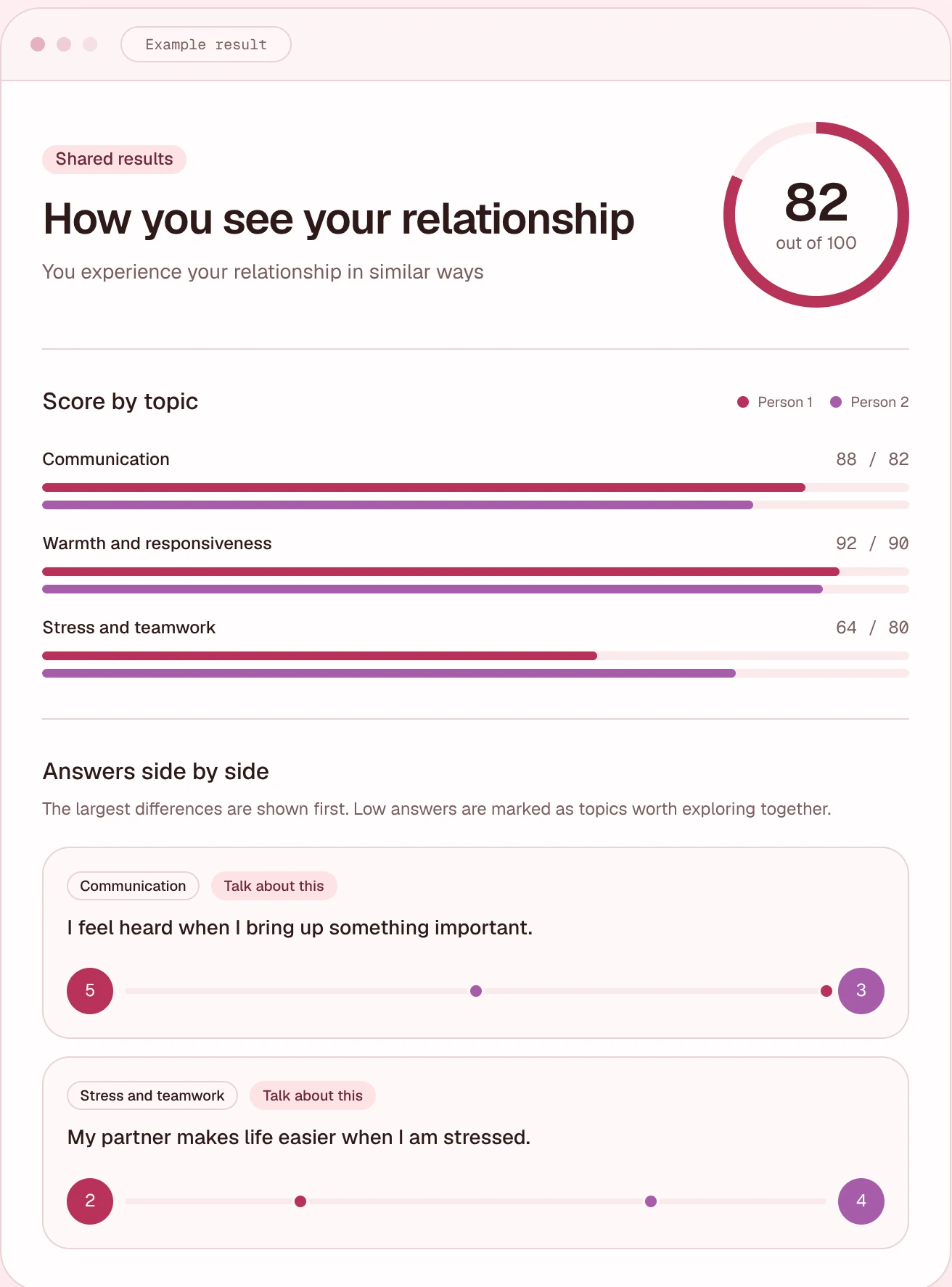
Partneri, familja, miqtë ose kolegët. Pasi të dy ta keni bërë testin, i shihni ngjashmëritë dhe dallimet krah për krah, me tema konkrete për të biseduar.
Fillo me profilin tënd privat.
Personi tjetër përgjigjet në mënyrë të pavarur.
Rezultati nxjerr në pah si ngjashmëritë, ashtu edhe dallimet.
3tema të qarta për bisedë
Përdore dallimin si një ftesë për të qenë kureshtar, jo si një gjykim.
Pair Perspective është testi ynë i marrëdhënieve. Përgjigjuni 57 pyetjeve veçmas, pastaj eksploroni pikat e forta që ndani dhe dallimet për të cilat ia vlen të bisedoni.
Big Five e përshkruan personalitetin përgjatë pesë dimensioneve të pavarura. Asnjë profil nuk është më i mirë se tjetri – ai thjesht pasqyron pika të forta, nevoja dhe prirje të ndryshme.
Gjej modelin tëndKureshtja, imagjinata dhe interesi për ide të reja.
Struktura, vetëdisiplina dhe mënyra si punon drejt qëllimeve.
Energjia sociale, iniciativa dhe nevoja për stimulim.
Besimi, empatia dhe mënyra si i takon njerëzit e tjerë.
Testi është falas. Nuk të duhet llogari dhe mund të përgjigjesh me ritmin tënd.
Bëj testin taniZgjidh opsionin që të përshkruan më mirë. Nuk ka përgjigje të sakta ose të gabuara.
Rezultati yt tregon pesë fusha kryesore dhe 30 aspekte të personalitetit.
Kupto modelet e tua dhe krahaso rezultatin me njerëzit që njeh.
Shpesh kërkon këndvështrime të reja dhe të pëlqejnë idetë që sfidojnë të zakonshmen.
Fillo me një përmbledhje të qartë, pastaj eksploro çdo tipar të personalitetit dhe çfarë mund të thonë pikët e tua në jetën e përditshme.
Profili yt përshkruan prirje, jo një diagnozë apo një përgjigje përfundimtare për atë kush je.
Thellime në pesë tiparet, kërkimin shkencor dhe mënyrën si personaliteti formëson jetën e përditshme.
Shiko të gjithë artikujtResearchers gave three AI models the stories of 220 children at a psychiatry clinic. With the child's own words the AI missed most problems. With the parent's words it found one in almost everyone, including the children who had none.
A study of 5,315 people found that the classic relationship questionnaires asked many questions that told almost nothing. The scale that replaced them shows how satisfaction differs between newlyweds and long marriages, and what goes with it.
In a classic experiment, two short sentences of thanks doubled the share of people who helped again. Other studies show that we thank each other surprisingly rarely, and that we badly underestimate how much it means.
Scientists searched the DNA of more than one million people for personality and found 1,260 genetic variants. The most interesting part is how little each of them matters, and what that says about who you are.
Every dog owner knows their dog is one of a kind. For decades, scientists called that wishful thinking. Now research shows that dog personality can be measured, that it is fairly stable, and that breed explains less than you might think.
Nice guys finish last, the saying goes. Some research seems to agree. But look closer, and the answer to whether your personality affects your pay is more surprising, and more useful, than the saying suggests.
Testi bazohet në modelin e hapur IPIP, është falas për t’u përdorur dhe është open source. Metoda dhe pyetjet e tij janë të disponueshme për shqyrtim.
Personaliteti, pikat e forta, interesat profesionale dhe më shumë. E merr rezultatin menjëherë.
Shiko të 40 testetPersonaliteti yt sipas pesë tipareve të mëdha dhe 30 aspekteve: hapja ndaj përvojave, ndërgjegjshmëria, ekstraversioni, pëlqyeshmëria dhe neurotizmi. Më pas krahasohu me miqtë dhe partnerin.
Explore nine personality types and the patterns you recognize in yourself. A free full profile for self-reflection.
Explore six sides of love, from chemistry and friendship to care. Get a personal profile and something to talk about.
How satisfied are you in your relationship? 32 questions and about five minutes, using a scale researchers and couples therapists use.
Is jealousy a feeling, a habit of checking, or a fear of losing someone? 16 statements, with a score on three sides.
A three-minute test of six broad traits: the Big Five plus honesty-humility. A quick overview; take the full Big Five test for facets and more detail.
Je introvert, ekstrovert apo diku në mes? 24 pohime, me vendosjen tënde dhe një rezultat në gjashtë aspekte.
IPIP-NEO-300 i plotë me 300 pyetje. Zgjat më shumë, por jep një profil më të saktë të pesë tipareve dhe të të 30 aspekteve.
Each Big Five trait split in two: compassion and politeness, industriousness and orderliness, and more. 100 public-domain statements give you ten aspects.
Six broad traits instead of five: the HEXACO model adds honesty-humility to the Big Five picture. 240 public-domain statements give you 24 facets.
Raymond Cattell's classic model with 16 factors, from warmth and dominance to vigilance and perfectionism. 163 public-domain statements give you a profile between opposite poles.
Detyra verbale, figurative dhe numerike në 15 minuta, nga një test i botuar nga psikologë në revistën Intelligence. Tregon arsyetimin tënd në tri fusha. Nuk është test IQ.
Find your signature strengths among the 24 character strengths in Peterson and Seligman's classification, from curiosity and kindness to bravery and humor.
Find out which of eight interest areas suit you best, from leadership and creativity to analysis and practical work, and which occupations match your profile.
Which of Holland's six interest types fit you: Realistic, Investigative, Artistic, Social, Enterprising or Conventional? Get your three-letter code and matching careers, with the O*NET Interest Profiler used in career guidance across the United States.
What do you need from a job to be happy in it: results, freedom, recognition, good colleagues, a supportive employer or good conditions? Get your six work values ranked, with careers that offer most of what you value.
Your profile across seven components of emotional intelligence: noticing your feelings, showing joy and distress, empathy, being moved by others, and how much feelings guide your decisions.
How strongly do you feel with others, and how much do you show it? 17 statements, with a score on two sides of empathy.
How quickly do you catch fire, and does it reach other people? 27 statements, with a score on four sides of anger.
Is work taking over your life, or do you just work hard? 16 statements, with a score and what drives it.
Do you demand perfection, or do you just care about details? 16 statements, with a score and what lies behind it.
How strongly do you react to rewards and to risks? Four scales on drive, fun seeking, reward responsiveness and caution, based on Gray's model of the brain's approach and avoidance systems.
Do you believe your life is steered by your own choices, by powerful others, or by chance? Three scales from Levenson's classic model, with your orientation explained.
Ten statements on how you value yourself and your abilities, based on Rosenberg's classic self-esteem scale. Quick, with a short explanation of your score.
Do you tend to see possibilities or difficulties? Ten statements about your outlook on life, with an explanation of your optimism score.
How satisfied are you with your life as a whole? Five statements and one minute, using one of the most widely used scales in happiness research.
A checklist of five kinds of everyday habits linked with good mental health: enjoyment, thinking habits, goals, routines and connection. With ideas for small steps.
The Short Dark Tetrad (SD4) measures four socially aversive traits found in everyone to some degree: Machiavellianism, narcissism, psychopathy and sadism.
Four sides of narcissism: the urge to lead, the need for attention, a sense of entitlement and a willingness to exploit others. Based on public-domain research scales.
How bold, how mean and how impulsive are you compared with others? Nine traits grouped into the three sides of psychopathy in Patrick's triarchic model. Measures normal variation, not a diagnosis.
The six-question screener from the WHO Adult ADHD Self-Report Scale (ASRS v1.1). Shows whether your answers are consistent with adult ADHD symptoms. Not a diagnosis.
Ten questions about how you have felt over the past 30 days, from the Kessler scale used in national health surveys. Shows your level of psychological distress. Not a diagnosis.
Seven questions about worry and nervousness over the past two weeks, from the most widely used anxiety questionnaire. Shows how much the symptoms bother you. Not a diagnosis.
Nine questions about mood, sleep, energy and self-worth over the past two weeks, from the most widely used depression questionnaire. Shows how much the symptoms bother you. Not a diagnosis.
Twenty questions about how much memories, avoidance, mood and tension after a very stressful experience have bothered you in the past month. Not a diagnosis.
Twelve statements about checking, washing, order, numbers and unwanted thoughts, showing how well typical obsessive-compulsive symptoms fit you. Not a diagnosis.
The World Health Organization's ten questions on how much you drink, signs of dependence and harm, with your risk level.
Thirteen questions about exhaustion in daily life and at work, from the Copenhagen Burnout Inventory. Shows how worn out you are compared with others. Not a diagnosis.
Fourteen statements from a research-based screener for autism in adults. Shows whether your answers resemble those common in autism. Not a diagnosis.
Build the missing figure in a matrix. Choose 12, 22 or 36 tasks. A free pilot with a raw score.
Falas · open source · pa regjistrim · rreth 10 minuta