Achievement-Striving: what drives ambition, and when does it go too far?
Why do some people always aim higher while others are happy with good enough? What research on ambition, grit and workaholism shows, and how the facet is measured.

Two students get the same assignment. One reads the task, works out what is needed for a pass, and spends the rest of the week with friends.
The other reads extra literature, rewrites the introduction four times and hands in something far beyond what was asked. Not because anyone demanded it, but because "good enough" just does not feel good enough.
Most of us know people from both camps. Maybe you recognise yourself in one of them.
Where does this drive come from, does it pay off, and when does ambition turn into something that wears you down?
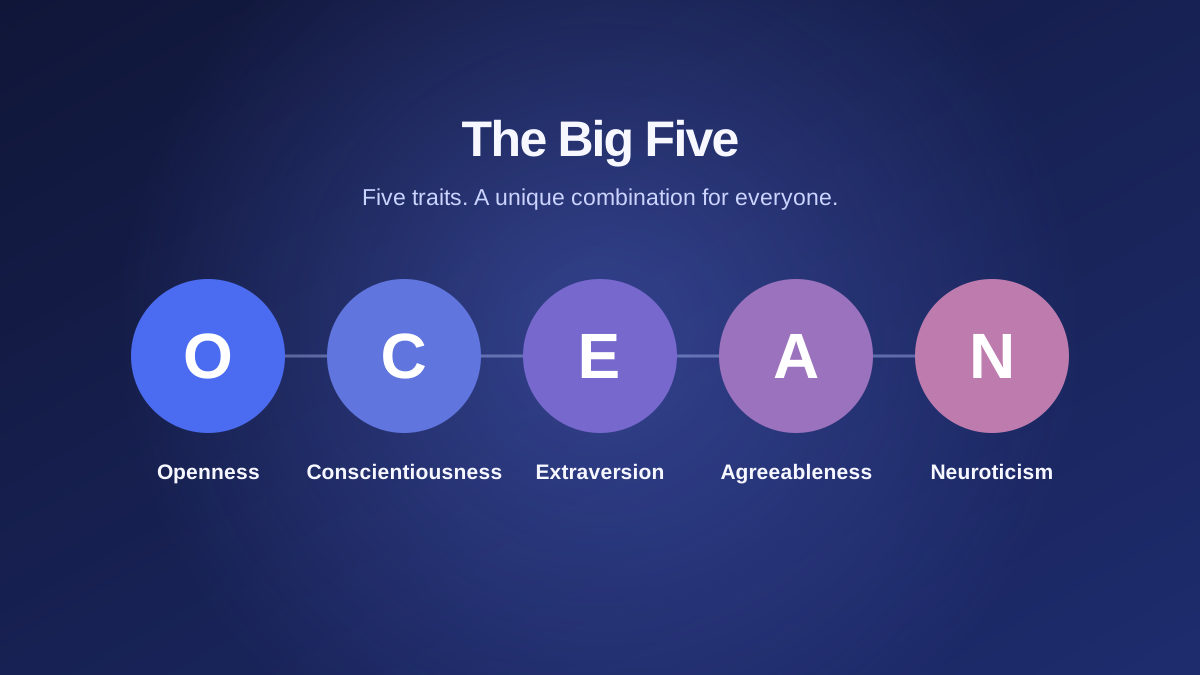
Psychologists call this tendency achievement-striving. In the Big Five model, it is one of six facets of conscientiousness. The facet describes how hard you work towards goals, and how high you set the bar for yourself.
What does achievement-striving mean?
Achievement-striving is about drive and ambition: the desire to do well, to reach goals and to deliver more than what is expected.
People who score high often recognise themselves in this:
- You work hard, often harder than you need to.
- You set high goals for yourself.
- You find it unsatisfying to do just enough to get by.
- You often have a clear sense of direction in life.
- You may find it hard to relax while something remains unfinished.
Achievement-striving is not the same as being competitive with others. You can be very ambitious on your own behalf without caring much about beating other people.
The key is not how much you achieve, but how strongly you are driven to do your best.
Does ambition pay off? Seventy years of data
One of the most impressive studies of ambition used data from a project started by the psychologist Lewis Terman in the 1920s. He followed a group of especially gifted children through their whole lives.
In 2012, two researchers used this data to study 717 of these people over seven decades. They wanted to know where ambition comes from and what it leads to.
Ambition was predicted by conscientiousness, extraversion, neuroticism and intelligence, as well as by having parents with more prestigious jobs. In turn, ambitious people achieved more education, more prestigious jobs and higher incomes. Ambition did not, however, affect how long they lived.
Bear in mind that everyone in the study was highly gifted. That makes the result even more interesting: even among people with the same high level of talent, ambition made a difference.
Is grit just conscientiousness in a new suit?
In 2007, the psychologist Angela Duckworth and her colleagues launched the concept of grit: perseverance and passion for long-term goals. The idea caught on quickly in schools and workplaces.
The original study found that grit predicted success in several different settings, including educational level among adults, grades among students at an elite university, which cadets stayed on at the West Point military academy, and how far children got in a national spelling competition. Grit was not related to higher IQ, but it was strongly related to conscientiousness.
Ten years later, a large meta-analysis pooled 88 samples with almost 67,000 people. The conclusion was more sober. Grit was only moderately linked with performance, and so strongly correlated with conscientiousness that it was unclear whether it was really something new.
The part of grit about perseverance and effort was the most useful, and that is very close to what achievement-striving and self-discipline measure. The authors also warned that programmes to increase grit might have only weak effects on performance.
The lesson is not that perseverance is unimportant. It is that the old, well-measured trait of conscientiousness already captures much of what made grit seem so promising.
Achievement-striving is not the same as workaholism
Working hard and being addicted to work are two different things.
A meta-analysis from 2016 examined what workaholism is related to. Workaholism was linked to perfectionism and the so-called type A personality, which is marked by impatience and a constant sense of time pressure. But it was generally not related to conscientiousness.
At the same time, workaholism was linked to many negative outcomes: burnout, stress at work, conflict between work and private life, and poorer physical and mental health. The researchers concluded that workaholism is best understood as an addiction to work.
In other words, a high score on achievement-striving does not mean you are a workaholic. Achievement-striving is about drive towards goals. Workaholism is about being unable to stop, even when it harms you.
Achievement-striving should also be separated from self-discipline. Achievement-striving is about how much you want to accomplish. Self-discipline is about whether you manage to get started and complete what you have planned. Many people are highly ambitious but struggle with procrastination.
What does a high or low score mean?
High achievement-striving
You are driven, goal-oriented and willing to put in a lot of work. That often pays off in education and working life, and others see you as someone who delivers.
The flip side may be that you find it hard to be satisfied, set the bar so high that it becomes a strain, or let work crowd out rest and relationships. Being aware of when "good enough" is actually good enough can protect you.
Low achievement-striving
You do not feel a strong need to excel, and you are content to do what is needed. That can give you more room for leisure, relationships and other things that matter to you.
A low score does not mean you are lazy or lacking in ability. Many low scorers simply put their energy elsewhere than performance. The risk is that others may underestimate you, or that you miss opportunities that require extra effort.
Both descriptions are about typical tendencies, not rules that hold in every situation.
In everyday life
- At work: High scorers often take on extra responsibility and climb faster, but are also at risk of overwork. Low scorers often protect their free time better.
- In school: Achievement-striving makes it easier to put in the extra hours before an exam. Self-discipline decides whether those hours actually get used well.
- In relationships: Differences in ambition can create friction, for example if one partner works every evening and the other wants more time together.
- In leisure: High scorers often turn hobbies into projects with goals and training plans. Low scorers more often do things just for the fun of it.
Can achievement-striving change?
Personality is fairly stable, but not fixed. In a study from 2015, researchers followed people for 16 weeks. Those who wanted to increase a particular Big Five trait tended to change in that direction, both in how they described themselves and in their daily behaviour.
One of the methods the researchers tested worked especially well: training participants to make concrete "if-then" plans, such as "If I get home before five, then I work on the project for half an hour."
If you want to be more driven, it often helps to choose goals that actually mean something to you, and break them into concrete steps. If you score very high and feel it is wearing you down, the work may be the opposite: setting limits, prioritising rest and accepting that not everything needs to be perfect.
If work fills your life to the extent that you experience exhaustion, sleep problems or low mood, it can be worth talking to your doctor or a psychologist. A Big Five score is not a diagnosis.
Frequently asked questions
Is high achievement-striving the same as perfectionism?
No. Achievement-striving is about working hard towards goals. Perfectionism involves demanding flawlessness and being harsh on yourself when you fall short. The two can go together, but many ambitious people are not perfectionists.
Is a low score the same as being lazy?
No. The facet measures how strongly you are driven to excel, not how much worth you have or how able you are. Many people with low scores work steadily and well, but without a need to do more than required.
Does ambition make you happier?
The research above shows that ambition is linked to education, job status and income. That does not automatically mean a better life. Workaholism, for example, is linked to poorer health and more conflict between work and private life.
How is achievement-striving measured in the Big Five test?
Our test is based on the IPIP-NEO-120, where each facet is measured with four statements. For achievement-striving, they are about working hard, doing more than what is expected of you, doing just enough to get by and putting little time and effort into your work. Read the score as a sign of a pattern, not as a complete description of you.
Find out where you score
Achievement-striving is only one of the six facets of conscientiousness. You can be highly ambitious and still score low on orderliness or cautiousness.
Take the Big Five test and see your whole profile, with all 30 facets.
Sources
- Judge, T. A. & Kammeyer-Mueller, J. D. (2012). On the value of aiming high: The causes and consequences of ambition. Journal of Applied Psychology, 97(4), 758–775.
- Duckworth, A. L., Peterson, C., Matthews, M. D. & Kelly, D. R. (2007). Grit: Perseverance and passion for long-term goals. Journal of Personality and Social Psychology, 92(6), 1087–1101.
- Credé, M., Tynan, M. C. & Harms, P. D. (2017). Much ado about grit: A meta-analytic synthesis of the grit literature. Journal of Personality and Social Psychology, 113(3), 492–511.
- Clark, M. A., Michel, J. S., Zhdanova, L., Pui, S. Y. & Baltes, B. B. (2016). All work and no play? A meta-analytic examination of the correlates and outcomes of workaholism. Journal of Management, 42(7), 1836–1873.
- Hudson, N. W. & Fraley, R. C. (2015). Volitional personality trait change: Can people choose to change their personality traits? Journal of Personality and Social Psychology, 109(3), 490–507.
- Johnson, J. A. (2014). Measuring thirty facets of the Five Factor Model with a 120-item public domain inventory: Development of the IPIP-NEO-120. Journal of Research in Personality, 51, 78–89.