Self-Discipline: why do we procrastinate?
Why do we put off tasks we know we should do? What research on procrastination, habits and willpower shows, and how self-discipline is measured in the Big Five.

The deadline is on Friday. On Monday you think you have plenty of time. On Tuesday you clean the kitchen, which has not been done in weeks. On Wednesday you check your phone "just for a minute" and look up an hour later.
On Thursday evening you sit down, stressed, and do in four hours what you could have done calmly over a week.
You knew this would happen. You have probably done it before. So why do we keep putting off things we know we should do?
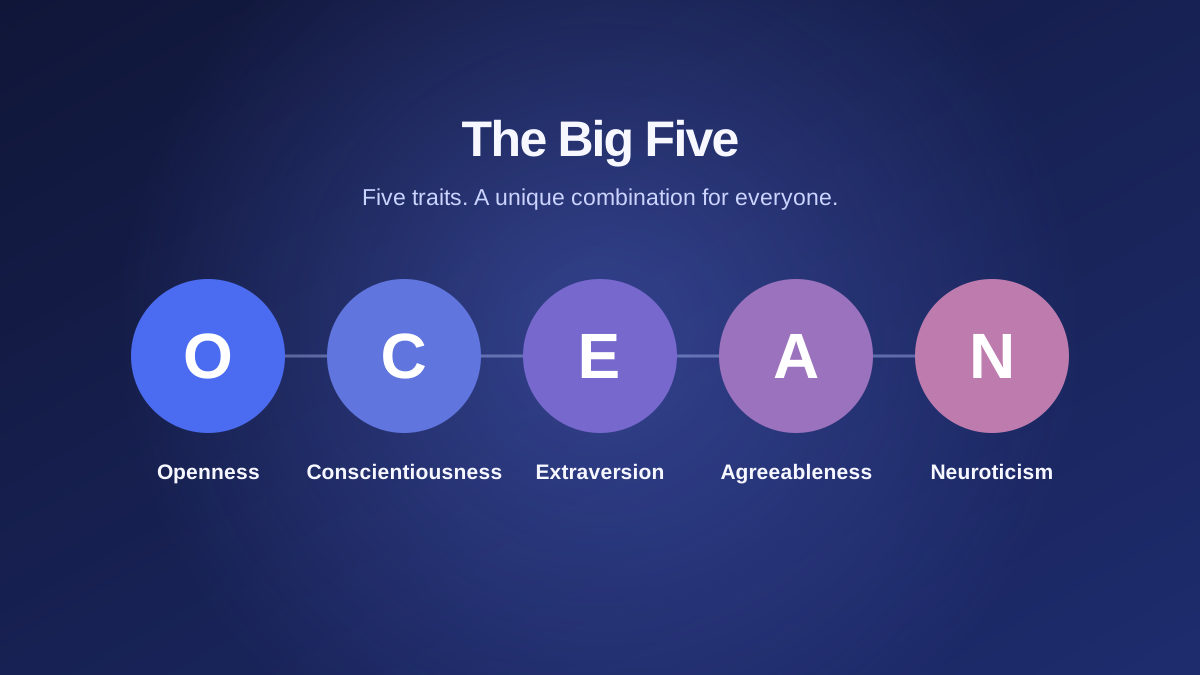
Part of the answer lies in what psychologists call self-discipline. In the Big Five model, it is one of six facets of conscientiousness. The facet describes how well you manage to get started on tasks and see them through, even when they are boring or unpleasant.
What does self-discipline mean?
Self-discipline is what many people call willpower: the ability to start on tasks and keep going until they are done, without being thrown off by distractions or reluctance.
People who score high often recognise themselves in this:
- You get started on tasks without much delay.
- You carry out the plans you make.
- You are usually prepared when it matters.
- You rarely feel that you have wasted the day.
- You can keep going with boring tasks until they are finished.
Self-discipline is not about how much you want to achieve. Many people with big ambitions struggle to get started, and many without big ambitions get through their tasks steadily and calmly.
The key is not how much you want something, but how easily you get from intention to action.
Procrastination: the classic failure of self-control
In 2007 the psychologist Piers Steel published a large review of procrastination research. He pooled 691 correlations from earlier studies to find out what actually predicts procrastination.
Some of the strongest predictors were related to the task: we put off tasks we find unpleasant, and tasks where the reward lies far in the future. Others were related to the person: low self-efficacy, impulsiveness, and low conscientiousness, including the parts that are about self-control, distractibility, organisation and achievement motivation.
Interestingly, neuroticism, rebelliousness and sensation-seeking had only weak links. Procrastination is therefore not mainly about anxiety or defiance, but about how we deal with tasks that are unpleasant now and rewarding later.
Steel explained this with what he called temporal motivation theory: we value rewards less the further away they are. A cosy evening on the sofa today easily beats a good grade in three weeks.
Procrastination feels good, until it doesn't
If procrastination is so harmful, why do we do it? Because it works in the short term.
In two studies from 1997, researchers followed students through a semester. Early in the semester, the procrastinators reported less stress and less illness than the others. Towards the end of the semester the pattern reversed: they now had more stress and more illness, and over the semester as a whole they were sicker. They also got lower grades on all their assignments.
The psychologists Fuschia Sirois and Timothy Pychyl have argued that procrastination is basically about mood. When a task makes us feel bored, anxious or insecure, putting it off is a quick way to feel better. The bill is passed on to our future self, who has to deal with both the task and the time pressure.
This changes how we can understand procrastination. It is not necessarily a sign of laziness, but of an attempt to regulate unpleasant feelings here and now.
The secret of self-disciplined people: habits
We often imagine that people with good self-discipline spend all day resisting temptations through sheer willpower. Research suggests otherwise.
A series of six studies from 2015, with a total of 2,274 participants, found that people with good self-control actually used less effortful resistance in daily life. The reason was that they had built good habits: for sleep, exercise, healthy snacks and schoolwork. Their behaviour had become more automatic.
The habits partly explained why self-control was linked to better outcomes, such as higher grades and staying on at university.
In other words, self-disciplined people are not necessarily stronger in the moment. They have arranged their lives so that they need to fight less.
Self-discipline is not the same as resisting temptation
Self-discipline is easily confused with another facet: immoderation under neuroticism.
Immoderation is about how hard it is to resist cravings and urges, such as eating too much, shopping or doing things you regret. It is about not giving in to something you want.
Self-discipline is about the opposite direction: getting yourself to do something you do not particularly want to do. You can be good at resisting cake and still put off the tax return for weeks.
Self-discipline should also be separated from achievement-striving. Achievement-striving is about how high you aim. Self-discipline is about whether you actually get started.
Low self-discipline is not the same as ADHD either. Problems getting started and staying focused are common in ADHD, but most people who procrastinate do not have ADHD. A Big Five score cannot be used to make a diagnosis. If you struggle with attention and getting things done in a way that causes major problems at school, work or home, a doctor or psychologist can assess it.
What does a high or low score mean?
High self-discipline
You get things done, often without much drama. That makes you reliable at work and in studies, and you probably experience less of the stress that last-minute work brings.
The flip side may be that you find it hard to let go of tasks and relax, or that you push through things that should have been dropped. Not every task deserves to be completed.
Low self-discipline
You often find it hard to get started, especially on boring tasks, and you may feel that time slips away. Many low scorers work best under pressure and can deliver a lot when the deadline is close.
A low score does not mean you lack ability or will. It mainly means that the step from intention to action is longer for you, and that you may benefit from more external structure.
Both descriptions are about typical tendencies, not rules that hold in every situation.
In everyday life
- At work: Self-discipline is especially important in jobs with a lot of freedom and little supervision, such as working from home or being self-employed.
- In studies: The gap between those who start early and those who start late often appears in grades, as the 1997 study showed.
- In health: Exercise, sleep and diet are all about doing something now for a reward later. Habits often help more than resolutions.
- At home: Bills, forms and appointments are classic procrastination tasks. Automating what can be automated takes away much of the problem.
Can self-discipline change?
Personality is fairly stable, but not fixed. In a study from 2015, researchers followed people for 16 weeks. Those who wanted to increase a particular Big Five trait tended to change in that direction. A method that worked particularly well was making concrete "if-then" plans.
The research on procrastination and habits points to some concrete strategies:
- Make the start smaller. "Write for ten minutes" is easier to begin than "write the report".
- Plan with if-then. "When I have had my coffee, I open the document."
- Build habits rather than relying on willpower. Fixed times and places make the task more automatic.
- Remove temptations. Put your phone in another room rather than trying to resist it.
- Work on the feeling, not just the task. Since procrastination is often about escaping bad feelings, it helps to make the task feel less unpleasant, for example by doing it with someone else or rewarding yourself afterwards.
Frequently asked questions
Is willpower a resource that runs out?
The idea that self-control is like a muscle that gets tired after use, often called ego depletion, was very popular for many years. In 2016, 23 laboratories with a total of 2,141 participants carried out the same experiment to test it. The effect they found was close to zero. The theory is therefore much more uncertain than it was long thought to be.
Is procrastination the same as laziness?
No. Lazy people do not particularly want to do the task. People who procrastinate often want to, and feel bad about not getting started. Research suggests that procrastination is largely about avoiding unpleasant feelings.
Can you be too self-disciplined?
Yes, if it means that you can never relax, or that you keep going with things that should have been dropped. Flexibility is also an important skill.
How is self-discipline measured in the Big Five test?
Our test is based on the IPIP-NEO-120, where each facet is measured with four statements. For self-discipline, they are about always being prepared, carrying out your plans, wasting your time and having difficulty starting tasks. Read the score as a sign of a pattern, not as a complete description of you.
Find out where you score
Self-discipline is only one of the six facets of conscientiousness. You can be low in self-discipline and still score high on dutifulness or achievement-striving.
Take the Big Five test and see your whole profile, with all 30 facets.
Sources
- Steel, P. (2007). The nature of procrastination: A meta-analytic and theoretical review of quintessential self-regulatory failure. Psychological Bulletin, 133(1), 65–94.
- Tice, D. M. & Baumeister, R. F. (1997). Longitudinal study of procrastination, performance, stress, and health: The costs and benefits of dawdling. Psychological Science, 8(6), 454–458.
- Sirois, F. M. & Pychyl, T. A. (2013). Procrastination and the priority of short-term mood regulation: Consequences for future self. Social and Personality Psychology Compass, 7(2), 115–127.
- Galla, B. M. & Duckworth, A. L. (2015). More than resisting temptation: Beneficial habits mediate the relationship between self-control and positive life outcomes. Journal of Personality and Social Psychology, 109(3), 508–525.
- Hagger, M. S., Chatzisarantis, N. L. D. et al. (2016). A multilab preregistered replication of the ego-depletion effect. Perspectives on Psychological Science, 11(4), 546–573.
- Hudson, N. W. & Fraley, R. C. (2015). Volitional personality trait change: Can people choose to change their personality traits? Journal of Personality and Social Psychology, 109(3), 490–507.
- Johnson, J. A. (2014). Measuring thirty facets of the Five Factor Model with a 120-item public domain inventory: Development of the IPIP-NEO-120. Journal of Research in Personality, 51, 78–89.