Orderliness: does a messy desk say anything about you?
Is a messy desk a sign of a creative mind or just disorder? What research on rooms, clutter and personality shows, and how orderliness is measured in the Big Five.

One person's desk has three neat piles, a pen holder and nothing else. The desk next to it is covered in papers, coffee cups and sticky notes, and its owner insists that they know exactly where everything is.
Most of us have an opinion about which of them is the better colleague. Some think the messy one must be chaotic. Others are sure that the mess belongs to a creative genius.
So does a messy desk actually say anything about the person sitting at it?
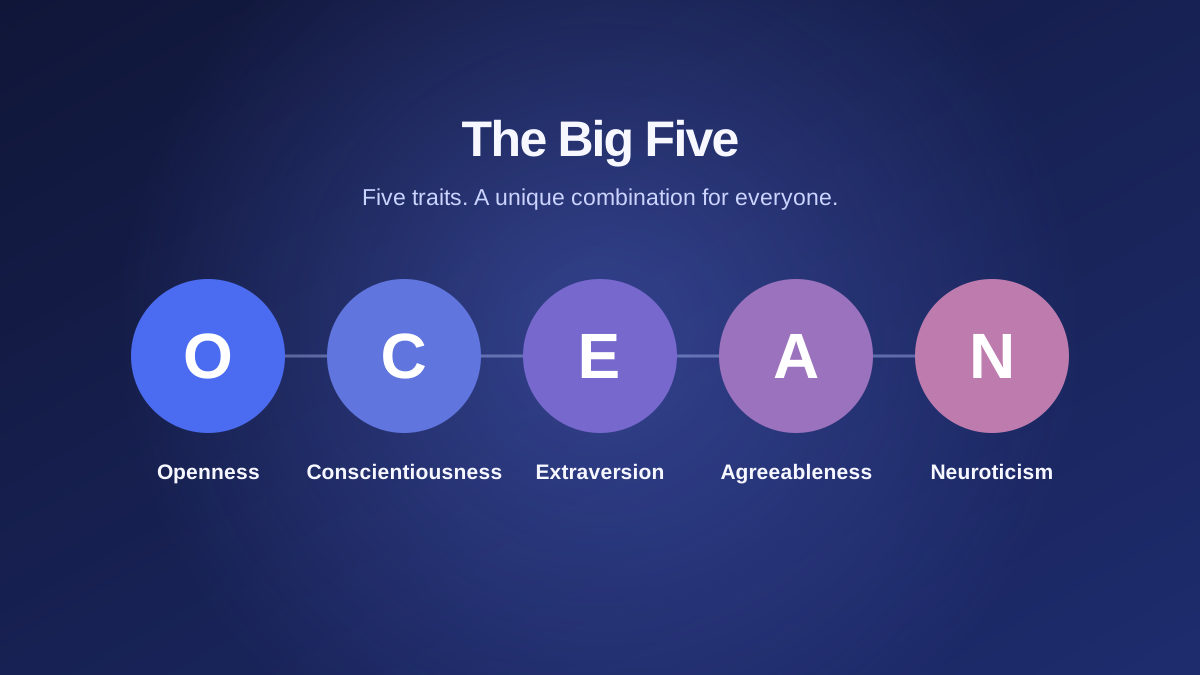
Psychologists have studied this, and the answer touches on what they call orderliness. In the Big Five model, it is one of six facets of conscientiousness. The facet describes how much you like structure, tidiness and having things in their proper place.
What does orderliness mean?
Orderliness is a preference for an organised environment and organised routines. It covers both physical order, such as a tidy home, and order in time, such as plans, lists and fixed habits.
People who score high often recognise themselves in this:
- You like to tidy up, and mess around you is irritating.
- Things have a fixed place, and you put them back there.
- You like lists, calendars and plans.
- You feel calmer when your surroundings are in order.
- You notice quickly when something is out of place.
Orderliness is not about being better or more hard-working than others. It describes how much structure you need and seek out, not how much you get done.
The key is not whether your home looks like a magazine, but how strongly you feel the need for things to be in order.
Strangers can read your room
In a well-known study from 2002, researchers let observers look around offices and student bedrooms while the occupants were away. The observers then rated the personality of the person who used the room.
Their ratings were compared with how the occupants described themselves and how people who knew them described them. Observers agreed with each other to a large extent, and their impressions showed some accuracy. Agreement and accuracy were generally stronger than when strangers judge people they have only just met.
Conscientiousness was one of the traits observers judged best, along with openness. A neat and well-organised room was a valid cue: those rooms tended to belong to people who described themselves as conscientious.
So yes, your desk does say something about you. But mostly it says something about this particular trait, not about whether you are smart, kind or creative.
Is a messy desk a sign of creativity?
In 2013 a study in Psychological Science got a lot of media coverage. In three experiments, participants were placed in either a tidy or a messy room.
Those in the tidy room more often chose a healthy snack and donated more money to charity. Those in the messy room came up with more creative ideas, and they were more likely to prefer an option labelled "new" rather than "classic". The researchers suggested that order pulls us towards convention, and disorder towards breaking with it.
It is a tempting story, but it has not held up particularly well. A study from 2019 tried to reproduce the creativity finding with a similar setup and a larger sample, where participants worked at either a neat or a messy desk. It found no difference in creativity and no difference in mental control between the groups. The authors concluded that the claims in the popular press were not justified.
Note also that these studies were about the room, not the person. They examined what happens when anyone is placed in a messy environment, not whether people with low orderliness are more creative. Creativity is mainly linked to a different trait, openness.
Can clutter affect how you feel?
A study from 2010 looked at this from another angle. Sixty spouses in couples where both partners worked gave the researchers a recorded tour of their own home. The researchers then counted the words they used.
Wives who talked a lot about clutter and unfinished projects had a less healthy daily pattern of the stress hormone cortisol, and their mood got lower over the course of the day. Wives who described their home as restful showed the opposite pattern. The results held after the researchers accounted for marital satisfaction and neuroticism.
This was not a study of orderliness as a personality trait, and the clear findings applied to the women. But it suggests that how you experience your home may matter for how restful it feels, and people high in orderliness probably feel the effect of clutter more strongly.
Orderliness is not the same as OCD
High orderliness is often joked about as being "a bit OCD". That is misleading.
Obsessive-compulsive disorder (OCD) involves unwanted, distressing thoughts and rituals that a person feels they have to carry out to reduce anxiety. Liking a tidy kitchen is something completely different.
There is a condition that lies closer to orderliness: obsessive-compulsive personality disorder (OCPD), marked by rigid perfectionism and a strong need for control. A study from 2011 of 536 students found that ordinary measures of conscientiousness had only small to moderate links with OCPD, while measures aimed at the extreme, unhealthy variants of conscientiousness had strong links. The researchers saw OCPD as a maladaptive extreme of normal conscientiousness.
So a high orderliness score is not a diagnosis. If a need for control or rituals takes up so much time that it limits your life, it can be worth talking to your doctor or a psychologist.
Orderliness should also be separated from self-discipline. You can love colour-coded calendars and still have trouble getting started on the tasks in them. And you can be messy, yet get through your workload without delay.
What does a high or low score mean?
High orderliness
You thrive with structure and like to know where things are and what happens next. That makes you good at planning, keeping track of details and creating systems that others benefit from.
The flip side may be that you find it stressful when plans change or when others do not share your standards. Shared households and open-plan offices can be a test.
Low orderliness
You are comfortable with a bit of mess and do not need everything to be planned in advance. You often adapt easily and can work in surroundings that would drive others mad.
The risk is that you lose things, forget appointments or spend time looking for what you need. Many low scorers solve this with a few simple systems for the things that really matter.
Both descriptions are about typical tendencies, not rules that hold in every situation.
In everyday life
- At work: High scorers often handle documentation, logistics and quality control well. Low scorers may be better suited to roles with improvisation and frequent changes.
- At home: Differences in orderliness are a classic source of friction between flatmates and partners. It often helps to agree on a few shared areas that must be tidy, and leave the rest.
- In studies: Good structure on notes and deadlines makes it easier to stay on top of things, but it does not replace the actual work.
- Travel and leisure: Some like a detailed plan for every day, others prefer to see what happens. Neither is wrong.
Can orderliness change?
Personality is fairly stable, but not fixed. A large meta-analysis from 2006 of 92 samples followed people over time and found that conscientiousness tends to increase through adulthood, especially between the ages of 20 and 40.
Many people therefore become somewhat more orderly with age, often as they get jobs, homes and families that require more structure.
If you want more order in your life without changing who you are, it is usually more effective to build simple systems than to rely on willpower:
- Give the most important things a fixed place, such as keys, wallet and documents.
- Use a single calendar instead of several.
- Tidy for a few minutes at a fixed time each day rather than in big rounds.
- Reduce the number of things that need to be kept in order.
Frequently asked questions
Are tidy people more successful?
Not necessarily. Orderliness is one part of conscientiousness, and it is the broad trait that is most often linked to success at school and work. You can be messy and still be hard-working and reliable.
Is a messy person lazy?
No. Orderliness is about the need for structure, not about effort. How hard you work is measured in another facet, achievement-striving.
Is low orderliness a sign of ADHD?
Not on its own. Many people are messy without having ADHD. A Big Five score cannot say anything about diagnoses. If you struggle with attention and organisation in a way that causes major problems, a doctor or psychologist can assess it.
How is orderliness measured in the Big Five test?
Our test is based on the IPIP-NEO-120, where each facet is measured with four statements. For orderliness, they are about liking to tidy up, often forgetting to put things back in their place, leaving your room messy and leaving your belongings lying around. Read the score as a sign of a pattern, not as a complete description of you.
Find out where you score
Orderliness is only one of the six facets of conscientiousness. You can be very orderly and still score low on achievement-striving or cautiousness.
Take the Big Five test and see your whole profile, with all 30 facets.
Sources
- Gosling, S. D., Ko, S. J., Mannarelli, T. & Morris, M. E. (2002). A room with a cue: Personality judgments based on offices and bedrooms. Journal of Personality and Social Psychology, 82(3), 379–398.
- Vohs, K. D., Redden, J. P. & Rahinel, R. (2013). Physical order produces healthy choices, generosity, and conventionality, whereas disorder produces creativity. Psychological Science, 24(9), 1860–1867.
- Manzi, A., Durmysheva, Y., Pinegar, S. K., Rogers, A. & Ramos, J. (2019). Workspace disorder does not influence creativity and executive functions. Frontiers in Psychology, 9, 2662.
- Saxbe, D. E. & Repetti, R. (2010). No place like home: Home tours correlate with daily patterns of mood and cortisol. Personality and Social Psychology Bulletin, 36(1), 71–81.
- Samuel, D. B. & Widiger, T. A. (2011). Conscientiousness and obsessive-compulsive personality disorder. Personality Disorders: Theory, Research, and Treatment, 2(3), 161–174.
- Roberts, B. W., Walton, K. E. & Viechtbauer, W. (2006). Patterns of mean-level change in personality traits across the life course: A meta-analysis of longitudinal studies. Psychological Bulletin, 132(1), 1–25.
- Johnson, J. A. (2014). Measuring thirty facets of the Five Factor Model with a 120-item public domain inventory: Development of the IPIP-NEO-120. Journal of Research in Personality, 51, 78–89.