Modesty: is humility a strength or a weakness?
Does it pay to be humble, or do the self-promoters win? What research says about modesty, bragging and first impressions, and how the Big Five measures modesty.

Two colleagues have done equally good work on a project. In the meeting with management, one talks confidently about everything she achieved. The other mentions that "the team did a good job" and leaves it at that.
Who gets the promotion? And who will the others want to work with a year from now?
Many people have been told that you have to sell yourself to get ahead. Others were raised to think that bragging is embarrassing.
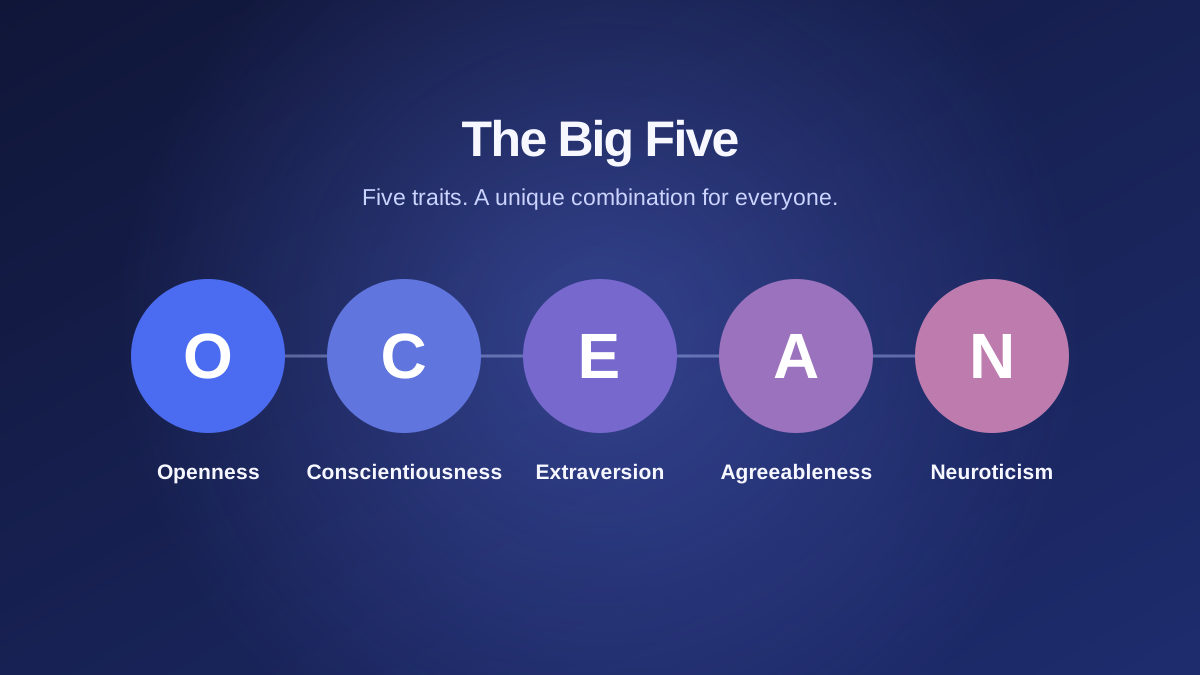
In the Big Five model, the tendency not to put yourself above others is called modesty. It is one of six facets of agreeableness, and it describes how reluctant you are to claim that you are better than other people.
What does modesty mean?
Modesty is about how you present yourself in relation to others, not necessarily what you think of yourself deep down.
People who score high often recognise themselves in this:
- You do not like talking about your own achievements.
- You find it uncomfortable when someone praises you in front of others.
- You do not think you are better than other people.
- You find boasting a little embarrassing, both in yourself and others.
People who score low are comfortable highlighting their strengths, think highly of themselves and do not mind saying so.
Modesty does not have to mean low self-confidence. Some modest people do have low self-esteem, but many know perfectly well that they are skilled and still find it unseemly to put themselves above others.
The key is not how good you think you are, but whether you feel the need to show that you are better than others.
Self-promoters win at first, then lose
Delroy Paulhus followed small discussion groups that met seven times over several weeks. After the first and last meeting, the members rated each other.
Those who tended to overrate themselves, measured with narcissism and other self-enhancement scales, made a good first impression. At the first meeting they were seen as pleasant, well adjusted and competent.
After seven weeks the picture had changed. Now the self-enhancers were rated negatively by the others in the group.
The study measured self-enhancement, not the modesty facet directly. But it illustrates a pattern many people recognise: self-promotion can work in the short term, but tends to wear thin as people get to know you.
Humility pays off in groups
Don Davis and colleagues studied 84 students who worked in small groups on tasks designed to put humility to the test. Over three measurement points, the group members rated each other.
Those with higher trait humility gained higher status in the group and were more accepted by the others.
At work, Bradley Owens and colleagues found that humility, as rated by others, predicted individual performance. Humility appeared to partly compensate for lower general mental ability. Among leaders, humility was linked to employees being more satisfied and engaged, and to employees staying longer.
Owens's studies measured "expressed humility", such as admitting mistakes, acknowledging others' strengths and being open to learning. That overlaps with the modesty facet, but is not the same thing.
Humblebragging backfires
What about those who try to have it both ways?
Ovul Sezer, Francesca Gino and Michael Norton studied humblebragging: bragging disguised as a complaint or as humility, such as "I can't believe they chose me to give the keynote, I'm so nervous."
Across nine studies they found that humblebragging was less effective than simply bragging. People who humblebragged were liked less and seen as less competent, because others saw them as insincere.
The lesson is that real modesty and fake modesty are perceived very differently. If you want to tell people about something you have achieved, it is better to do it straight.
Modesty is not the same as low self-esteem
This is an important distinction.
Self-esteem is about how you value yourself. Modesty is about how you present yourself to others, and whether you see yourself as above them. You can have solid self-esteem and still be modest. You can also have fragile self-esteem and compensate by bragging.
Paulhus found that self-enhancement correlated with higher self-esteem. That is one reason why a low modesty score need not mean anything negative: it can partly reflect that you simply feel good about yourself.
Modesty is also different from self-efficacy, a facet of conscientiousness, which is about believing that you can handle tasks. Many people who score high on self-efficacy are still modest about it.
A very low modesty score is not the same as narcissism. Narcissism involves more, such as a need for admiration and little empathy. Read more in our article on narcissism.
What does a high or low score mean?
High modesty
You do not like to put yourself forward and do not see yourself as better than others. People often find you pleasant and easy to work with, and you rarely come across as arrogant.
The risk is that your efforts go unnoticed, especially in settings where others promote themselves. You may need to practise talking about your results in a factual way.
Low modesty
You are comfortable talking about your strengths and think highly of yourself. This can make it easier to apply for jobs, negotiate pay and take on visible roles.
The risk is that others perceive you as arrogant, especially over time. As Paulhus's research suggests, the first impression can be good, but it is not always lasting.
Both descriptions are about typical tendencies, not rules that hold in every situation.
In everyday life
- At work: Modest people are often popular colleagues, but can be overlooked for promotion. Keeping a list of concrete results makes it easier to present them factually when it matters.
- In job interviews: Here you are expected to talk about yourself. Describing what you did and what the result was is not bragging.
- In relationships: Modesty makes it easier to admit mistakes and apologise, which matters in close relationships.
- On social media: Social media rewards self-presentation. Modest people often post less about their own achievements.
Can modesty change?
There is little research on how the modesty facet changes on its own. A large review by Brent Roberts and colleagues found that psychological interventions changed personality traits, but that the changes were mainly in emotional stability and extraversion.
The more useful question is perhaps not how to become more or less modest, but how to use your style well:
- If you are very modest: practise describing your achievements factually, without exaggerating or downplaying them.
- If you are low in modesty: ask others for feedback, and give credit to others when it is due.
- In both cases: avoid humblebragging. Be straightforward.
- Remember that admitting mistakes and acknowledging others' strengths is not weakness. In the research, humility is linked to acceptance and status in groups.
Frequently asked questions
Is it a weakness to be modest?
Not in general. Modesty can cost you visibility in the short term, but research on humility suggests it is associated with acceptance, status in groups and good relationships over time. The challenge is to make sure your efforts are still seen.
Is low modesty the same as arrogance?
No. A low score means you think highly of yourself and do not mind showing it. Whether it comes across as arrogance depends a lot on how you do it, and on whether you also show respect for others.
Should I brag more to get ahead?
It depends on how. Sezer and colleagues found that humblebragging works worse than straightforward bragging. Telling people about concrete results, in a factual way, is usually better than both false modesty and boasting.
How is modesty measured in the Big Five test?
Our test is based on the IPIP-NEO-120, where each facet is measured with four statements. For modesty, all four are reversed: they are about believing that you are better than others, thinking highly of yourself, having a high opinion of yourself and boasting about your virtues. Because all four statements are about thinking well of yourself, a low score can partly reflect good self-esteem, not just arrogance. Read the score as a sign of a pattern, not as a complete description of you.
Find out where you score
Modesty is only one of the six facets of agreeableness. You can be modest and still score low on cooperation or sympathy.
Take the Big Five test and see your whole profile, with all 30 facets.
Sources
- Paulhus, D. L. (1998). Interpersonal and intrapsychic adaptiveness of trait self-enhancement: A mixed blessing? Journal of Personality and Social Psychology, 74(5), 1197–1208.
- Davis, D. E. et al. (2013). Humility and the development and repair of social bonds: Two longitudinal studies. Self and Identity, 12(1), 58–77.
- Owens, B. P., Johnson, M. D. & Mitchell, T. R. (2013). Expressed humility in organizations: Implications for performance, teams, and leadership. Organization Science, 24(5), 1517–1538.
- Sezer, O., Gino, F. & Norton, M. I. (2018). Humblebragging: A distinct—and ineffective—self-presentation strategy. Journal of Personality and Social Psychology, 114(1), 52–74.
- Roberts, B. W. et al. (2017). A systematic review of personality trait change through intervention. Psychological Bulletin, 143(2), 117–141.
- Johnson, J. A. (2014). Measuring thirty facets of the Five Factor Model with a 120-item public domain inventory: Development of the IPIP-NEO-120. Journal of Research in Personality, 51, 78–89.