Morality: why do some people stay honest when nobody is watching?
Why do some people refuse to cheat even when they could never be caught? What research on lying and honesty shows, and how the Big Five measures morality.

The self-checkout at the supermarket misses an item. Nobody has noticed, and nobody ever will.
Some people walk back and pay without a second thought. Others shrug and think it is the shop's problem. Most of us have probably been in a similar situation, with a tax form, an expense report or a game where you could peek at the answers.
Why do some people stay honest even when cheating would be free and invisible?
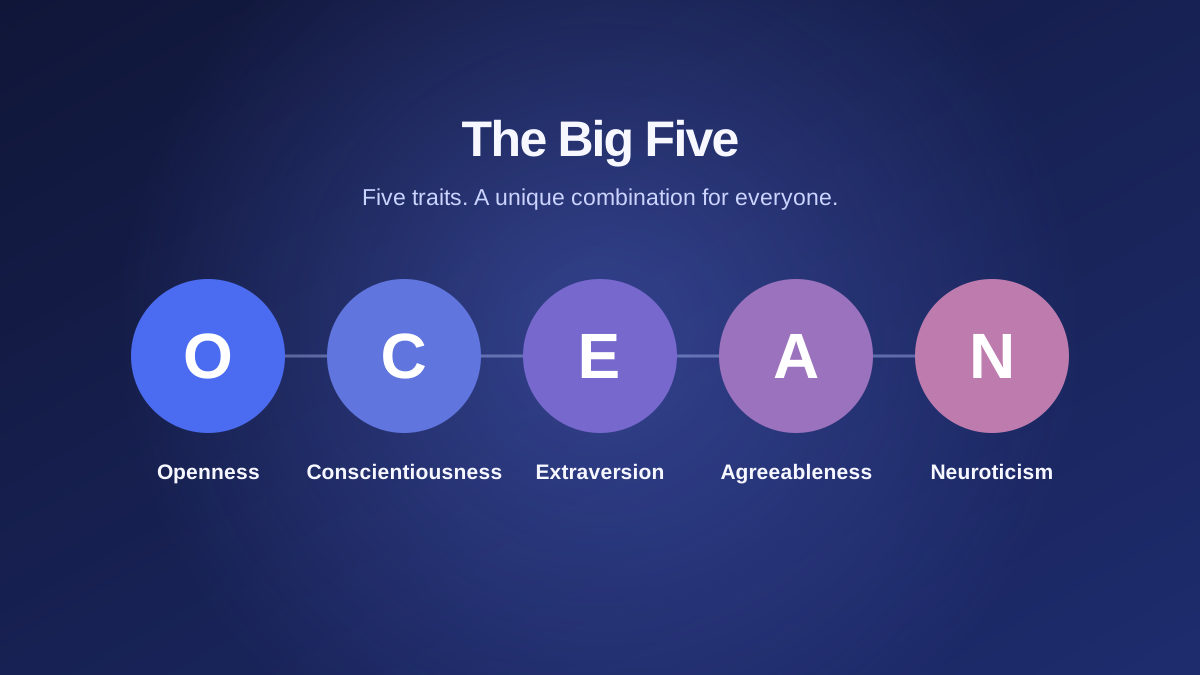
Part of the answer lies in what the Big Five calls morality. It is one of six facets of agreeableness, and it describes how unwilling a person is to cheat, manipulate or take advantage of others to get ahead.
What does morality mean?
The name can be misleading. The facet is not about religious beliefs, political values or which moral rules you think society should have. In the original NEO model the same facet is called straightforwardness.
It is about how you treat people in practice. People who score high often recognise themselves in this:
- You find it uncomfortable to use people for your own ends.
- You would rather lose than win by cheating.
- You say what you mean, rather than playing games.
- You do not deliberately stand in the way of others' plans.
People who score low are more willing to bend the truth or play tactically when it pays off. That does not make them criminals. Many simply believe that a certain amount of strategy and discretion is part of how the world works.
The key is not what you believe is right, but whether you are willing to exploit others when you get the chance.
Most people lie less than they could
Economists Urs Fischbacher and Franziska Föllmi-Heusi designed a simple experiment. Participants rolled a die in private and reported the number themselves. The higher the number, the more money they got. Nobody could check the individual roll.
Since the true distribution of a die is known, the researchers could still see how much cheating took place in the group as a whole.
About 20 percent lied to the fullest extent possible. But 39 percent were completely honest, even though nobody could have caught them. Many of the rest lied only a little: they reported a higher number, but not the one that paid the most.
So both full honesty and full dishonesty exist, and a large group lands somewhere in between.
Cheating "just a little"
Why would anyone lie a little, but not all the way?
Nina Mazar, On Amir and Dan Ariely proposed an explanation in 2008. Most people like to think of themselves as honest. They therefore cheat enough to profit, but not so much that they have to see themselves as dishonest.
In their first experiment, participants who first tried to recall the Ten Commandments cheated less on a later task. That result became famous. But when 25 research groups repeated the experiment with a shared protocol and almost 5,800 participants, the effect of the moral reminder disappeared.
The idea that people protect their self-image remains influential, but simple tricks to make people more honest have proved less reliable than first thought.
Who lies? Personality makes a difference
The situation matters. A meta-analysis of 565 experiments by Philipp Gerlach and colleagues found that dishonesty depended on factors such as the size of the reward, but also on characteristics of the person, such as gender and age.
What about personality? Daniel Heck and colleagues reanalysed 16 studies with over 5,000 participants who had all had a chance to cheat in a die task.
The strongest predictor was a trait called Honesty-Humility, from the HEXACO personality model. The higher people scored on this trait, the less likely they were to cheat. The researchers described the effect as medium to large, and it held up regardless of other traits, age and gender.
Of the Big Five traits, only agreeableness was linked to cheating, but it added nothing beyond Honesty-Humility.
Why does this matter here? Honesty-Humility is not one of the Big Five, but it overlaps strongly with two agreeableness facets: morality and modesty. The study did not measure the morality facet directly, but it shows that the tendency not to exploit others is something people really differ in, and that it shows up in behaviour, not only in questionnaires.
Morality is not the same as following rules
It is easy to confuse morality with dutifulness, a facet of conscientiousness.
Dutifulness is about keeping promises, following rules and doing what you have committed to. Morality is about not exploiting other people.
Imagine two employees. One always fills in the forms correctly and turns up on time, but happily takes credit for a colleague's idea. The other is sloppy with the paperwork, but would never deceive a colleague. The first is high in dutifulness, the second high in morality.
Morality is also different from liberalism, which is about attitudes to authority and tradition, not about how honestly you treat people.
A low score is not a sign of psychopathy or any other disorder. Manipulation and callousness in their extreme forms are described in the article on the dark core of personality, but an ordinary Big Five profile cannot diagnose anything.
What does a high or low score mean?
High morality
You are straightforward and see little need for pretence or manipulation. People usually find it easy to relate to you, because they know where they stand.
The flip side is that you may be unprepared when others play tactically, and you may find negotiations or office politics draining.
Low morality
You are more willing to be strategic and keep your cards close to your chest. In some settings, such as hard negotiations or competitive markets, this can be an advantage.
It does not mean you lack principles. Often it reflects a belief that some degree of tactics is necessary and that others do the same. But if others discover that you have exploited them, trust can be hard to rebuild.
Both descriptions are about typical tendencies, not rules that hold in every situation.
In everyday life
- At work: High scorers are often seen as reliable colleagues and fair leaders. Low scorers may navigate politics and negotiations more easily, but risk losing trust over time.
- In relationships: Honesty is a foundation of most close relationships. High scorers often expect the same openness from their partner and can be deeply hurt by deception.
- In games and sports: Some people can never bring themselves to cheat at a board game, even against children. Others see small tricks as part of the fun.
- Money and forms: Tax returns, expense claims and insurance are classic situations where nobody is watching and where the difference shows.
Can morality change?
Personality is fairly stable, but not fixed. A very large study by Christopher Soto and colleagues compared over 1.2 million people aged 10 to 65. Among adults, the age differences were overwhelmingly in the direction of greater maturity and adjustment. The study compared age groups rather than following the same people over time, so it shows differences between ages rather than change within each person.
At the same time, the research on cheating shows that the situation matters a great deal. Large rewards and low risk tempt most people. If you want to act more in line with your values, it may be more effective to change your surroundings than to rely on willpower:
- Avoid situations where cheating is easy and tempting, rather than testing yourself.
- Decide in advance how you will act, before the temptation arises.
- Think about the person on the other side, not just the abstract system.
- Be honest with yourself about the small exceptions you allow yourself.
Frequently asked questions
Does a high score mean I am a better person?
No. The facet measures one tendency, not your value as a person. Moral character involves much more, such as compassion, courage and fairness, and you can score high on morality and still have other blind spots.
Does a low score mean I am dishonest?
Not necessarily. Low scorers are more willing to be strategic, but many have clear limits for what they consider acceptable. The score says something about a tendency, not about specific actions.
Why do most people lie only a little?
According to Mazar and colleagues, most of us want to see ourselves as honest. Small lies can be explained away, large ones cannot. That is why many people in experiments cheat a little, but not as much as they could.
How is morality measured in the Big Five test?
Our test is based on the IPIP-NEO-120, where each facet is measured with four statements. For morality, all four are reversed: they are about using others for your own ends, cheating to get ahead, taking advantage of others and obstructing other people's plans. Read the score as a sign of a pattern, not as a complete description of you.
Find out where you score
Morality is only one of the six facets of agreeableness. You can be very honest and still be low in trust or sympathy.
Take the Big Five test and see your whole profile, with all 30 facets.
Sources
- Fischbacher, U. & Föllmi-Heusi, F. (2013). Lies in disguise: An experimental study on cheating. Journal of the European Economic Association, 11(3), 525–547.
- Mazar, N., Amir, O. & Ariely, D. (2008). The dishonesty of honest people: A theory of self-concept maintenance. Journal of Marketing Research, 45(6), 633–644.
- Verschuere, B. et al. (2018). Registered Replication Report on Mazar, Amir, and Ariely (2008). Advances in Methods and Practices in Psychological Science, 1(3), 299–317.
- Gerlach, P., Teodorescu, K. & Hertwig, R. (2019). The truth about lies: A meta-analysis on dishonest behavior. Psychological Bulletin, 145(1), 1–44.
- Heck, D. W., Thielmann, I., Moshagen, M. & Hilbig, B. E. (2018). Who lies? A large-scale reanalysis linking basic personality traits to unethical decision making. Judgment and Decision Making, 13(4), 356–371.
- Soto, C. J., John, O. P., Gosling, S. D. & Potter, J. (2011). Age differences in personality traits from 10 to 65: Big Five domains and facets in a large cross-sectional sample. Journal of Personality and Social Psychology, 100(2), 330–348.
- Johnson, J. A. (2014). Measuring thirty facets of the Five Factor Model with a 120-item public domain inventory: Development of the IPIP-NEO-120. Journal of Research in Personality, 51, 78–89.