Trust: is it naive to trust strangers?
Do you assume people mean well, or that they are out to fool you? What research says about trust, cynicism and gullibility, and how the Big Five measures trust.

You are selling a bike online. A buyer asks if he can take it now and transfer the money tonight. He seems friendly and gives a plausible reason.
Some people say yes without thinking twice. Others would never dream of it, and think the first group is asking to be fooled.
Who is right? Is trusting strangers a sign of naivety, or is suspicion the more expensive mistake?
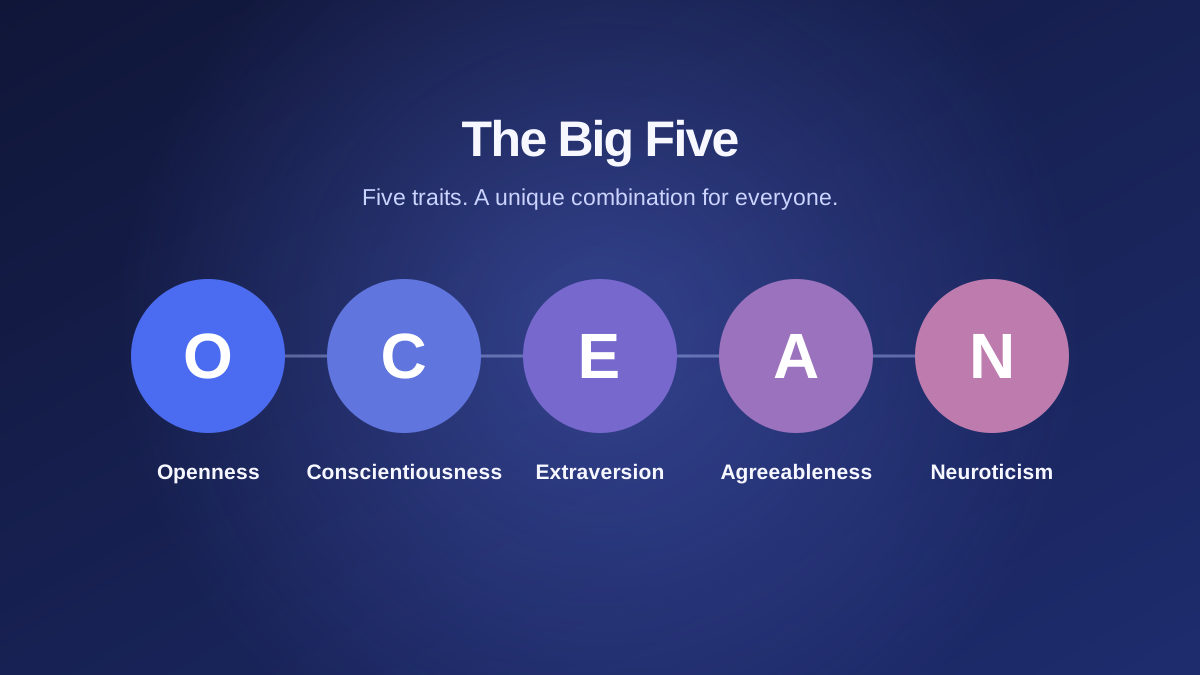
Psychologists have studied this question for decades. In the Big Five model, the tendency to assume the best about others is called trust. It is one of six facets of agreeableness, and it describes how readily you believe that people are honest and mean well.
What does trust mean?
Trust as a personality facet is not about one specific person, like your partner or your best friend. It is a general expectation about people you do not yet know well.
People who score high often recognise themselves in this:
- You assume most people have good intentions.
- You take what people say at face value until you have reason not to.
- You give others the benefit of the doubt when something goes wrong.
- You do not spend much energy checking up on others.
People who score low tend to expect hidden motives, double-check claims and keep their guard up until others have earned their confidence.
Trust is not the same as being gullible. Gullibility means failing to notice the signs that someone is lying. As we will see, high trust and poor judgment do not necessarily go together.
The key is your starting assumption about people, not whether you ignore evidence when it appears.
Trusting people are not more gullible
A common assumption is that people who trust others easily are simply bad at spotting liars.
The Japanese social psychologist Toshio Yamagishi and his colleagues tested this in a series of experiments. They measured general trust with a questionnaire, and then looked at how well people judged others.
The high trusters were more sensitive than low trusters to information suggesting that someone was untrustworthy. They were also more accurate at predicting how other people would act in a one-shot game where cooperating and cheating were both possible.
Yamagishi's interpretation was that trust can be a kind of social intelligence. People who are good at spotting warning signs can afford to be open to new relationships. People who lack that skill may protect themselves by assuming that everyone is out to cheat them.
Why we underestimate other people
If trust is not naive, why are so many people cynical?
Detlef Fetchenhauer and David Dunning suggested an answer in 2010. People in their study watched short videos of strangers and decided whether to trust each one in an economic game.
Overall, the participants underestimated how trustworthy the strangers actually were, even when they were paid to guess correctly.
The researchers pointed to a learning problem. When you trust someone and they let you down, you find out, and it hurts. When you refuse to trust someone, you never learn that they would have been honest. Your experience is skewed towards disappointments.
When participants got feedback on every person, whether they had trusted them or not, they became less cynical.
Cynicism can be expensive
Distrust protects you against being exploited. But it also has a price.
Olga Stavrova and Daniel Ehlebracht analysed large, nationally representative surveys from the United States and Germany. People who held cynical beliefs about human nature earned less money years later than less cynical people. In the German data, cynicism at the start held back income growth over the following nine years.
The effect held up after taking the Big Five traits into account. The researchers suggested a mechanism: cynical people avoid cooperation and spend effort on monitoring and protection, and so miss opportunities.
There was one important exception. In a dataset covering 41 countries, the negative effect of cynicism was weaker in countries with high homicide rates, little prosocial behaviour and much societal cynicism. In other words, distrust pays off less, unless the distrust happens to be justified.
Trust is not the same as being trustworthy
Trust is about what you expect from others. Whether you yourself are honest and fair is a different question.
In the Big Five, your own honesty and unwillingness to exploit others is measured by a separate facet, morality. The two often go together, but not always. You can be completely honest and still expect others to cheat, and you can be quick to trust and still cut corners yourself.
Low trust is also not the same as paranoia. Healthy scepticism is part of normal personality. Suspicion that becomes so strong that it affects your relationships, work or daily life is something else, and a Big Five score cannot diagnose it.
What does a high or low score mean?
High trust
You usually assume that people are honest and mean well. This makes it easy to cooperate, delegate and form new relationships, and others often feel respected by you.
The risk is that you can be disappointed or exploited by the few who do not deserve your trust, especially in situations where the stakes are high and you do not know the other person.
Low trust
You are careful about other people's motives and want evidence before you rely on them. This can protect you in negotiations, business deals and situations where someone might take advantage of you.
The risk is that you miss good opportunities, or that others feel suspected without reason. As the research shows, caution also has a cost.
Both descriptions are about typical tendencies, not rules that hold in every situation.
In everyday life
- At work: High trusters delegate more easily and are often seen as good colleagues. Low trusters can be valuable in roles such as auditing, security and quality control.
- In relationships: Trust makes it easier to feel safe, but blind trust can make it hard to see warning signs. Low trust can protect you, but can also wear down a relationship if your partner feels constantly checked.
- With strangers: High trusters more easily strike up conversations, lend things and accept help. Low trusters keep a polite distance.
- Online: Scams target everyone. Good habits, such as checking payment before handing over goods, are useful regardless of your score.
Can trust change?
Personality is fairly stable, but trust is not fixed.
Michael Poulin and Claudia Haase analysed data from almost 200,000 people in 83 countries, and followed over 1,200 Americans for four years. Older adults reported higher trust than younger adults, and trust increased over time across age groups. Higher trust also predicted increasing well-being.
The study by Fetchenhauer and Dunning points to a practical lesson: cynicism grows partly because we only learn from the cases where trust went wrong. Some ways to get a more realistic picture:
- Notice the times people keep their promises, not only when they break them.
- Start with small, low-risk acts of trust and see what happens.
- Separate situations where trust costs little from situations where it pays to check first.
- Ask yourself whether your caution is based on this person, or on a bad experience with someone else.
Frequently asked questions
Is it naive to have high trust?
Not necessarily. Research by Yamagishi and colleagues found that high trusters were better than low trusters at picking up signs of untrustworthiness. Trust becomes naive only when you overlook clear warning signs.
Is low trust a sign of paranoia?
No. Low trust is a normal personality variation and often reflects caution. If suspicion is very strong and makes it hard to function, it may be worth talking to a doctor or psychologist, but a test score cannot say anything about that alone.
Can I trust others without being exploited?
Yes. Trust and caution can be combined. You can start from good faith and still make sure that important agreements are written down and that payment comes before delivery.
How is trust measured in the Big Five test?
Our test is based on the IPIP-NEO-120, where each facet is measured with four statements. For trust, they are about trusting others, believing that people have good intentions, trusting what people say, and (reversed) distrusting people. Read the score as a sign of a pattern, not as a complete description of you.
Find out where you score
Trust is only one of the six facets of agreeableness. You can be high in trust and still score low on modesty or cooperation.
Take the Big Five test and see your whole profile, with all 30 facets.
Sources
- Yamagishi, T., Kikuchi, M. & Kosugi, M. (1999). Trust, gullibility, and social intelligence. Asian Journal of Social Psychology, 2(1), 145–161.
- Fetchenhauer, D. & Dunning, D. (2010). Why so cynical? Asymmetric feedback underlies misguided skepticism regarding the trustworthiness of others. Psychological Science, 21(2), 189–193.
- Stavrova, O. & Ehlebracht, D. (2016). Cynical beliefs about human nature and income: Longitudinal and cross-cultural analyses. Journal of Personality and Social Psychology, 110(1), 116–132.
- Poulin, M. J. & Haase, C. M. (2015). Growing to trust: Evidence that trust increases and sustains well-being across the life span. Social Psychological and Personality Science, 6(6), 614–621.
- Johnson, J. A. (2014). Measuring thirty facets of the Five Factor Model with a 120-item public domain inventory: Development of the IPIP-NEO-120. Journal of Research in Personality, 51, 78–89.