A te profilod
 Alex
Big Five személyiségteszt
A személyiséged az öt nagy vonás és 30 alskála mentén: nyitottság, lelkiismeretesség, extraverzió, barátságosság és neuroticizmus. Utána összehasonlíthatod magad a barátaiddal és a partnereddel.
Kapj árnyalt képet arról, hogyan gondolkodsz, érzel és cselekszel, és hasonlítsd össze magad a pároddal, a családoddal vagy a kollégáiddal. A teszt az IPIP-NEO-ra épül, a Big Five mögött álló nyílt kutatási modellre. Ingyenes, regisztráció nélkül.
Hiszem, hogy jobb vagyok másoknál
Csalok, hogy előnyhöz jussak
Hiszem, hogy nincs abszolút jó és rossz
Élvezem a jó kis összecsapásokat
Hiszem, hogy keményen kell fellépni a bűnözés ellen
Megszegem a szabályokat
Öt személyiségjegy. Egy teljes kép.
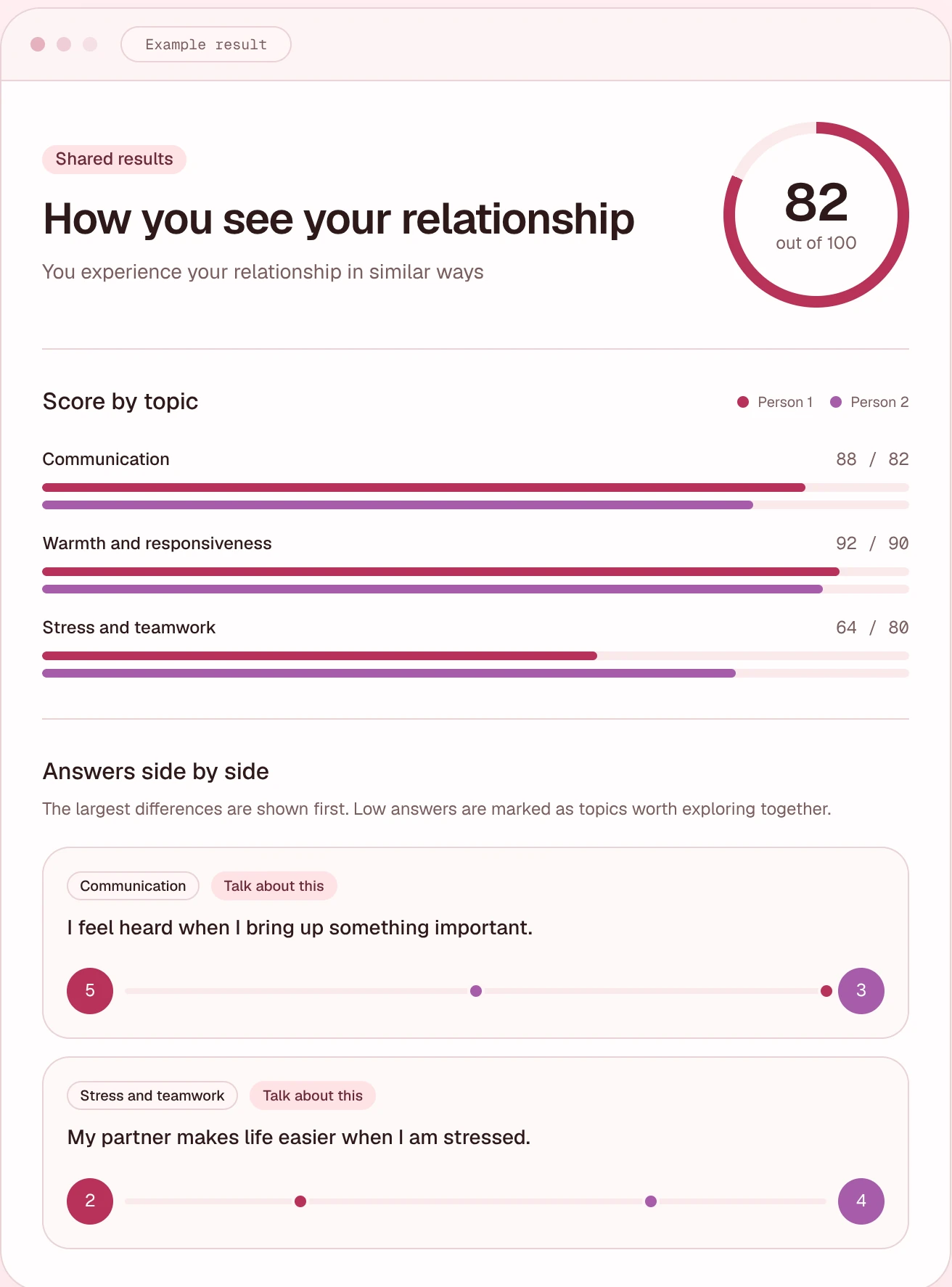
A pároddal, a családoddal, a barátaiddal vagy a kollégáiddal. Ha mindketten kitöltöttétek a tesztet, egymás mellett látjátok a hasonlóságokat és a különbségeket, konkrét beszédtémákkal együtt.
Kezdd a saját, privát profiloddal.
A másik személy önállóan válaszol.
Az eredmény a hasonlóságokat és a különbségeket is kiemeli.
3konkrét beszédtéma
Tekints a különbségre a kíváncsiságra való meghívásként, ne ítéletként.
A Pair Perspective a párkapcsolati tesztünk. Válaszoljatok külön-külön 57 kérdésre, majd fedezzétek fel a közös erősségeiteket és azokat a különbségeket, amelyekről érdemes beszélni.
A Big Five a személyiséget öt független dimenzió mentén írja le. Egyik profil sem jobb a másiknál – egyszerűen különböző erősségeket, igényeket és hajlamokat tükröz.
Találd meg a mintázatodatKíváncsiság, képzelőerő és az új gondolatok iránti érdeklődés.
Rendszeretet, önfegyelem és az, ahogyan a céljaid felé haladsz.
Társas energia, kezdeményezőkészség és az ingerek iránti igény.
Bizalom, empátia és az, ahogyan másokhoz viszonyulsz.
Gyakran keresel új nézőpontokat, és élvezed azokat a gondolatokat, amelyek megkérdőjelezik a megszokottat.
Kezdd egy áttekinthető összegzéssel, majd fedezd fel az egyes személyiségjegyeket, és azt, mit jelenthetnek a pontszámaid a mindennapokban.
A profilod hajlamokat ír le, nem diagnózist vagy végleges választ arra, ki vagy.
Személyiség, erősségek, pályaérdeklődés és még sok más. Azonnal megkapod az eredményedet.
Mind a 53 teszt megtekintéseA személyiséged az öt nagy vonás és 30 alskála mentén: nyitottság, lelkiismeretesség, extraverzió, barátságosság és neuroticizmus. Utána összehasonlíthatod magad a barátaiddal és a partnereddel.
Explore nine personality types and the patterns you recognize in yourself. A free full profile for self-reflection.
Explore six sides of love, from chemistry and friendship to care. Get a personal profile and something to talk about.
How satisfied are you in your relationship? 32 questions and about five minutes, using a scale researchers and couples therapists use.
Is jealousy a feeling, a habit of checking, or a fear of losing someone? 16 statements, with a score on three sides.
A three-minute test of six broad traits: the Big Five plus honesty-humility. A quick overview; take the full Big Five test for facets and more detail.
Introvertált vagy, extrovertált, vagy valahol a kettő között? 24 állítás, a helyed a skálán és pontszám hat alskálán.
A teljes IPIP-NEO-300, 300 kérdéssel. Tovább tart, de pontosabb profilt ad az öt vonásról és mind a 30 alskáláról.
Each Big Five trait split in two: compassion and politeness, industriousness and orderliness, and more. 100 public-domain statements give you ten aspects.
Six broad traits instead of five: the HEXACO model adds honesty-humility to the Big Five picture. 240 public-domain statements give you 24 facets.
Raymond Cattell's classic model with 16 factors, from warmth and dominance to vigilance and perfectionism. 163 public-domain statements give you a profile between opposite poles.
Verbális, figurális és numerikus feladatok 15 perc alatt egy olyan tesztből, amelyet pszichológusok az Intelligence folyóiratban publikáltak. Megmutatja a gondolkodásodat három területen. Nem IQ-teszt.
Find your signature strengths among the 24 character strengths in Peterson and Seligman's classification, from curiosity and kindness to bravery and humor.
Find out which of eight interest areas suit you best, from leadership and creativity to analysis and practical work, and which occupations match your profile.
Which of Holland's six interest types fit you: Realistic, Investigative, Artistic, Social, Enterprising or Conventional? Get your three-letter code and matching careers, with the O*NET Interest Profiler used in career guidance across the United States.
What do you need from a job to be happy in it: results, freedom, recognition, good colleagues, a supportive employer or good conditions? Get your six work values ranked, with careers that offer most of what you value.
Your profile across seven components of emotional intelligence: noticing your feelings, showing joy and distress, empathy, being moved by others, and how much feelings guide your decisions.
How strongly do you feel with others, and how much do you show it? 17 statements, with a score on two sides of empathy.
How quickly do you catch fire, and does it reach other people? 27 statements, with a score on four sides of anger.
Is work taking over your life, or do you just work hard? 16 statements, with a score and what drives it.
Do you demand perfection, or do you just care about details? 16 statements, with a score and what lies behind it.
How strongly do you react to rewards and to risks? Four scales on drive, fun seeking, reward responsiveness and caution, based on Gray's model of the brain's approach and avoidance systems.
Do you believe your life is steered by your own choices, by powerful others, or by chance? Three scales from Levenson's classic model, with your orientation explained.
Ten statements on how you value yourself and your abilities, based on Rosenberg's classic self-esteem scale. Quick, with a short explanation of your score.
Do you tend to see possibilities or difficulties? Ten statements about your outlook on life, with an explanation of your optimism score.
How satisfied are you with your life as a whole? Five statements and one minute, using one of the most widely used scales in happiness research.
A checklist of five kinds of everyday habits linked with good mental health: enjoyment, thinking habits, goals, routines and connection. With ideas for small steps.
The Short Dark Tetrad (SD4) measures four socially aversive traits found in everyone to some degree: Machiavellianism, narcissism, psychopathy and sadism.
A nárcizmus négy oldala: a vezetés vágya, a figyelem iránti igény, a feljogosítottság érzése és a hajlandóság mások kihasználására. Közkincsnek számító kutatási skálákon alapul.
Mennyire vagy merész, rosszindulatú és impulzív másokhoz képest? Kilenc vonás, a pszichopátia három oldala szerint csoportosítva Patrick triarchikus modellje alapján. A normális változatosságot méri, nem diagnózis.
The six-question screener from the WHO Adult ADHD Self-Report Scale (ASRS v1.1). Shows whether your answers are consistent with adult ADHD symptoms. Not a diagnosis.
Ten questions about how you have felt over the past 30 days, from the Kessler scale used in national health surveys. Shows your level of psychological distress. Not a diagnosis.
Seven questions about worry and nervousness over the past two weeks, from the most widely used anxiety questionnaire. Shows how much the symptoms bother you. Not a diagnosis.
Yes-or-no questions about sudden anxiety attacks and their symptoms, from the Patient Health Questionnaire. Shows whether your answers fit the pattern of panic disorder. Not a diagnosis.
Fourteen questions about fear of vomiting: worry, avoidance, checking and nausea over the past week. Shows whether your answers suggest emetophobia. Not a diagnosis.
Kilenc kérdés a hangulatról, az alvásról, az energiáról és az önértékelésről az elmúlt két hétben, a legelterjedtebb depresszió-kérdőívből. Megmutatja, mennyire zavarnak a tünetek. Nem diagnózis.
Fifteen questions about pain, dizziness, stomach problems, tiredness and sleep, from the Patient Health Questionnaire. Shows how much physical symptoms weigh on you. Not a diagnosis.
Ten questions about falling asleep, waking up, daytime energy and worrying about sleep. Shows whether your sleep problems may be insomnia. Not a diagnosis.
Yes-or-no questions about binge eating and ways of avoiding weight gain, from the Patient Health Questionnaire. Screens for bulimia and binge eating disorder. Not a diagnosis.
Twenty questions about how much memories, avoidance, mood and tension after a very stressful experience have bothered you in the past month. Not a diagnosis.
Eighteen questions from the ICD-11 trauma questionnaire. Shows whether your answers match the pattern for PTSD or complex PTSD, with its effects on emotions, self-image and relationships. Not a diagnosis.
22 questions on grief reactions after the death of someone close, scored against ICD-11 and DSM-5-TR prolonged grief disorder. Not a diagnosis.
Questions on stressful life changes, worry and coping, based on ICD-11 adjustment disorder. Shows whether a strain has become hard to adapt to. Not a diagnosis.
Twelve statements about checking, washing, order, numbers and unwanted thoughts, showing how well typical obsessive-compulsive symptoms fit you. Not a diagnosis.
Questions on worry about your appearance, checking, hiding and avoiding, from David Veale's scales. Shows whether your answers suggest body dysmorphic disorder. Not a diagnosis.
Nineteen statements about control, cutting down and consequences of sex and porn use, based on ICD-11. Shows whether you may be at high risk of compulsive sexual behaviour disorder. Not a diagnosis.
The World Health Organization's ten questions on how much you drink, signs of dependence and harm, with your risk level.
Eight questions about how often you use cannabis, how much and how it affects you. Shows whether your use may be risky. Not a diagnosis.
Eleven questions about drug use, loss of control and harm, the drug counterpart of the AUDIT alcohol test. Shows whether your use may cause problems. Not a diagnosis.
Four questions on the WHO's features of gaming disorder: control, priority, continuing despite problems and harm. Shows whether your gaming may be a problem. Not a diagnosis.
Thirteen questions about exhaustion in daily life and at work, from the Copenhagen Burnout Inventory. Shows how worn out you are compared with others. Not a diagnosis.
Fourteen statements from a research-based screener for autism in adults. Shows whether your answers resemble those common in autism. Not a diagnosis.
Build the missing figure in a matrix. Choose 12, 22 or 36 tasks. A free pilot with a raw score.
Mélyebb betekintés az öt személyiségjegybe, a kutatásokba, és abba, hogyan formálja a személyiség a mindennapokat.
Összes cikkFive years after two doses of psilocybin and about eleven hours of therapy, 67 % of a small group of people with depression were in remission. The bigger trials tell a more modest story. A guide to the results, the doubts, the risks and where the treatment is allowed.
Researchers gave three AI models the stories of 220 children at a psychiatry clinic. With the child's own words the AI missed most problems. With the parent's words it found one in almost everyone, including the children who had none.
A study of 5,315 people found that the classic relationship questionnaires asked many questions that told almost nothing. The scale that replaced them shows how satisfaction differs between newlyweds and long marriages, and what goes with it.
In a classic experiment, two short sentences of thanks doubled the share of people who helped again. Other studies show that we thank each other surprisingly rarely, and that we badly underestimate how much it means.
Scientists searched the DNA of more than one million people for personality and found 1,260 genetic variants. The most interesting part is how little each of them matters, and what that says about who you are.
Every dog owner knows their dog is one of a kind. For decades, scientists called that wishful thinking. Now research shows that dog personality can be measured, that it is fairly stable, and that breed explains less than you might think.
A teszt a nyílt IPIP-modellen alapul, ingyenesen használható és nyílt forráskódú. A módszere és a kérdései bárki számára átnézhetők.
Ingyenes · nyílt forráskódú · nincs regisztráció · körülbelül 10 perc