Þinn prófíll
 Alex
Big Five persónuleikapróf
Persónuleiki þinn á fimm stóru þáttunum og 30 undirþáttum: víðsýni, samviskusemi, úthverfu, samvinnuþýði og tilfinninganæmi. Berðu þig svo saman við vini og maka.
Fáðu blæbrigðaríka mynd af því hvernig þú hugsar, finnur til og bregst við, og berðu þig saman við maka, fjölskyldu eða samstarfsfólk. Prófið byggir á IPIP-NEO, opna rannsóknarlíkaninu á bak við Big Five. Ókeypis og án skráningar.
Ég trúi að ég sé betri en aðrir
Ég svindla til að komast áfram í lífinu
Ég trúi að ekkert sé algerlega rétt eða rangt
Ég hef gaman af góðri rimmu
Ég tel að við ættum að taka hart á glæpum
Ég brýt reglur
Fimm þættir. Ein heildarmynd.
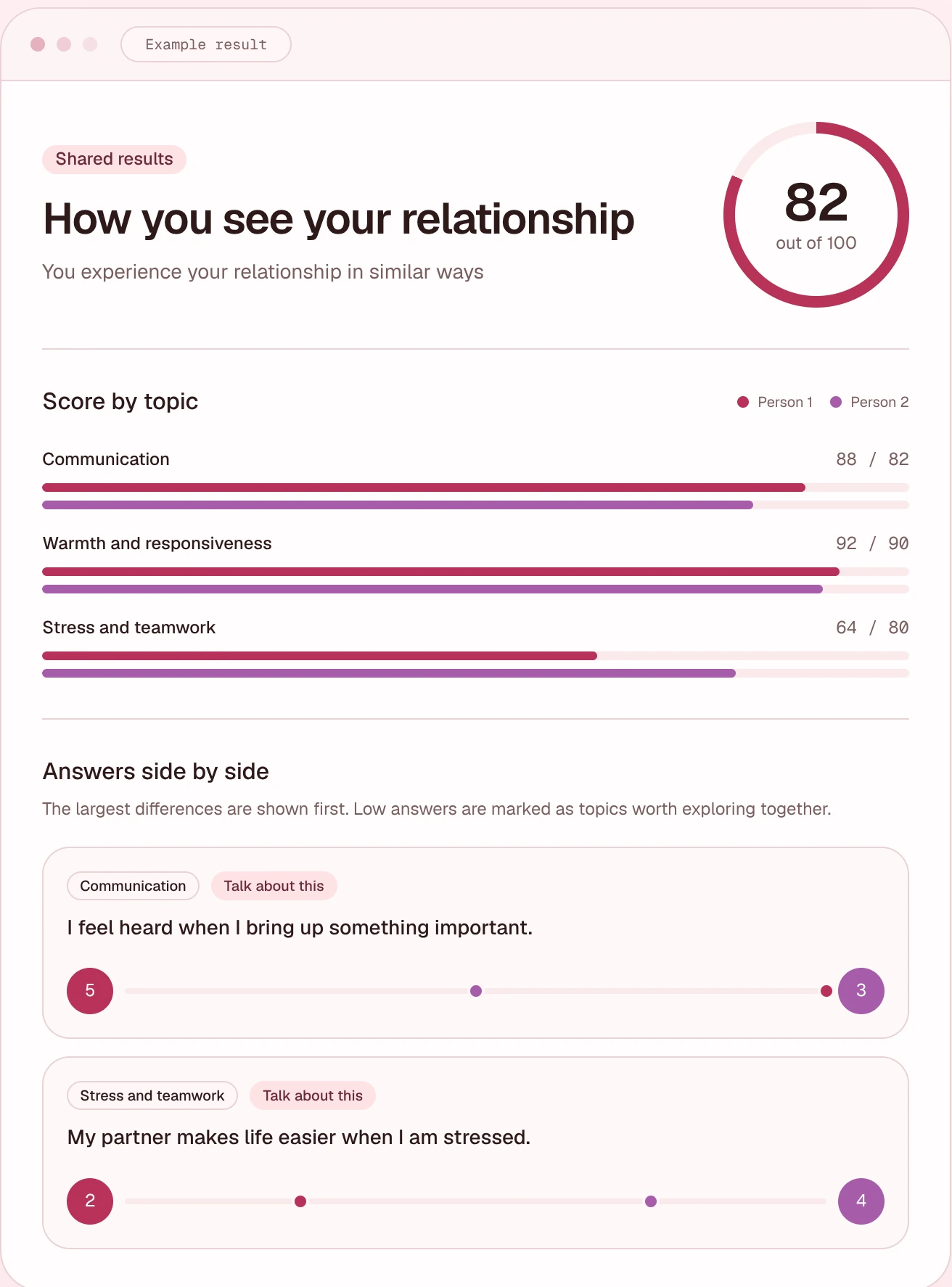
Maki, fjölskylda, vinir eða samstarfsfólk. Þegar þið hafið bæði tekið prófið sjáið þið það sem er líkt og ólíkt hlið við hlið, með áþreifanlegum umræðuefnum.
Byrjaðu á þínum eigin persónulega prófíl.
Hin manneskjan svarar sjálfstætt.
Niðurstaðan dregur fram bæði það sem er líkt og ólíkt.
3skýr umræðuefni
Nýttu muninn sem boð um að vera forvitin, ekki sem dóm.
Pair Perspective er sambandsprófið okkar. Svarið 57 spurningum hvort í sínu lagi og skoðið svo styrkleikana sem þið deilið og muninn sem vert er að ræða.
Big Five lýsir persónuleika eftir fimm óháðum víddum. Enginn prófíll er betri en annar – hann endurspeglar einfaldlega ólíka styrkleika, þarfir og tilhneigingar.
Finndu þitt mynsturForvitni, ímyndunarafl og áhugi á nýjum hugmyndum.
Skipulag, sjálfsagi og hvernig þú vinnur að markmiðum.
Félagsleg orka, frumkvæði og þörf fyrir örvun.
Traust, samkennd og hvernig þú mætir öðru fólki.
Þú leitar oft nýrra sjónarhorna og hefur gaman af hugmyndum sem ögra hinu kunnuglega.
Byrjaðu á skýru yfirliti og skoðaðu svo hvern persónuleikaþátt og hvað stigin þín geta þýtt í daglegu lífi.
Prófíllinn þinn lýsir tilhneigingum, ekki greiningu eða endanlegu svari við því hver þú ert.
Persónuleiki, styrkleikar, starfsáhugi og fleira. Þú færð niðurstöðuna strax.
Sjá öll 57 prófinPersónuleiki þinn á fimm stóru þáttunum og 30 undirþáttum: víðsýni, samviskusemi, úthverfu, samvinnuþýði og tilfinninganæmi. Berðu þig svo saman við vini og maka.
Hver af fjögurra stafa gerðunum 16 á best við þig? 40 fullyrðingar, með gerðinni þinni og því hversu sterkt þú hallast í aðra áttina á hverju andstæðuparanna fjögurra.
Explore nine personality types and the patterns you recognize in yourself. A free full profile for self-reflection.
Explore six sides of love, from chemistry and friendship to care. Get a personal profile and something to talk about.
How satisfied are you in your relationship? 32 questions and about five minutes, using a scale researchers and couples therapists use.
Is jealousy a feeling, a habit of checking, or a fear of losing someone? 16 statements, with a score on three sides.
A three-minute test of six broad traits: the Big Five plus honesty-humility. A quick overview; take the full Big Five test for facets and more detail.
Ertu intróvert, extróvert eða einhvers staðar þar á milli? 24 fullyrðingar, með staðsetningu þinni og skori á sex undirþáttum.
Hversu sterkt bregstu við streitu, áhyggjum og mótlæti? 24 fullyrðingar, með skori þínu í tilfinninganæmi og skori á sex undirþáttum.
Allt IPIP-NEO-300 með 300 spurningum. Það tekur lengri tíma en gefur nákvæmari mynd af fimm þáttunum og öllum 30 undirþáttunum.
Each Big Five trait split in two: compassion and politeness, industriousness and orderliness, and more. 100 public-domain statements give you ten aspects.
Sex breiðir þættir í stað fimm: HEXACO-líkanið bætir heiðarleika-auðmýkt við Big Five-myndina. 240 staðhæfingar í almenningseign gefa þér 24 undirþætti.
Raymond Cattell's classic model with 16 factors, from warmth and dominance to vigilance and perfectionism. 163 public-domain statements give you a profile between opposite poles.
Munnleg, myndræn og töluleg verkefni á 15 mínútum, úr prófi sem sálfræðingar birtu í tímaritinu Intelligence. Sýnir rökhugsun þína á þremur sviðum. Ekki greindarpróf.
Find your signature strengths among the 24 character strengths in Peterson and Seligman's classification, from curiosity and kindness to bravery and humor.
Find out which of eight interest areas suit you best, from leadership and creativity to analysis and practical work, and which occupations match your profile.
Which of Holland's six interest types fit you: Realistic, Investigative, Artistic, Social, Enterprising or Conventional? Get your three-letter code and matching careers, with the O*NET Interest Profiler used in career guidance across the United States.
What do you need from a job to be happy in it: results, freedom, recognition, good colleagues, a supportive employer or good conditions? Get your six work values ranked, with careers that offer most of what you value.
Your profile across seven components of emotional intelligence: noticing your feelings, showing joy and distress, empathy, being moved by others, and how much feelings guide your decisions.
How strongly do you feel with others, and how much do you show it? 17 statements, with a score on two sides of empathy.
How quickly do you catch fire, and does it reach other people? 27 statements, with a score on four sides of anger.
Is work taking over your life, or do you just work hard? 16 statements, with a score and what drives it.
Do you demand perfection, or do you just care about details? 16 statements, with a score and what lies behind it.
How strongly do you react to rewards and to risks? Four scales on drive, fun seeking, reward responsiveness and caution, based on Gray's model of the brain's approach and avoidance systems.
Do you believe your life is steered by your own choices, by powerful others, or by chance? Three scales from Levenson's classic model, with your orientation explained.
Ten statements on how you value yourself and your abilities, based on Rosenberg's classic self-esteem scale. Quick, with a short explanation of your score.
Hversu mikla góðvild sýnir þú þér þegar eitthvað fer úrskeiðis? 26 fullyrðingar úr kvarða Kristin Neff, með skori þínu og sex hliðum sjálfssamkenndar.
Do you tend to see possibilities or difficulties? Ten statements about your outlook on life, with an explanation of your optimism score.
How satisfied are you with your life as a whole? Five statements and one minute, using one of the most widely used scales in happiness research.
A checklist of five kinds of everyday habits linked with good mental health: enjoyment, thinking habits, goals, routines and connection. With ideas for small steps.
The Short Dark Tetrad (SD4) measures four socially aversive traits found in everyone to some degree: Machiavellianism, narcissism, psychopathy and sadism.
Four sides of narcissism: the urge to lead, the need for attention, a sense of entitlement and a willingness to exploit others. Based on public-domain research scales.
How bold, how mean and how impulsive are you compared with others? Nine traits grouped into the three sides of psychopathy in Patrick's triarchic model. Measures normal variation, not a diagnosis.
The six-question screener from the WHO Adult ADHD Self-Report Scale (ASRS v1.1). Shows whether your answers are consistent with adult ADHD symptoms. Not a diagnosis.
Ten questions about how you have felt over the past 30 days, from the Kessler scale used in national health surveys. Shows your level of psychological distress. Not a diagnosis.
Seven questions about worry and nervousness over the past two weeks, from the most widely used anxiety questionnaire. Shows how much the symptoms bother you. Not a diagnosis.
Yes-or-no questions about sudden anxiety attacks and their symptoms, from the Patient Health Questionnaire. Shows whether your answers fit the pattern of panic disorder. Not a diagnosis.
Fourteen questions about fear of vomiting: worry, avoidance, checking and nausea over the past week. Shows whether your answers suggest emetophobia. Not a diagnosis.
Nine questions about mood, sleep, energy and self-worth over the past two weeks, from the most widely used depression questionnaire. Shows how much the symptoms bother you. Not a diagnosis.
Fifteen questions about pain, dizziness, stomach problems, tiredness and sleep, from the Patient Health Questionnaire. Shows how much physical symptoms weigh on you. Not a diagnosis.
Ten questions about falling asleep, waking up, daytime energy and worrying about sleep. Shows whether your sleep problems may be insomnia. Not a diagnosis.
Yes-or-no questions about binge eating and ways of avoiding weight gain, from the Patient Health Questionnaire. Screens for bulimia and binge eating disorder. Not a diagnosis.
Twenty questions about how much memories, avoidance, mood and tension after a very stressful experience have bothered you in the past month. Not a diagnosis.
Eighteen questions from the ICD-11 trauma questionnaire. Shows whether your answers match the pattern for PTSD or complex PTSD, with its effects on emotions, self-image and relationships. Not a diagnosis.
22 questions on grief reactions after the death of someone close, scored against ICD-11 and DSM-5-TR prolonged grief disorder. Not a diagnosis.
Questions on stressful life changes, worry and coping, based on ICD-11 adjustment disorder. Shows whether a strain has become hard to adapt to. Not a diagnosis.
Twelve statements about checking, washing, order, numbers and unwanted thoughts, showing how well typical obsessive-compulsive symptoms fit you. Not a diagnosis.
Questions on worry about your appearance, checking, hiding and avoiding, from David Veale's scales. Shows whether your answers suggest body dysmorphic disorder. Not a diagnosis.
Nineteen statements about control, cutting down and consequences of sex and porn use, based on ICD-11. Shows whether you may be at high risk of compulsive sexual behaviour disorder. Not a diagnosis.
The World Health Organization's ten questions on how much you drink, signs of dependence and harm, with your risk level.
Eight questions about how often you use cannabis, how much and how it affects you. Shows whether your use may be risky. Not a diagnosis.
Eleven questions about drug use, loss of control and harm, the drug counterpart of the AUDIT alcohol test. Shows whether your use may cause problems. Not a diagnosis.
Four questions on the WHO's features of gaming disorder: control, priority, continuing despite problems and harm. Shows whether your gaming may be a problem. Not a diagnosis.
Thirteen questions about exhaustion in daily life and at work, from the Copenhagen Burnout Inventory. Shows how worn out you are compared with others. Not a diagnosis.
Fourteen statements from a research-based screener for autism in adults. Shows whether your answers resemble those common in autism. Not a diagnosis.
Twenty-five statements about hiding or compensating for autistic traits in social situations. Shows your scores for compensation, masking and assimilation. Not a diagnosis.
Build the missing figure in a matrix. Choose 12, 22 or 36 tasks. A free pilot with a raw score.
Ítarleg umfjöllun um þættina fimm, rannsóknirnar og hvernig persónuleiki mótar daglegt líf.
Sjá allar greinarFive years after two doses of psilocybin and about eleven hours of therapy, 67 % of a small group of people with depression were in remission. The bigger trials tell a more modest story. A guide to the results, the doubts, the risks and where the treatment is allowed.
Researchers gave three AI models the stories of 220 children at a psychiatry clinic. With the child's own words the AI missed most problems. With the parent's words it found one in almost everyone, including the children who had none.
A study of 5,315 people found that the classic relationship questionnaires asked many questions that told almost nothing. The scale that replaced them shows how satisfaction differs between newlyweds and long marriages, and what goes with it.
In a classic experiment, two short sentences of thanks doubled the share of people who helped again. Other studies show that we thank each other surprisingly rarely, and that we badly underestimate how much it means.
Scientists searched the DNA of more than one million people for personality and found 1,260 genetic variants. The most interesting part is how little each of them matters, and what that says about who you are.
Every dog owner knows their dog is one of a kind. For decades, scientists called that wishful thinking. Now research shows that dog personality can be measured, that it is fairly stable, and that breed explains less than you might think.
Prófið byggir á opna IPIP-líkaninu, er ókeypis í notkun og opinn hugbúnaður. Aðferðin og spurningarnar eru aðgengilegar til skoðunar.
Ókeypis · opinn hugbúnaður · engin skráning · um 10 mínútur